
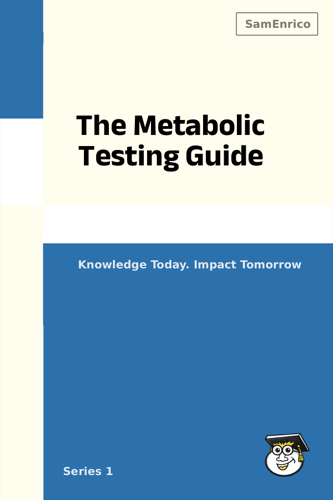
Non-FictionHealth & WellnessTesting
The Metabolic Testing Guide eBook
Measure your resting metabolic rate with indirect
Measure your resting metabolic rate with indirect calorimetry.
Formats
Free sample
Chapter 1: The 70% Lie...--–- Sarah had done everything right.For eighteen months, she weighed every portion. She logged every calorie in an app. She never ate back her exercise calories. She said no to birthday cake, office pizza, and wine with dinner. She ate 1,400 calories per day, sometimes less, and she walked 10,000 steps religiously.At the end of eighteen months, she had gained twelve pounds.Her doctor looked at her chart, frowned, and said the six words that change Sarah’s life: “Maybe you should eat less and move more.”Sarah wanted to scream.
Instead, she went home and ate a bowl of rice cakes with no toppings, because she had internalized the message: You are the problem. You lack willpower. You’re cheating somewhere. She wasn’t cheating. She was starving.This book exists because Sarah is not an exception.
She is the rule.The Confession Every Dietitian Wants to Make Let me tell you something that most health professionals are afraid to say out loud: We have been guessing about your metabolism.Not estimating. Not calculating with sophisticated science. Guessing.The calorie numbers you see on apps, fitness trackers, and diet websites—the ones that tell you to eat 1,200 calories if you’re a woman or 1,800 if you’re a man—are based on mathematical equations invented decades ago. These equations were never designed for you. They were designed for populations.
Averages. Theoretical humans who do not actually exist.And here is the terrifying truth: these equations are wrong for up to 70% of individuals.Let that land. Seven out of ten people reading this book have been following calorie targets that were mathematically guaranteed to be inaccurate for their specific body. Some of those people have been told to eat too many calories. They gain weight and blame themselves.
Some have been told to eat too few. They lose weight briefly, crash their metabolism, gain it all back, and then blame themselves even harder.The multi-billion dollar weight loss industry runs on this self-blame. Because if you believe it’s your fault, you’ll keep buying solutions.But what if it was never your fault? What if the problem wasn’t your willpower but the equations that failed you? What if there was a way to measure your actual metabolism—not guess it—and build a plan around the truth?There is.
It’s called indirect calorimetry. And by the end of this chapter, you will understand why it changes everything.A Brief History of Being Wrong To understand why we are so bad at predicting metabolism, we need to go back to 1918. That was the year American biochemist Francis Gano Benedict published a massive study measuring the metabolic rates of hundreds of subjects. Along with his collaborator James Harris, he developed the Harris-Benedict Equation—the first widely used formula for estimating energy expenditure.For 1918, this was revolutionary. Before Harris and Benedict, doctors had no way to estimate a patient’s calorie needs.
They guessed. Harris and Benedict at least used some math. Their equation considered weight, height, age, and sex. It was a genuine scientific advancement.Here is what Harris and Benedict did not have: computers, modern statistical methods, diverse subject populations, or any understanding that metabolism varies dramatically between individuals with the same body size. Their subjects were overwhelmingly young, healthy, white, and male.
They did not study people with obesity, thyroid disorders, metabolic syndrome, or anyone over 60.Despite these limitations, the Harris-Benedict Equation became the standard. It was used in hospitals, research labs, and eventually diet books. It was still being taught in medical schools in the 1990s—nearly eighty years after it was developed.In 1990, researchers Mifflin and St. Jeor published a new equation based on a more diverse sample. It was better than Harris-Benedict.
Marginally. But it still assumed that all people of the same age, weight, height, and sex have roughly the same metabolic rate. That assumption is false. It was false in 1918. It was false in 1990.
It remains false today.The Katch-Mc Ardle equation, another popular formula, attempted to improve accuracy by including lean body mass. This was a step forward, but it introduced a new problem: most people don’t know their lean body mass. And even when they do, the equation still fails for individuals who have metabolic adaptations from dieting, medication use, or medical conditions.Here is the uncomfortable truth that no fitness app will tell you: predictive equations predict the average, not the individual. If you are that average person—the statistical unicorn whose metabolism perfectly matches the equation—congratulations. You are one of the 30%.
For everyone else, the equation is wrong by an average of 10-20%. And for some people, it’s wrong by 40% or more.That 40% error means a person who should be eating 2,000 calories to maintain their weight might be told to eat 1,200. Or 2,800. And then blamed when the wrong number doesn’t work.The Case of Two Marias Let me introduce you to two real people. I’ve changed their names, but their numbers are真实的.Maria A.
is 45 years old, 5’4”, and weighs 150 pounds. She works as a teacher, walks her dog daily, and does yoga twice a week. She has never dieted aggressively. She sleeps seven hours a night. Her thyroid function is normal.Maria B.
is also 45 years old, 5’4”, and weighs 150 pounds. She works as a nurse, sits for most of her shift, and has tried every diet in existence: keto, vegan, intermittent fasting, Weight Watchers, and the Master Cleanse (twice). She sleeps five hours a night. Her thyroid function is normal.These two women are identical by every standard metric. Same age.
Same height. Same weight. Same sex. Same activity level by self-report.Predictive equations give them the same calorie target: approximately 1,450-1,550 calories per day for weight loss.Now watch what happens when we measure their actual resting metabolic rate using indirect calorimetry.Maria A. has an RMR of 1,520 calories per day.
Her metabolism is almost exactly average. The predictive equation was within 5% for her. She can lose weight eating 1,350 calories per day. It will be mildly uncomfortable but achievable.Maria B. has an RMR of 1,080 calories per day.
Her metabolism is 30% slower than predicted. Years of chronic dieting have downregulated her thyroid, reduced her sympathetic nervous system activity, and trained her body to survive on remarkably few calories.If Maria B. follows the app’s recommendation of 1,350 calories per day (a 200-calorie deficit from her measured maintenance of 1,550), she will gain weight. Slowly, insidiously, she will pack on pounds while eating what every calculator told her was a deficit.Now ask yourself: Who gets blamed? Who gets told “you’re not really eating that little” or “you must be cheating” or “have you tried cutting carbs”?Maria B.
gets blamed. Maria B. internalizes the shame. Maria B. spends thousands of dollars on programs, supplements, and therapists trying to fix a problem that was never in her head—it was in her metabolism.This is the cruelty of predictive equations.
They don’t fail evenly. They fail hardest for the people who have tried the hardest, who have dieted the most, who have done everything “right” and still can’t get…
This is the end of the free sample. Get the eBook to keep going. Buy now
About this book
Details
- Author
- Valdez Lawrence
- Publisher
- SamEnrico
- Language
- English
- Genre
- Non-Fiction, Health & Wellness, Testing
- Released
- 2026-06-08
- Pages (approx.)
- 143
- Available as
- eBook, Audiobook

Read better in the ZLOADR app
Your eBooks on your phone or tablet. Sign in with your SamEnrico account and start reading.
More by Valdez Lawrence
 Password Pattern RecognitionValdez Lawrence$11.99
 Retail Positioning MapValdez Lawrence$11.99
 CBT For Bipolar Disorder GuideValdez Lawrence$11.99
 Multi Echelon Inventory AIValdez Lawrence$11.99
 Self Esteem and BurnoutValdez Lawrence$11.99
 Family Boundary Setting GuideValdez Lawrence$11.99
 Improv for FilmmakersValdez Lawrence$11.99
 The Illusionist Who Defied Apartheid: The Untold Story of Dada MoriykeValdez Lawrence$11.99
 The Battle of the Beauties: Twiggy vs. Jean Shrimpton in the Swinging SixtiesValdez Lawrence$11.99
 How to Produce Outdoor Umbrella and Sunshade AccessoriesValdez Lawrence$11.99
 How to Produce Condiments and SaucesValdez Lawrence$11.99
 A Collector's Handbook to the Tornado ThunderboltValdez Lawrence$11.99
You may also like
 Hong Kong Handover 1997Dunn Johnnie$11.99
 Zumba For Postnatal Recovery CourseNeal Christian$11.99
 Zumba for BeginnersLadner Nikia$11.99
 YouTube Comment Mining GuideHumes Pandora$12.99
 Worry Box MeditationCarlin Rudy$11.99
 Workplace Stress MeditationNguyen Lynn$11.99
 Workplace Stress and Sleep RepairHawley Ivory$11.99
 Workplace Perfectionism CureDelaney Jeffry$11.99
 Workplace Injustice Anger GuideWallen Isabelle$11.99
 Work Addiction and Burnout LinkGreenwood Ester$11.99
 Women in Yoga and WellnessBeattie Galina$11.99
 Women in Stand Up ComedyChun Evangeline$11.99