
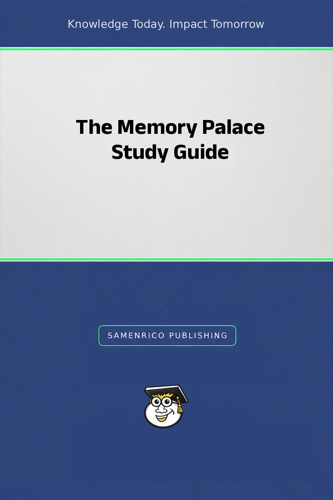
The Memory Palace Study Guide eBook
Uses spatial memory to store and recall facts.
by Irby Kimber
Uses spatial memory to store and recall facts.
Formats
Free sample
Chapter 1: The Baker’s Secret--–- Try a simple experiment right now. Look away from this page—actually turn your head—and name the first three items on your grocery list. If you’re like most people, you hesitated. Maybe you remembered milk, but forgot eggs. Perhaps you recalled bread, but the apples vanished.
Now try something different: close your eyes and visualize the kitchen where you grew up. See the refrigerator, the stove, the sink, the cabinets. Notice how easily the layout comes back—the greasy spot on the handle, the squeaky drawer, the crack in the tile. You haven’t lived there in years, yet the map remains crisp. That contrast—failing at a list of five items while flawlessly navigating a house you left a decade ago—is the most important clue about how your memory actually works.
And it is the foundation of everything this book will teach you.The Myth of the Bad Memory Nearly everyone believes they have a “bad memory” for something. Students say they’re terrible with dates. Professionals claim they can’t remember names. Parents joke about losing their keys. But here is the secret that memory champions, elite military intelligence officers, and record-holding mnemonists know: there is no such thing as a bad memory.
There is only untrained spatial thinking.Every single healthy human being possesses a memory system that can reliably store and recall thousands of items with near-perfect accuracy. You already use it every day without realizing it. You remember the layout of your bedroom. You know where the light switches are. You can walk to the bathroom in complete darkness.
You never forget which cabinet holds the coffee mugs. These are not trivial accomplishments. They are demonstrations of a biological superpower—spatial memory—that evolution spent hundreds of millions of years perfecting. The problem is not that your memory fails. The problem is that you have been asking it to do the wrong kind of work in the wrong way.Consider this: the average person can recognize thousands of faces, navigate complex city streets, and recall the plot of a movie seen years ago.
Yet that same person cannot remember a seven-digit phone number for more than a few seconds. Why? Because phone numbers, grocery lists, historical dates, and vocabulary words are presented to the brain as abstract, isolated, meaningless data. They have no location. No context.
No story. They float in a void. And the human brain hates voids. It was not designed for filing cabinets or spreadsheets. It was designed for survival in a three-dimensional world where knowing the location of water, predators, and shelter meant the difference between life and death.The Baker/Baker Paradox In the 1980s, a psychologist named Timothy Baker (yes, that is his real name) discovered a peculiar phenomenon that would become famous in memory research.
He asked two groups of people to remember the same piece of information. To the first group, he said, “Remember that this man’s name is Baker.” To the second group, he said, “Remember that this man is a baker.” Later, when both groups were tested, the second group remembered the information nearly three times more often than the first group.Why? Because “baker” as a profession is rich with associations—flour, ovens, aprons, early mornings, bread smell, white hats. “Baker” as a name is an arbitrary label attached to nothing. The brain seized on meaning, story, and connection, but rejected pure abstraction.
This is the Baker/baker paradox, and it explains why you remember that your neighbor works in accounting but forget that her last name is Smith. It explains why you recall the plot of a novel but struggle with the chapter numbers. And it explains why the Method of Loci—the Memory Palace technique—has survived for over two thousand years.The Baker/baker paradox reveals a fundamental truth about cognition: the brain does not store information in isolation. It stores information by weaving it into existing networks of meaning, sensation, and space. When you learn a fact without anchoring it to something you already know, you are asking your brain to do something it cannot reliably do.
When you anchor that fact to a vivid image, a familiar location, and a bizarre story, you are working with your brain’s natural architecture.What This Book Will Do for You The Memory Palace Study Guide is not a collection of tricks or gimmicks. It is a complete training system that converts abstract data into spatial, sensory, story-rich experiences—then systematically transfers those experiences from short-term working memory into durable long-term storage. By the time you finish this book, you will be able to:Memorize a 50-item shopping list after a single five-minute walk through your home Recall a 20-slide presentation without notes by walking a familiar route Learn 50 foreign vocabulary words per hour with 90% retention after one week Store hundreds of historical dates, chemical formulas, or legal precedents in dedicated “palaces”Master the Major System for numbers and the Person-Action-Object system for playing cards Diagnose which material is suited for palaces and which is better left to other methods Build a network of interconnected journeys capable of holding thousands of facts These are not claims of superhuman ability. They are descriptions of normal human spatial memory, properly trained. The only difference between a memory champion and you is that the champion has learned to think in places, images, and actions—while you have been taught to think in lists, flashcards, and repetition.But there is a catch.
The Method of Loci requires effort. It is not passive reading or highlighting. It is active construction—building mental architecture, casting vivid characters, and staging absurd dramas. This book will not work if you simply read it. You must do the exercises, build the palaces, and practice the reviews.
The first few attempts will feel slow and awkward. That is normal. Every skill feels clumsy before it becomes fluid. By Chapter 4, you will have built your first real palace. By Chapter 8, you will be storing numbers.
By Chapter 12, you will have a networked system that serves your specific learning goals.The Grocery List Demonstration Let us prove the point immediately. Take out a piece of paper or open a blank document. Do not skip this exercise. The difference between understanding a concept and experiencing it is the difference between reading about swimming and jumping into the water.First, try the old way. Read the following list of ten items once, then look away and write down as many as you can: milk, eggs, butter, apples, bread, rice, soap, batteries, toothpaste, coffee.
Most people remember five or six. A few manage seven. Almost no one gets all ten in order. This is not a failure of intelligence. It is a failure of method.Now clear your mind.
Close your eyes. Visualize the front door of your current home or childhood home. See its color, its texture, its handle. Now I am going to give you a new list of ten items. But this time, you will not try to remember them as words.
You will place each item on a specific location at your front door, using the most absurd images you can…
This is the end of the free sample. Get the eBook to keep going. Buy now
About this book
Details
- Author
- Irby Kimber
- Publisher
- SamEnrico
- Language
- English
- Genre
- Non-Fiction, Self-Help, Mnemonics
- Released
- 2026-06-05
- Pages (approx.)
- 124
- Available as
- eBook, Audiobook

Read better in the ZLOADR app
Your eBooks on your phone or tablet. Sign in with your SamEnrico account and start reading.
More by Irby Kimber
 TM For Low Self EsteemIrby Kimber$11.99
 Travis CI Outage GuideIrby Kimber$11.99
 Salt Craving Addiction GuideIrby Kimber$11.99
 Different Coping Styles GuideIrby Kimber$11.99
 The Healers of Issus: Medicine in the Shadow of AlexanderIrby Kimber$11.99
 Shopify Advanced Store StrategiesIrby Kimber$11.99
 Madrid Members World MapIrby Kimber$12.99
 Venture Debt Red FlagsIrby Kimber$12.99
 How to Start a Blocks Made of Concrete Business (Beginners Guide)Irby Kimber$11.99
 Understanding Warman–mulliken–hayward SyndromeIrby Kimber$17.99
You may also like
 The Acronym and Acrostic GuideGraf Audrie$11.99
 Memory Palace Studying GuideCoffman Randee$11.99
 Memory Palace Method GuideHarwood Lilla$11.99
 The Method of Loci GuideMetcalf Estela$11.99
 Pegword System for Ordered ListsLeclair Darline$11.99
 Number Rhyme Peg System MasteryKirkwood Celesta$11.99
 Alphabet Peg System PrimerBarber William$11.99
 Name First Letter AnchorPackard Elissa$11.99
 Memory Palace Technique HandbookLang Vinnie$11.99
 The Rhyme and Song MethodBaer Jacinto$11.99
 The Memory Peg SystemStewart Sadie$11.99
 Memory Palace Technique for StudentsSchiller Shenika$11.99