
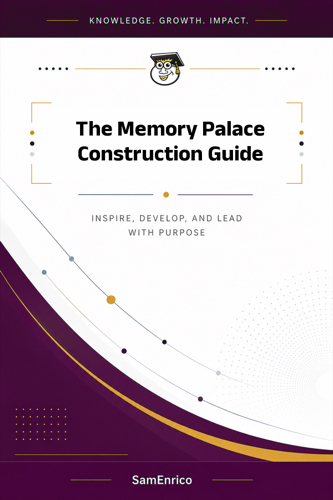
The Memory Palace Construction Guide eBook
Teaches how to build mental locations for storing
Teaches how to build mental locations for storing information using the method of loci.
Formats
Free sample
Chapter 1: The Corpse That Changed Memory...--–- The poet arrived at the banquet house expecting wine and applause. Instead, he found rubble, bodies, and the strange birth of a technique that would outlive empires.Simonides of Ceos was not a soldier. He was not a philosopher, though he had debated with them. He was a poet—the kind of man paid to turn athletic victories into verses that would echo through stadiums. On that late summer evening in 477 BC, somewhere in Thessaly, he had done what he always did: he recited.
The crowd cheered. The wine flowed. And Simonides, modest despite his fame, took his fee and slipped out the door.Two minutes later—perhaps less—the roof collapsed.The banquet hall of his host, a wealthy nobleman named Scopas, caved inward as if the sky itself had grown tired of holding itself up. Stone, timber, and clay buried every guest still inside. Limbs were crushed beyond recognition.
Faces disappeared under rubble. When the dust settled and the screaming stopped, the dead were indistinguishable from each other—a tangle of flesh and fabric that no family could claim.The families came anyway. Mothers, wives, brothers, and daughters arrived at the ruin demanding their loved ones. "Show us where he fell," they begged. "Show us she did not suffer."The nobleman Scopas was dead.
His heir was useless. No one knew who had sat where. No one except Simonides, who had not been crushed but had, in the strange cruelty of survival, been gifted with a perfect memory of the room's geometry.He closed his eyes. He saw the table. He saw the couches arranged in a U-shape, the way Greeks dined in those days—reclining on left elbows, right hands free for cups and bread.
He saw the lamp near the eastern wall. The wine jug by the pillar. The garlands hanging from the beams that were now toothpicks.And then he saw the guests.One by one, Simonides walked through the wreckage in his mind. He pointed. "Here sat the banker from Larissa.
Here was the merchant with the scar on his hand. Here—against this shattered bench—was the twin brothers' father. Here, by the broken column, the young man who laughed too loudly at my jokes."He named each corpse by its position, not its face.The families wept and thanked him. The city marveled. And somewhere in the smoke of that Thessalian afternoon, the Method of Loci was born—not in a university lecture hall or a philosopher's treatise, but in the desperate need to tell the dead from the dead.Why Your Grocery List Is Not the Problem Let me tell you something that will either comfort you or infuriate you: your memory is not broken.I mean this literally.
If I asked you to close your eyes right now and describe the floor plan of the home where you lived at age twelve—the creaky stair, the window that stuck in summer, the cabinet where your mother kept the crackers—you could probably do it. Not perfectly, perhaps. But you could draw a rough map. You could walk that house in your mind, room by room, even if you haven't stepped inside it in twenty years.Now try to recite the first ten digits of pi. Or the capital of Burkina Faso.
Or the name of the person you were introduced to at a party three hours ago.That's the mystery, isn't it? Your brain can hold a three-dimensional map of a house you haven't seen since childhood, but it cannot reliably hold a string of eight numbers for thirty seconds. This is not because you are forgetful. This is not because you are getting older or because you didn't pay attention in school. This is because your brain was not designed for the world you live in.Your brain was designed for the savanna.The Visuospatial Sketchpad: Your Brain's Forgotten Superpower Let me introduce you to a term you will forget and relearn and forget again—but that is not your fault.
The term is visuospatial sketchpad. It sounds like something a child would draw on. In fact, it is one of the most powerful memory systems in the human skull.In the 1970s, a cognitive psychologist named Alan Baddeley proposed that working memory—the mental workspace where you hold information temporarily—is not a single thing. It is a team. One member of that team is the phonological loop, which handles sounds and words.
Another is the central executive, which directs attention. And the third, the one that matters to you right now, is the visuospatial sketchpad.The sketchpad is responsible for storing and manipulating visual and spatial information. When you mentally rotate a shape, you are using the sketchpad. When you remember where you parked your car, you are using the sketchpad. When you close your eyes and walk through your childhood home, you are using the sketchpad.Here is what scientists have discovered about this system, and here is why it will change how you think about memory:First, the visuospatial sketchpad has enormous capacity compared to the phonological loop.
Try to hold a list of seven random words in your head. It's possible but effortful. Now try to hold the image of your living room in your head. That image contains dozens—hundreds—of discrete pieces of information: the color of the couch, the position of the lamp, the stack of books on the coffee table, the orientation of the rug. You are holding all of that at once, without effort, because the sketchpad is that good.Second, the sketchpad is ancient.
It evolved long before language. Your ancestors used it to track predators, remember water holes, and navigate home across featureless grasslands. The phonological loop, by contrast, is a relative newcomer—useful for gossip and songs, but not essential for survival.Third—and this is the key—the sketchpad can be recruited to store information it was never meant to store. You cannot hear a number. You cannot taste a capital city.
You cannot smell a name. But you can see them. You can place them in space. And when you do, the sketchpad's enormous capacity becomes available for your grocery list, your Spanish vocabulary, your presentation slides, and the hundred digits of pi that have haunted you since grade school.This is not a metaphor. This is cognitive neuroscience.The Myth of the Bad Memory Here is a confession: I have taught the Method of Loci to more than three thousand people, and every single one of them began by telling me some version of "I have a bad memory."A software engineer told me he could not remember client names.
A medical student told her she could not retain anatomy terms. A grandfather told me he could not remember the punchlines of jokes his grandchildren told him. A high school sophomore told me he could not pass his history exams because "facts just leak out."I asked each of them the same question: "Can you describe your kitchen?"Yes, they said. Of course."Can you describe the walk from your front door to your bedroom?"Yes. Obviously."Can you describe…
This is the end of the free sample. Get the eBook to keep going. Buy now
About this book
Details
- Author
- Villanueva Freeman
- Publisher
- SamEnrico
- Language
- English
- Genre
- Non-Fiction, Self-Help, Mnemonics
- Released
- 2026-06-06
- Pages (approx.)
- 132
- Available as
- eBook, Audiobook

Read better in the ZLOADR app
Your eBooks on your phone or tablet. Sign in with your SamEnrico account and start reading.
More by Villanueva Freeman
 EMDR And Dream Processing ManualVillanueva Freeman$11.99
 The Assertive Cultural Adaptation GuideVillanueva Freeman$11.99
 Ottoman Empire Napoleonic Relations HandbookVillanueva Freeman$11.99
 DBT For HopelessnessVillanueva Freeman$11.99
 Silk and Scandal: The Duchess Who Ruled from the ShadowsVillanueva Freeman$11.99
 Understanding Syndactyly–cenani–lenz TypeVillanueva Freeman$17.99
 Long Term Contracts ChinaVillanueva Freeman$12.99
 Industry Experience for PhDVillanueva Freeman$12.99
 Fry CookVillanueva Freeman$11.99
 How to Start a Muslin Finishing Business (Beginners Guide)Villanueva Freeman$11.99
You may also like
 Hong Kong Handover 1997Dunn Johnnie$11.99
 Zumba For Postnatal Recovery CourseNeal Christian$11.99
 Zumba for BeginnersLadner Nikia$11.99
 YouTube Comment Mining GuideHumes Pandora$12.99
 Worry Box MeditationCarlin Rudy$11.99
 Workplace Stress MeditationNguyen Lynn$11.99
 Workplace Stress and Sleep RepairHawley Ivory$11.99
 Workplace Perfectionism CureDelaney Jeffry$11.99
 Workplace Injustice Anger GuideWallen Isabelle$11.99
 Work Addiction and Burnout LinkGreenwood Ester$11.99
 Women in Yoga and WellnessBeattie Galina$11.99
 Women in Stand Up ComedyChun Evangeline$11.99