
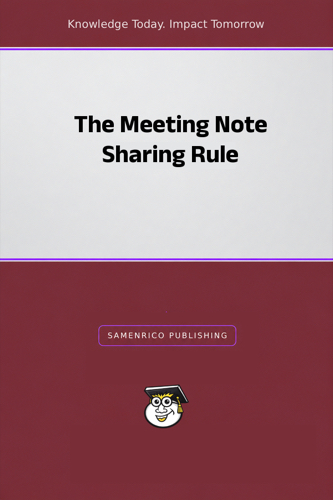
The Meeting Note Sharing Rule eBook
Distributes notes within 2 hours of meeting end.
Distributes notes within 2 hours of meeting end.
Formats
Free sample
Chapter 1: The Twenty-Two Day Theft--You have already lost twenty-two days of your life this year. Not to sleep. Not to commuting. Not to the unavoidable friction of being human. You lost them to a silent, invisible theft that happens in every organization, in every time zone, every single day.
The thief does not wear a mask or carry a weapon. The thief wears a suit and carries a laptop to a conference room. The thief is the gap between a meeting ending and its notes arriving.Let me show you the math, because the math is the only thing that will make you angry enough to act.The average knowledge worker attends sixty-two meetings per month. That is not a typo. Across industries and seniority levels, the number hovers between fifty-five and seventy depending on your source—Atlassian, Harvard Business Review, the team at Read.ai who have analyzed millions of meeting hours.
Sixty-two meetings. Every month. Seven hundred and forty-four meetings per year.Now watch what happens when notes arrive late.When meeting notes arrive twenty-four hours after the conversation—which is faster than most organizations, by the way—each meeting generates approximately forty-seven minutes of rework. That rework includes asking colleagues what was decided, searching for notes that do not exist yet, re-deciding things because no one remembers, chasing owners who do not know they were assigned, and sitting through follow-up meetings that are actually just replays of the first meeting.Forty-seven minutes is conservative. Some studies put it at sixty-two minutes.
But let us stick with forty-seven.Sixty-two meetings per month. Forty-seven minutes of rework per meeting. That equals 2,914 minutes per month. Divide by sixty. That is 48.5 hours per month.
Multiply by eleven working months. That is 533.5 hours per year.Divide by twenty-four. That is twenty-two days.Twenty-two days. You spend twenty-two days every year cleaning up the mess from meetings that already happened. That is not productivity.
That is purgatory. That is the difference between leaving at five o'clock and sending emails at nine o'clock. That is the weekend you lost to catching up. That is the project that shipped late because someone, somewhere, forgot what they agreed to.And here is the cruelest part: you do not even notice it. The forty-seven minutes per meeting is not a block of time you can point to.
It is scattered across your day like sand. Five minutes here, asking Dave what we decided. Ten minutes there, recreating a decision that was already made. Two minutes searching for an email that never came. By the end of the week, you have lost a full day.
By the end of the year, you have lost a month.The 2-Hour Rule is not about speed for speed's sake. It is about stealing back those twenty-two days.The Science of Forgetting There is a reason the twenty-four-hour standard fails, and it has nothing to do with laziness, incompetence, or bad intentions. It has to do with how human memory works. The German psychologist Hermann Ebbinghaus discovered something in the 1880s that every manager should have tattooed on their forearm: the forgetting curve.Ebbinghaus memorized lists of nonsense syllables—meaningless combinations like "ZOF" and "KAP"—and then tested himself at intervals to see how much he retained. What he found was brutal.
Within twenty minutes of learning something new, he had forgotten forty-two percent of it. Within one hour, fifty-six percent. Within twenty-four hours, sixty-seven percent. By the end of the first week, seventy-five percent was gone.The curve is exponential. It falls fast at first, then flattens.
The most forgetting happens in the first hour. The second most happens in the next twenty-three hours. After that, what remains is what sticks.Now apply that to a meeting.You walk out of a conference room at ten in the morning. You have just spent an hour discussing the Q3 marketing plan, the budget reallocation, and the timeline for the product launch. At 10:01 AM, you remember roughly ninety percent of what was said.
At 10:30 AM, you remember about seventy percent. At eleven in the morning, you are down to sixty percent. By five in the afternoon, you remember less than half. By ten the next morning, when most notes finally arrive, you remember maybe thirty percent of the discussion—and you have already filled in the gaps with your own assumptions.Here is the part that should terrify you: you do not know what you have forgotten. Your brain is not a hard drive with a "last modified" timestamp.
Your brain is a storyteller. It fills gaps with plausible fictions. When you cannot remember exactly what was decided, your brain manufactures a memory that feels true. That is not a bug in human cognition. That is a feature.
But it is a feature that destroys group alignment.Four people leave the same meeting. By the time notes arrive twenty-four hours later, each of them has reconstructed the conversation using their own biases, their own priorities, and their own imperfect memory. Person A remembers that the budget was approved. Person B remembers that the budget was tabled pending further review. Person C remembers that the budget was approved but only for Q3, not Q4.
Person D does not remember the budget conversation at all.All four of them are wrong. None of them knows it. And they will discover their disagreement only when the work fails to align—three weeks later, during a status update, when the budget variance report lands like a bomb.That is group memory failure. It is not an individual failing. It is a systems failure.
And the system that fails is the gap between conversation and documentation.The Cost of Cold Context When notes arrive late, something else dies: the emotional heat of commitment.There is a phenomenon in organizational psychology called the closing ritual. When a meeting ends and the facilitator says, "So we agree that Sarah will draft the proposal by Friday, and John will review it by Monday," something happens in the room. Heads nod. People say "got it" or "makes sense." There is a moment of shared acknowledgment. That moment is not ceremonial.
It is the moment when a spoken agreement becomes a felt obligation.But that moment has a half-life.Within a few hours, the felt obligation fades. Other priorities intrude. The urgent replaces the important. The action item that felt concrete at ten in the morning feels abstract at four in the afternoon. By the time the notes arrive the next morning, the action item has become a suggestion rather than a commitment.This is what I call cold context.
The note arrives, but the emotional temperature of the room has dropped. The recipient reads "Sarah: draft proposal" and thinks, "Oh, right, that thing." They do not feel the weight of the agreement. They do not remember the conversation that led to the assignment. They do not hear the voices of their colleagues nodding in agreement. They see a line of text.
And a line of text is infinitely easier to ignore than a spoken commitment made in front of peers.The 2-Hour Rule solves this by compressing the gap. When notes arrive within…
This is the end of the free sample. Get the eBook to keep going. Buy now
About this book
Details
- Author
- Bolden Georgine
- Publisher
- SamEnrico
- Language
- English
- Genre
- Non-Fiction, Business Brief, Accountability
- Released
- 2026-06-12
- Pages (approx.)
- 120
- Available as
- eBook, Audiobook

Read better in the ZLOADR app
Your eBooks on your phone or tablet. Sign in with your SamEnrico account and start reading.
More by Bolden Georgine
 Breast Cancer Caregiver GuideBolden Georgine$11.99
 The Parkinson's Pain GuideBolden Georgine$11.99
 Data Leak Merger and Acquisition ScriptsBolden Georgine$11.99
 The Viking Plague: Blood, Ice, and the Birth of Maritime MedicineBolden Georgine$11.99
 The Silent War: The Rise and Fall of the Hittite EmpireBolden Georgine$11.99
 Copyright LawBolden Georgine$11.99
 Understanding Collagen DisorderBolden Georgine$17.99
 Blocking for Hiring SeasonBolden Georgine$12.99
 UK Company Structure GuideBolden Georgine$12.99
 How to Start a Shotblasting of Buildings Business (Beginners Guide)Bolden Georgine$11.99
You may also like
 Values And Mission Alignment Value Violation Consequences GuideGarber Stefanie$11.99
 Meeting Pre Read PenaltyGoulet Kenton$11.99
 Self Serving Bias ChecksDelarosa Marlen$11.99
 The Remote Accountability GuideClemens Carl$11.99
 Focus Partner Accountability SystemJasper Aracelis$11.99
 Deep Work Accountability PartnerHanes Deena$11.99
 Meeting Parking Lot OwnerNewby Gertrud$11.99