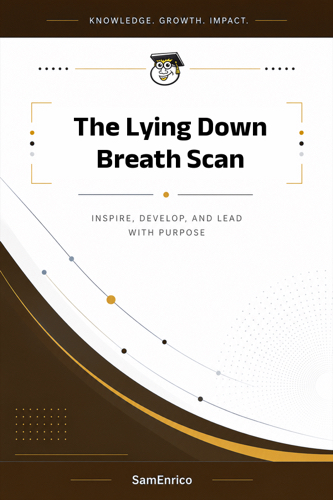
The Lying Down Breath Scan eBook
Combines breath with full body awareness supine.
by Walter Cole
Combines breath with full body awareness supine.
Formats
Free sample
Chapter 1: Gravity as Blanket–- Every morning at 7:15 a.m., Sarah does the same thing. She sits at the edge of her bed, feet flat on the floor, spine stacked in what she believes is proper posture, and she tries to meditate. She has tried apps with soothing voices, guided visualizations of forests and streams, and even a course on mindfulness that cost her three hundred dollars. And every morning, by the seven-minute mark, her lower back aches, her mind races faster than before she began, and she concludes—again—that she is simply bad at meditation.Sarah is not bad at meditation. She is sitting up.This chapter dismantles the single most damaging myth in the modern wellness landscape: the belief that "proper" meditation requires an upright spine on a cushion or chair.
For the millions of people who sit for eight to twelve hours per day at desks, who carry chronic tension in their hips and shoulders, who struggle with anxiety that manifests as physical restlessness, or who live with back pain that makes sitting unbearable—the upright posture is not a path to enlightenment. It is a barrier.The Lying Down Breath Scan offers a radical alternative: supine awareness. By lying on your back, you remove gravity as a compressive force and transform it into a supportive blanket. You release the muscular effort that upright posture demands. You signal safety to the oldest, most reactive part of your brain.
And you finally give yourself permission to do nothing while doing everything.This chapter will establish the biomechanical, neurological, and psychological reasons why lying down is not a concession to laziness but a strategic advantage. You will learn why the psoas muscle—the hidden culprit behind most meditation discomfort—only releases when horizontal. You will discover how the supine position speaks directly to your amygdala, the brain's fear detector, telling it that you are safe enough to rest. And you will complete a practical setup checklist that transforms your floor, bed, or yoga mat into a precision instrument for nervous system regulation.By the end of this chapter, you will never again apologize for lying down.The Myth of the Straight Spine The ideal of the upright meditator—cross-legged, spine like a stack of coins, hands resting on knees—has ancient roots in yogic and Buddhist traditions. For monks who spent their days walking, working, and sitting on the floor, this posture was natural.
Their bodies were conditioned by hours of movement and ground-level living. Their psoas muscles were long and supple. Their spines had never met an office chair.You are not a monk.The average modern human sits for 9.5 hours per day, according to recent sedentary behavior research. That is more time than most people spend sleeping. Add in time spent lying on a couch watching screens, and the average person is in a flexed, seated, or semi-recumbent position for nearly fourteen hours daily.
The body adapts to what you do most. If you sit most, your hips shorten. Your lower back stiffens. Your diaphragm learns to operate in a compressed range.When you then try to sit upright for meditation, you are asking shortened muscles to lengthen, stiff joints to articulate, and a diaphragm accustomed to shallow breathing to suddenly expand fully. The result is not clarity.
The result is discomfort, distraction, and the quiet conviction that you are failing.The Lying Down Breath Scan bypasses this entire struggle. It meets your body where it already is—horizontal, supported, and free from the constant micro-adjustments that upright sitting demands.The Psoas: The Muscle You Have Never Heard Of To understand why lying down matters, you must meet the psoas (pronounced SO-az). This is a long, thick muscle that originates on the sides of your five lumbar vertebrae (the lower spine) and runs down through your pelvis to attach to the top of your femur (thigh bone). It is the only muscle that connects your spine to your legs. It is also, according to trauma researcher and bodywork pioneer Dr.
David Berceli, a primary storage site for unresolved physical and emotional tension.In upright sitting, the psoas remains in a chronically shortened position. It is working, subtly and continuously, to stabilize your spine against gravity. You do not feel this work because it has become automatic—like your heart beating or your eyelids blinking. But it is there, consuming metabolic energy and maintaining a low-grade sympathetic (fight-or-flight) tone.When you lie supine, something remarkable happens. For the first time in hours, the psoas can fully lengthen.
The origin (spine) and insertion (femur) move apart. The muscle fibers relax. And as the psoas releases, it sends a signal up the fascial network—a kind of biological internet connecting muscles, bones, and organs—that the body is no longer preparing for action.This is not subtle. Many first-time practitioners report a sudden, involuntary sigh, a sensation of warmth spreading through the pelvis, or even a trembling in the legs as the psoas lets go of holding patterns that may have been present for years. One of my students, a fifty-three-year-old accountant with chronic lower back pain, described the feeling as "my hips apologizing to the rest of my body for working overtime since 1987."Anatomy Trains and the Deep Front Line The psoas does not operate in isolation.
It is part of a continuous fascial network that Thomas Myers, author of the seminal text Anatomy Trains, calls the Deep Front Line (DFL). This line runs from the underside of your tongue (yes, your tongue), down through the throat, the chest, the diaphragm, the psoas, and all the way to the arches of your feet.The DFL is your body's core stabilizer. When you stand or sit, it maintains tension from top to bottom. When you lie down, that tension can finally dissipate. The tongue relaxes away from the roof of the mouth.
The throat softens. The diaphragm descends more fully on the inhale. The psoas lengthens. The pelvic floor drops. The arches of the feet release.This is why lying down feels so good after a long day.
It is not just psychological relief—it is mechanical release along a specific anatomical pathway. The Lying Down Breath Scan uses this pathway intentionally, guiding your awareness along the DFL to identify and release areas of chronic holding that you have probably never consciously felt.Most meditation traditions direct your attention from the crown of the head downward or from the feet upward. The DFL suggests a different route: from the core outward. In later chapters, you will learn to scan along this line, using your breath as a probe to access tension in places you did not know could hold tension—the underside of the tongue, the connective tissue around the heart, the space between the hip bones.But first, you must understand how the supine position communicates safety to your nervous system.Gravity as a Blanket: The Neuroception of Safety Dr. Stephen Porges, the pioneering neuroscientist who developed Polyvagal Theory, coined the term "neuroception" to describe how the nervous system continuously scans the environment for cues of safety, danger, or life threat.
This happens below conscious awareness. You do not decide to feel safe because you read a reassuring statistic; your neuroception…
This is the end of the free sample. Get the eBook to keep going. Buy now
About this book
Details
- Author
- Walter Cole
- Publisher
- SamEnrico
- Language
- English
- Genre
- Non-Fiction, Self-Help, Lying
- Released
- 2026-06-12
- Pages (approx.)
- 150
- Available as
- eBook, Audiobook

Read better in the ZLOADR app
Your eBooks on your phone or tablet. Sign in with your SamEnrico account and start reading.
More by Walter Cole
 Micro Breaks for CarersWalter Cole$11.99
 Hypnotic Catalepsy InductionWalter Cole$11.99
 Acupuncture for Nail PsoriasisWalter Cole$11.99
 Twitter Intellectual Status GameWalter Cole$11.99
 The Frozen Frontier: Antarctica’s First Forgotten ExplorersWalter Cole$11.99
 Paws of Justice: The Dog Who Solved the Lindbergh Baby CaseWalter Cole$11.99
 How to Start a Scheduled Freight Air Transportation BusinessWalter Cole$11.99
 Understanding Dyskeratosis Congenita of Zinsser–Cole–engmanWalter Cole$17.99
 Configuration Management EngineerWalter Cole$11.99
 Nature Stock Phone GuideWalter Cole$12.99
 Founder Breakup GuideWalter Cole$12.99