
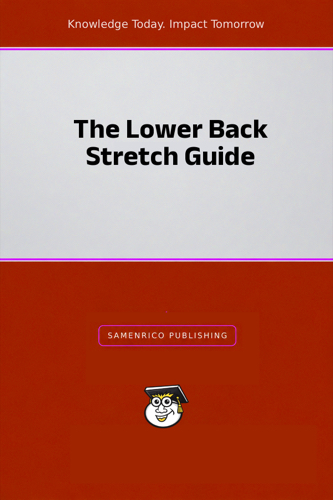
Non-FictionHealth & WellnessBack Pain
The Lower Back Stretch Guide eBook
Relieves tension and improves spinal mobility.
by Mcnulty Echo
Relieves tension and improves spinal mobility.
Formats
Free sample
Chapter 1: The Motion Paradox--–- Your back hurts. You have probably just shifted in your chair while reading that sentence, or you felt a familiar twinge as you reached for this book. Maybe you have already tried stretching before—perhaps this morning, or last week—and it either did nothing or made things worse. That experience, right there, is the single greatest barrier to healing your lower back. And it is based on a lie you have been told your entire adult life.The lie is this: that your back is fragile, that pain means damage, and that the safest response to tension is to stop moving.Nothing could be further from the truth.
And yet, this lie has been repeated by well-meaning doctors, cautious family members, and a healthcare system that profits from treating symptoms rather than teaching self-management. The result is an epidemic of unnecessary suffering. Eighty percent of adults will experience debilitating lower back pain at some point, making it the leading cause of disability worldwide. But here is the twist that changes everything: the vast majority of that pain is not coming from structural damage. It is coming from a simple, reversible problem that you can solve with the right information.Your lower back is not broken.
It is not degenerating faster than it should. You do not have a "bad back" any more than you have a "bad stomach" when you are hungry. What you have is a back that has been starved of the specific type of movement it requires to stay healthy, and it has been sending you increasingly urgent signals that you have misinterpreted as danger rather than instruction.This chapter will fundamentally change how you hear those signals. By the time you finish reading, you will understand why modern life has created a back pain epidemic, why the stretches you have tried in the past may have failed, and—most importantly—how to identify exactly what your specific back needs to finally release its grip of tension. No generic advice.
No one-size-fits-all routines. Just a diagnostic framework that will guide you through every stretch in this book with precision and confidence.The 9,000-Hour Culprit You Never Noticed Let us start with a simple experiment. Do not stand up. Stay exactly where you are, but pay attention to the position of your spine. Are you sitting?
Of course you are. Now answer this: is your pelvis tucked under you, with your lower back slightly rounded, or are you sitting upright with a natural curve in your lower back?For the vast majority of readers, the answer is the first one. You are sitting in what biomechanists call "end-range flexion"—your spine is as bent forward as it can comfortably go, and you have been holding it there for hours. Now multiply that position by your typical day. If you work at a desk, drive a car, eat meals at a table, look at your phone, and watch television in the evening, you are spending somewhere between nine and twelve hours every single day with your spine in flexion.
That is not an exaggeration. It is the average reality of the modern knowledge worker.To understand why this matters, you need to visualize what happens to your spine in this position. Picture a jelly donut. When you squeeze it from the front, the jelly pushes out the back. Your spinal discs are exactly the same.
They are fluid-filled structures sandwiched between your vertebrae, designed to distribute load and absorb shock. When you sit with a rounded lower back, you are squeezing the front of those discs and forcing the gel-like nucleus backward—toward the space where your nerves live. Do this for an hour, and your body adapts. Do it for a decade, and the back of the disc becomes permanently stressed, the surrounding ligaments stretch, and the nerves become increasingly irritated.But here is what almost no one tells you: that process is almost entirely reversible. The disc is not a piece of dead rubber.
It is a living, hydrated structure that responds to movement. When you extend your spine—bending backward—you reverse the pressure gradient. The nucleus moves forward again. Fluid is drawn back into the disc. Nerves get the space they need.
The tension that has been building for hours begins to dissolve in minutes.The problem is not that your back is broken. The problem is that your life has been spent almost entirely on one side of the flexion-extension equation, and your back has been screaming for the other side.Why "Just Stretch More" Is Terrible Advice You have heard it a hundred times. From your doctor. From well-meaning friends. From every article titled "Five Stretches for a Pain-Free Back." Just stretch more.
And so you have tried. You touched your toes. You twisted side to side. You maybe even bought a foam roller. And sometimes it helped for a few minutes.
But more often, it either did nothing or—and this is the part people do not talk about—it made your pain worse.There is a reason for this, and it is not because you are doing it wrong. It is because the "just stretch more" advice ignores the single most important variable in back pain treatment: direction.Let me explain. Your lower back has a directional preference. That is not a theory or a trend—it is a well-established clinical observation validated by decades of physical therapy research. Every person's spine responds differently to the two primary directions of movement: flexion (forward bending) and extension (backward bending).
For some people, moving into flexion feels relieving. It opens up space, reduces compression, and eases their specific type of tension. For other people—a completely different group—flexion is aggravating. It makes their pain worse, their nerves more irritated, and their back tighter. Those people need extension.Here is the cruel irony of generic stretching advice: if you are a flexion person who needs extension, and you spend ten minutes every morning touching your toes, you are not helping yourself.
You are literally doing the opposite of what your back requires. And because no one ever told you about directional preference, you assumed stretching just does not work for you. You gave up. Your back got tighter. And the cycle continued.This book will never ask you to "just stretch more." Instead, it will teach you how to identify your directional preference using a simple thirty-second test you can perform right now—which we will get to in a moment.
Then, every stretch in this book will be organized by whether it serves flexion-preferring or extension-preferring backs. You will never waste time on a stretch that could make you worse.The Three Faces of Back Tension Directional preference is one piece of the puzzle. But before you can know which direction to move, you need to know what kind of tension you are dealing with. Back pain is not a single experience. It is a category that contains three fundamentally different phenomena, each requiring a different approach.Muscular Tension is what most people think they have.
It feels like a dull, achy tightness. It is the sensation of your erector spinae muscles—those two columns of muscle…
This is the end of the free sample. Get the eBook to keep going. Buy now
About this book
Details
- Author
- Mcnulty Echo
- Publisher
- SamEnrico
- Language
- English
- Genre
- Non-Fiction, Health & Wellness, Back Pain
- Released
- 2026-06-07
- Pages (approx.)
- 153
- Available as
- eBook, Audiobook

Read better in the ZLOADR app
Your eBooks on your phone or tablet. Sign in with your SamEnrico account and start reading.
More by Mcnulty Echo
 Co Founder Alignment WorksheetMcnulty Echo$11.99
 Email Persuasion GuideMcnulty Echo$11.99
 Apology Receiving GuideMcnulty Echo$11.99
 Whispers of the Lost City: The Atlantis EnigmaMcnulty Echo$11.99
 Medical Affairs ManagerMcnulty Echo$11.99
 How to Start a Bowling Lanes Operation Business (Beginners Guide)Mcnulty Echo$11.99
 LinkedIn Experience Bullets GuideMcnulty Echo$12.99
 Learn to Play the KotoMcnulty Echo$11.99
You may also like
 Hong Kong Handover 1997Dunn Johnnie$11.99
 Zumba For Postnatal Recovery CourseNeal Christian$11.99
 Zumba for BeginnersLadner Nikia$11.99
 YouTube Comment Mining GuideHumes Pandora$12.99
 Worry Box MeditationCarlin Rudy$11.99
 Workplace Stress MeditationNguyen Lynn$11.99
 Workplace Stress and Sleep RepairHawley Ivory$11.99
 Workplace Perfectionism CureDelaney Jeffry$11.99
 Workplace Injustice Anger GuideWallen Isabelle$11.99
 Work Addiction and Burnout LinkGreenwood Ester$11.99
 Women in Yoga and WellnessBeattie Galina$11.99
 Women in Stand Up ComedyChun Evangeline$11.99