
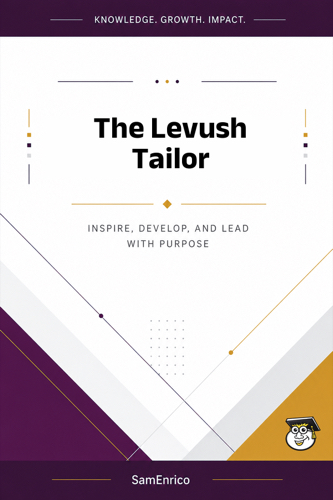
The Levush Tailor eBook
Details Rabbi Mordecai Yoffe's comprehensive code.
by Wilde Pa
Details Rabbi Mordecai Yoffe's comprehensive code.
Formats
Free sample
Chapter 1: The Unraveling of Heaven...--The year 1492 is remembered for two events that could not have been more different. On the third of August, Christopher Columbus set sail from Palos de la Frontera with three ships and a dream of reaching India by sailing west. He carried a letter from the Spanish monarchs authorizing him to claim whatever lands he found. On the same day, the last Jews of Spain were given a choice that was no choice at all: convert to Catholicism, leave the country, or die. By midnight, the roads to Portugal, North Africa, and the Ottoman Empire were clogged with families carrying whatever they could fit into wooden carts and cloth bundles.
The Inquisition had won. Sepharad had fallen.Historians have written libraries about the economic and political consequences of the Expulsion. They have traced the flow of capital, the rise of Ottoman Jewry, the intellectual flowering of Safed. But what they have rarely asked is a question that cuts deeper: What happens to a religion when its center of gravity suddenly shifts? What happens when the people who wrote the poetry, composed the liturgy, and argued the law are scattered to the four winds, and those who remain are suddenly unsure of which way to face when they pray?The answer, as it turned out, was nothing less than a crisis of authority that would consume the next century and give birth to a man known as the Tailor.The Shattering of the Seam Before 1492, Jewish life in Europe had been organized around two poles.
In the south, the great Sephardic communities of Spain, Portugal, and southern France produced a tradition that was philosophically inclined, linguistically fluid, and legally sophisticated. The great codifiers—Maimonides, Nahmanides, the Tur’s author Jacob ben Asher—had all emerged from this Mediterranean world. They wrote in Hebrew and Arabic, read Aristotle and Plato, and believed that reason could illuminate the divine law.In the north, the Ashkenazi communities of Germany, France, and eventually Poland developed a different character. They were pietistic, legally rigorous, and deeply suspicious of philosophy. They wrote Tosafot—glosses on the Talmud that piled question upon question—and they valued intellectual combat over elegant synthesis.
The great Ashkenazi scholars were not philosophers but dialecticians. They did not ask what God is. They asked what God means when the text says one thing and the tradition says another.For centuries, these two worlds had coexisted uneasily, like two rooms in a large house connected by a narrow hallway. Sephardic scholars read Ashkenazi commentaries. Ashkenazi rabbis cited Sephardic authorities.
The hallway was narrow, but it was passable.The Expulsion of 1492 blew out the walls. Suddenly, the Sephardic world was in motion. The great families who had produced the Rishonim—the early authorities—fled to North Africa, to Constantinople, to the Land of Israel. They carried their manuscripts and their memories, but they also carried a question: Were they still Sephardic if they no longer lived in Sepharad?The Ashkenazi world, meanwhile, was also in motion. The massacres and expulsions that had punctuated the fourteenth and fifteenth centuries—the Black Death persecutions, the Armleder uprisings—had pushed Ashkenazi Jewry eastward, into Poland and Lithuania.
By 1500, the center of Ashkenazi life had shifted from the Rhine Valley to the cities of Krakow, Lublin, and Prague. The language remained Yiddish. The customs remained German. But the geography had changed forever.The Printing Press as Fire Into this fractured landscape came a technology that would transform everything: the printing press.Johannes Gutenberg had printed his Bible in Mainz around 1455. Within fifty years, Hebrew presses were operating in Rome, Constantinople, and Venice.
By 1520, a Jewish scholar in Krakow could own a copy of the Talmud that would have taken a scribe three years to copy by hand. By 1550, the great legal codes were rolling off presses in editions of thousands rather than the handful of manuscripts that had existed before.This was, by any measure, a blessing. The more texts circulated, the more scholars could read, argue, and refine. But the printing press was also a curse. In the age of manuscripts, every copy was slightly different, and every scholar knew that the text they held was one of perhaps fifty in existence.
Authority was distributed, but it was also manageable. A single scholar could reasonably claim to have read everything.In the age of print, the number of available texts exploded. Every yeshiva had a library. Every library had multiple editions. Every edition had its own pagination, its own marginal glosses, its own approbations from living rabbis.
The old hierarchy—Talmud first, then Rashi, then Tosafot, then the later authorities—was suddenly crowded with new voices. Who had the right to decide which opinion was correct? Who could say, with authority, "This is the law, and no further argument is needed"?The answer, in the sixteenth century, was no one. And that was the problem.The Codification Race Into this vacuum stepped a man who believed he could restore order. His name was Joseph Caro, and he was a Sephardic refugee who had settled in Safed, the mystical city in the hills of Galilee.
Caro had spent decades compiling a massive commentary on the Arba’ah Turim—the four rows of Jewish law organized by Jacob ben Asher in the fourteenth century. He called his work the Beit Yosef, the House of Joseph. It was monumental: hundreds of thousands of words, tracing every law from the Talmud through the Rishonim to his own day.But Caro knew that no one would read a work that large. So he condensed it. He stripped away the arguments, the dissents, the multiple opinions, and produced a bare-bones code of law.
He called it the Shulchan Arukh—the Set Table. It was published in Venice in 1565.The Shulchan Arukh was a marvel of clarity. On every question of Jewish law—from how to tie your shoes on Shabbat to how to divorce a wife who would not accept a get—Caro gave a single, decisive ruling. No arguments. No dissents.
Just the law, plain and simple.The Sephardic world rejoiced. Finally, a code that everyone could follow. Finally, an end to the chaos of competing opinions.The Ashkenazi world was horrified. Caro's rulings were Sephardic through and through. He cited Sephardic authorities.
He favored Sephardic customs. He ignored the Tosafot, the German pietists, the entire tradition of Ashkenazi legal reasoning. His "Set Table" had no place for the dishes that Ashkenazi Jews had been eating for centuries.Enter Moses Isserles of Krakow, known by his acronym the Re MO. Isserles was everything Caro was not. He was Ashkenazi, critical, and deeply aware that a single code could never capture the richness of Jewish legal tradition.
He took Caro's Shulchan Arukh and wrote a gloss on it, paragraph by paragraph, adding the Ashkenazi customs that Caro had ignored. He called his work the Mappah—the Tablecloth. It was published in 1571.The Mappah was brilliant, but it was also a confession of failure. Isserles had not written a code. He had written a corrective to someone else's code.
He had accepted Caro's structure, Caro's decisions, Caro's Sephardic framework—and then tried to patch it with Ashkenazi patches. The table…
This is the end of the free sample. Get the eBook to keep going. Buy now
About this book
Details
- Author
- Wilde Pa
- Publisher
- SamEnrico
- Language
- English
- Genre
- Non-Fiction, Biography, Halacha
- Released
- 2026-06-10
- Pages (approx.)
- 139
- Available as
- eBook, Audiobook

Read better in the ZLOADR app
Your eBooks on your phone or tablet. Sign in with your SamEnrico account and start reading.
More by Wilde Pa
 Exercise Selection for HGH BoostWilde Pa$11.99
 Hostage Art TherapyWilde Pa$11.99
 The Stay At Home Parent ResilienceWilde Pa$11.99
 Sex Addicts Anonymous Step GuideWilde Pa$11.99
 Chromatic Uprising: The Day the World Turned PinkWilde Pa$11.99
 The Forgotten Eruption: The Medieval Explorers Who Unlocked the Secrets of CotopaxiWilde Pa$11.99
 Engineering TechnicianWilde Pa$11.99
 Understanding Brachydactyly Type A2Wilde Pa$17.99
 10 Ways to Use Cocktail (Recipe Book)Wilde Pa$11.99
 Voice Commerce 2026-2030 ForecastWilde Pa$12.99
 Top Coding Bootcamps ComparedWilde Pa$12.99
You may also like
 Hong Kong Handover 1997Dunn Johnnie$11.99
 Zumba For Postnatal Recovery CourseNeal Christian$11.99
 Zumba for BeginnersLadner Nikia$11.99
 YouTube Comment Mining GuideHumes Pandora$12.99
 Worry Box MeditationCarlin Rudy$11.99
 Workplace Stress MeditationNguyen Lynn$11.99
 Workplace Stress and Sleep RepairHawley Ivory$11.99
 Workplace Perfectionism CureDelaney Jeffry$11.99
 Workplace Injustice Anger GuideWallen Isabelle$11.99
 Work Addiction and Burnout LinkGreenwood Ester$11.99
 Women in Yoga and WellnessBeattie Galina$11.99
 Women in Stand Up ComedyChun Evangeline$11.99