
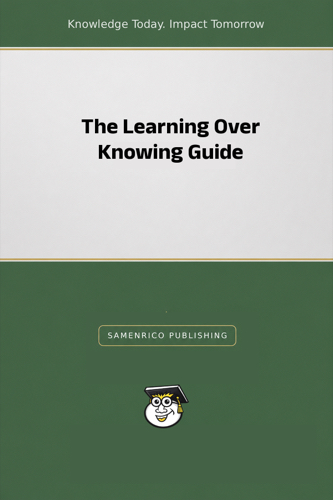
Non-FictionSelf-HelpIntellectual Humility
The Learning Over Knowing Guide eBook
Prioritizes curiosity and questions over having al
Prioritizes curiosity and questions over having all the answers in conversations.
Formats
Free sample
Chapter 1: The Ego Trap...--The first time I watched a surgeon dismiss a nurse's question, I was twenty-three years old, newly hired as a administrative assistant in a major teaching hospital, and profoundly naive about the difference between confidence and competence.The patient was a middle-aged man complaining of chest pain. The surgeon, a man with thirty years of experience and a reputation for never being wrong, had already made his diagnosis: indigestion. The nurse, a woman who had worked cardiac intensive care for two decades, noticed the man's jaw pain and shortness of breath – classic signs of myocardial infarction that the surgeon had missed in his rushed five-minute exam."Dr. Harriman," the nurse said quietly, "should we order an EKG just to rule out –""I've been doing this since you were in diapers," the surgeon interrupted, not looking up from his chart. "It's indigestion.
Discharge him."The nurse asked again, softer but more urgent. "His troponin levels –""I said it's indigestion."The patient was discharged at 4:17 PM. He collapsed in the parking lot at 4:52 PM. He was pronounced dead at 5:30 PM. The autopsy confirmed a massive heart attack.The surgeon never apologized.
He never acknowledged that he had been wrong. At the morbidity and mortality conference, he blamed the nurse for not being more insistent, the patient for not having classic symptoms, and the hospital for having inadequate discharge protocols. Everyone in the room knew the truth. No one said a word.I spent the next decade collecting stories like this one. Not just from medicine – though medicine is a gold mine for this particular pathology – but from corporate boardrooms, political campaigns, family dinners, and couples therapy sessions.
I collected stories of people who knew they were wrong but couldn't admit it. People who watched disasters unfold because someone in power refused to say three simple words: "I don't know."I collected stories of my own failures, too. The meeting where I pretended to understand a financial model I had never studied. The argument with my partner where I doubled down on a position I had already realized was indefensible. The parenting moment where my three-year-old asked why the moon followed the car, and instead of saying "I don't know, let's find out together," I invented a stupid answer just to feel like I was in control.This book is the result of those ten years of collecting, studying, and ultimately trying to break a habit that is destroying our relationships, our organizations, and our ability to navigate an increasingly complex world.The habit has a name.
I call it the Answer Reflex.The Anatomy of the Answer Reflex The Answer Reflex is exactly what it sounds like: the automatic, often unconscious compulsion to provide an answer, defend a position, or project certainty – even when you lack sufficient information, even when you suspect you might be wrong, and especially when admitting uncertainty would make you feel vulnerable.The surgeon had the Answer Reflex. He couldn't say "I don't know" because, in his mind, thirty years of experience meant he should know everything. The nurse, by contrast, was demonstrating what I call the Learning Over Knowing mindset: she was willing to ask a question, to be curious, to risk looking foolish in front of a powerful man because she cared more about getting it right than about being right.The Answer Reflex is not a personality flaw. It is not a sign of low intelligence or moral failure. It is a trained response – a habit that has been reinforced thousands of times over the course of your life, starting in childhood and continuing through every performance review, every standardized test, and every social interaction where certainty is rewarded and doubt is penalized.Let me be specific about how the Answer Reflex works.When you encounter a question you cannot immediately answer, your brain experiences a small spike of anxiety.
This is not a bug; it's a feature. Evolutionarily speaking, uncertainty was dangerous. Not knowing whether that rustle in the bushes was a predator or the wind could get you killed. So your brain evolved to resolve uncertainty as quickly as possible – even if that resolution meant guessing, even if it meant making something up, even if it meant lying.The problem is that we no longer live in an environment where immediate answers are adaptive. We live in a world of staggeringly complex systems – climate science, global economics, public health, artificial intelligence – where the correct answer is often counterintuitive, where the person who claims certainty is almost certainly wrong, and where the ability to sit with uncertainty, to ask good questions, and to change your mind in response to new evidence is the single most valuable skill you can possess.But your brain doesn't know that.
Your brain is still running software that was written for the savanna. So when you feel that spike of anxiety, your Answer Reflex kicks in. You provide an answer. You defend a position. You project certainty.
And in doing so, you sacrifice learning on the altar of looking like you already know.The Four Faces of the Answer Reflex Over years of studying this phenomenon, I have identified four distinct ways the Answer Reflex manifests. You will recognize yourself in at least one of these. Most people recognize themselves in three.Face One: The Know-It-All The Know-It-All has an answer for everything. Ask them about cryptocurrency, they have a definitive opinion. Ask them about parenting, they have a system.
Ask them about geopolitics, they have a solution. The Know-It-All is exhausting to be around, but here's the crucial insight: the Know-It-All is not trying to be annoying. They are trying to manage their own anxiety. Their relentless certainty is a shield against the terror of not knowing.The Know-It-All is most common among high-achieving professionals, particularly those who were rewarded early and often for having the right answer in school. They have built an entire identity around being the person who knows things.
To admit uncertainty would be to destabilize that identity, and the ego will resist that with astonishing ferocity.I once worked with a CEO – let's call him Martin – who had built a successful software company from his garage. Martin knew everything about his product. But when the market shifted and his product became obsolete, Martin could not admit that he didn't know what to do next. He faked answers. He held meetings where he spoke confidently about strategies he had invented on the spot.
He fired anyone who asked difficult questions. The company went bankrupt within eighteen months. At the closing meeting, Martin gave a speech blaming everyone except himself. His final words to his employees were "I did everything right."He believed it. That is the terrifying power of the Answer Reflex.
It doesn't just make you wrong. It makes you unable to see that you are wrong.Face Two: The Impostor The Impostor is the mirror image of the Know-It-All. Where the Know-It-All pretends to certainty they do not feel, the Impostor feels certain they are about to be exposed as a fraud. The Impostor's Answer Reflex manifests not as overconfidence but as frantic information-gathering, over-preparation, and a pathological inability…
This is the end of the free sample. Get the eBook to keep going. Buy now
About this book
Details
- Author
- Chestnut Teressa
- Publisher
- SamEnrico
- Language
- English
- Genre
- Non-Fiction, Self-Help, Intellectual Humility
- Released
- 2026-06-08
- Pages (approx.)
- 148
- Available as
- eBook, Audiobook

Read better in the ZLOADR app
Your eBooks on your phone or tablet. Sign in with your SamEnrico account and start reading.
More by Chestnut Teressa
 Cocaine Psychosis TreatmentChestnut Teressa$11.99
 Spin to Win Cycling GuideChestnut Teressa$11.99
 The Fear of Beards GuideChestnut Teressa$11.99
 Self Talk for Imposter Syndrome WorkbookChestnut Teressa$11.99
 The Icebound Corpse: A Forensic Mystery on the SS ArcticChestnut Teressa$11.99
 How to Start a Petroleum Product (at Refineries) Business (Beginners Guide)Chestnut Teressa$11.99
 Engineering Team LeadChestnut Teressa$11.99
 UK Market Eco CertificationsChestnut Teressa$12.99
 Singapore Tech Pass GuideChestnut Teressa$12.99
 Understanding Ulnar Hypoplasia Lobster Claw Deformity of FeetChestnut Teressa$17.99
You may also like
 Hong Kong Handover 1997Dunn Johnnie$11.99
 Zumba For Postnatal Recovery CourseNeal Christian$11.99
 Zumba for BeginnersLadner Nikia$11.99
 YouTube Comment Mining GuideHumes Pandora$12.99
 Worry Box MeditationCarlin Rudy$11.99
 Workplace Stress MeditationNguyen Lynn$11.99
 Workplace Stress and Sleep RepairHawley Ivory$11.99
 Workplace Perfectionism CureDelaney Jeffry$11.99
 Workplace Injustice Anger GuideWallen Isabelle$11.99
 Work Addiction and Burnout LinkGreenwood Ester$11.99
 Women in Yoga and WellnessBeattie Galina$11.99
 Women in Stand Up ComedyChun Evangeline$11.99