
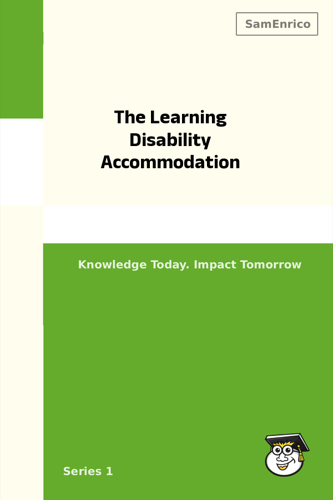
The Learning Disability Accommodation eBook
Request and use academic supports without embarras
by Kern Lyman
Request and use academic supports without embarrassment or shame.
Formats
Free sample
Chapter 1: The Operational Tax--–- Mia stared at the same paragraph for the seventh time. Her eyes moved across the words, but nothing stuck. The library around her hummed with the quiet productivity of other students—fingers tapping keyboards, highlighters gliding across pages, the occasional rustle of a snack bag. She had been sitting here for two hours. She had read exactly four pages.
Her friend Sarah, who sat two tables over, had arrived forty-five minutes ago and was already packing up to leave. "See you tomorrow," Sarah whispered, waving. Mia smiled and waved back. Then she put her head in her hands.The problem was not that Mia was lazy. The problem was not that she was stupid.
The problem was that she had dyslexia, and she was trying to read a dense textbook the same way everyone else did—by looking at the words on the page and decoding them letter by letter. She had done this for nineteen years. She was exhausted. And she had never once asked for an audiobook or text-to-speech software because, in her mind, that would be "cheating."This chapter is about that exhaustion. It is about the invisible surcharge that students with learning disabilities pay every single day—not because they lack intelligence or effort, but because they lack permission to work differently.
I call this surcharge the Operational LD Tax. It is measured in three currencies: time, energy, and self-esteem. And until you learn to see it, you cannot stop paying it.The Three Currencies of the LD Tax Let us begin with a simple question: What does it actually cost you to get through a single day of school without accommodations?For most students without learning disabilities, a two-hour reading assignment takes about two hours. For a student with dyslexia, that same assignment might take four, five, or six hours. That is not because the dyslexic student is less capable of understanding the material—in fact, many dyslexic students have above-average comprehension once the information enters their brain.
The bottleneck is the input channel. Decoding individual letters into sounds into words into meaning is slow, effortful, and metabolically expensive.Time is the first currency of the LD Tax. Consider the following scenario, drawn from dozens of interviews with college students who have learning disabilities:A professor assigns three chapters of a textbook, estimated reading time: 90 minutes.A typical student reads for 90 minutes, takes a break, and moves on to other work.A student with unaccommodated dyslexia reads for 90 minutes and finishes 15 pages. They need another 90 minutes to finish the chapter. Then another 90 minutes to take notes.
Total time: 4.5 hours.Where did those extra three hours come from? They came from sleep. They came from exercise. They came from socializing. They came from the student's other classes.
This is the LD Tax in its most basic form: you spend your most finite resource—time—on tasks that take your peers half as long.But time is only the beginning.The second currency of the LD Tax is energy. Unlike time, which can be measured in hours, energy is harder to quantify. But anyone who has lived with an unaccommodated learning disability knows exactly what I mean. It is the bone-deep fatigue that sets in after a single hour of reading. It is the headache that blooms behind your eyes after a handwritten exam.
It is the feeling of having nothing left for your friends, your hobbies, or even basic self-care because you spent everything just to keep your head above water academically.Here is what energy depletion looks like in practice: A student with dysgraphia (a writing disability) refuses to use speech-to-text software because they think it is "weird." Instead, they handwrite all their essays. Their hand cramps after 200 words. Their letters become illegible. They erase and rewrite the same sentence three times. By the time they finish a five-paragraph essay, they have expended the same amount of mental energy that their peers would expend on a ten-page research paper.
Then they have a math test tomorrow. Then they have a group project meeting. Then they collapse into bed at midnight, too exhausted to brush their teeth.This is not a moral failing. This is a functional mismatch. You are using a tool that fights against your brain rather than working with it.
And the cost is measured in energy you will never get back.The third currency of the LD Tax is the most insidious: self-esteem. Unlike time and energy, which are finite but replenishable, self-esteem can be permanently eroded by years of uncompensated struggle. The message that students internalize is not "I have a learning disability" but rather "I am not smart enough to do this." And that message, repeated thousands of times across thousands of assignments, becomes a belief.Here is how that erosion works. You spend four hours on a reading that took your roommate one hour. You assume, therefore, that you are four times less intelligent than your roommate.
You do not consider the possibility that your brain processes written text differently. You do not consider the possibility that an audiobook would have leveled the playing field. You simply conclude: I am bad at this. I should not be here. Everyone else seems to manage, so the problem must be me.This is the hidden tax.
It is hidden because no one tells you it exists. Your professors do not mention it. Your friends do not see it. Even your parents, who have watched you struggle for years, may not have the language to name it. But you feel it.
Every single day.Medical Diagnosis versus Functional Limitation Before we go any further, we need to make a critical distinction. Most students think about learning disabilities in terms of diagnoses: I have dyslexia. I have ADHD. I have dyscalculia. I have a processing disorder.
These labels are useful for doctors, insurance companies, and school administrators. But they are not very useful for you, right now, in this moment, trying to get through a Tuesday afternoon.Why? Because a diagnosis tells you what you have. It does not tell you what you struggle with in a classroom.Two students can have the same diagnosis—say, ADHD—and present with completely different functional limitations. One student might struggle primarily with attention regulation: they cannot stay focused during lectures, they lose their train of thought in the middle of a test, they forget deadlines constantly.
Another student with the same diagnosis might struggle primarily with output: they can focus just fine, but they cannot organize their thoughts into a coherent essay, and they freeze under timed pressure.If both students ask for the same accommodation—say, extended time—it might help the second student enormously and do almost nothing for the first student. The first student needs a distraction-reduced environment, not more time. The diagnosis alone is not enough to tell you that.This is why this book focuses on functional limitations rather than medical labels. A functional limitation is a specific, observable difficulty that affects your ability to learn or demonstrate your knowledge in a typical classroom setting. Examples include:"I cannot keep up with assigned readings because I read slowly.""I cannot finish…
This is the end of the free sample. Get the eBook to keep going. Buy now
About this book
Details
- Author
- Kern Lyman
- Publisher
- SamEnrico
- Language
- English
- Genre
- Non-Fiction, Self-Help, Learning Disabilities
- Released
- 2026-06-10
- Pages (approx.)
- 129
- Available as
- eBook, Audiobook

Read better in the ZLOADR app
Your eBooks on your phone or tablet. Sign in with your SamEnrico account and start reading.
More by Kern Lyman
 Medical Relapse Prevention Laboratory MonitoringKern Lyman$11.99
 Curie Paris Institute FoundingKern Lyman$11.99
 Breaking Sugar Addiction Recovery GuideKern Lyman$11.99
 Writing Effective Remote EmailsKern Lyman$11.99
 Chronic Illness Parent ChildhoodKern Lyman$11.99
 Fast Food Drive Through UrgeKern Lyman$11.99
 Anticipatory Grief JournalKern Lyman$11.99
 Autophagy Growth Hormone BalanceKern Lyman$11.99
 The Forgotten Navigator: Abel Tasman and the First European Sightings of Australia and New ZealandKern Lyman$11.99
 Pets.com: The Balloon That BurstKern Lyman$11.99
 The Bloodhound and the Billionaire: How a Dog Solved the Case of the Missing Mona LisaKern Lyman$11.99
 Weekly Global Sync Email TemplateKern Lyman$12.99
You may also like
 Learning Disability Self Worth HandbookMaier Terrell$11.99
 Anger And Learning Disability GuideHolder Maile$11.99
 The Learning Disability Shame GuideJarvis Daryl$11.99
 Anger At Child's Learning DisabilityFields Dale$11.99
 Method of Loci for Learning DisabilitiesPak Candra$11.99
 Learning Disability Self EsteemFischer Ilse$11.99
 Working Memory Training For DyslexiaNicholson Jon$11.99