
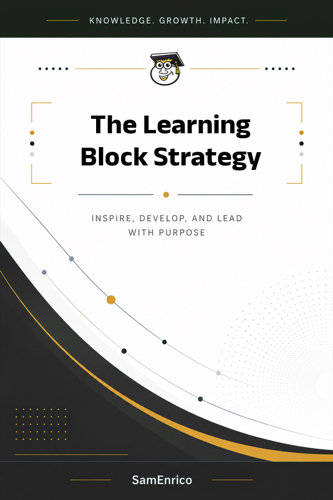
The Learning Block Strategy eBook
Schedule deliberate practice blocks for skill deve
by Sapp Letty
Schedule deliberate practice blocks for skill development and courses.
Formats
Free sample
Chapter 1: The Practice Trap--–- Consider a woman named Priya. For eleven months, she has woken up at 5:30 AM every weekday. She pours a cup of black coffee, opens her laptop, and works through a popular coding course. She has completed 187 exercises. She has watched over forty hours of video lectures.
She has taken meticulous notes—three full notebooks, color-coded by topic. Priya wants to transition from her marketing role to a junior developer position. She has sacrificed sleep, social time, and her morning runs. She is trying. She is grinding.
She is desperate.And she cannot write a simple function from scratch without looking at a solution.When she sits down to solve a new problem—something not covered in the course—her mind goes blank. She types a few lines, deletes them, opens Stack Overflow, copies a snippet, pastes it, feels a flicker of relief, then closes the browser with a sick feeling in her stomach. She knows she is not learning. She knows she is mimicking. But she does not know what else to do.Priya is not lazy.
She is not unintelligent. She has a degree in economics. She has led teams at work. She can learn. And yet, after nearly a thousand hours of studying, she is no closer to her goal than she was on day one.
She has fallen into the most seductive, well-disguised, and emotionally devastating trap in all of human learning.It is called the Practice Trap. And this book is the escape route.The Deception of Effort Here is a sentence that will change how you think about improvement: Effort is not a proxy for learning. Just because you are trying hard does not mean you are getting better. Just because you are exhausted does not mean you are progressing. Just because you showed up does not mean you left with anything valuable.This sounds obvious when stated plainly.
And yet, almost every person who has struggled to learn a skill has fallen for the deception. We confuse the feeling of effort with the reality of growth. We believe that if we just push harder, grind longer, and sacrifice more, the universe will reward us with competence. But the universe does not care about your suffering. The universe cares about structure.Let me be brutal: Priya’s 5:30 AM coding sessions are almost worthless.
Not because coding is hard or because she lacks aptitude, but because she is engaging in what Anders Ericsson, the world’s leading researcher on expertise, called naive practice. Naive practice is repetition without a specific goal, without immediate feedback, without a method for correcting errors, and without a way to measure progress. It is the intellectual equivalent of digging a hole and then filling it back up. You move a lot of dirt. You build nothing.The tragedy is that naive practice feels productive.
It produces the dopamine hit of checking a box. “Completed lesson 47.” “Watched another tutorial.” “Added three pages of notes.” These are the counterfeit currencies of learning. They buy you nothing but the illusion of progress.The Real Science of Getting Better To understand why Priya is stuck, we must go inside the brain. For decades, neuroscientists believed that the adult brain was largely fixed—that after a certain age, you could learn new facts but not rewire your fundamental circuits. That view has been completely overturned.
We now know that the brain remains plastic throughout life. It can grow new connections, strengthen existing pathways, and even generate new neurons. But here is the catch: plasticity is not automatic. It requires a specific trigger.That trigger is myelin.Myelin is a fatty, whitish substance that wraps around the long fibers of your neurons, called axons. Think of it as the insulation on an electrical wire.
When a pathway is used repeatedly with intense focus and precision, the brain sends out cells called oligodendrocytes that wrap myelin around that pathway. More myelin means faster signal transmission, less signal leakage, and more reliable execution. Every time a concert pianist plays a flawless arpeggio, every time a surgeon ties a perfect knot, every time a coder types a complex function without pausing, they are riding on a heavily myelinated pathway.Here is the critical insight that most self-help books get wrong: myelination does not happen during mindless repetition. It happens when you attempt something slightly beyond your current ability, fail, correct, and try again. The failure is essential.
The correction is essential. The focused attention is essential. Without those three ingredients, the oligodendrocytes do not show up. The myelin does not wrap. The skill does not stick.This is why Priya can do 187 coding exercises and learn almost nothing.
She is not failing enough. She is not correcting enough. She is following step-by-step instructions that eliminate the need for error detection and correction. She is a passenger, not a pilot. And passengers do not build myelin.The Thousand-Hour Plateau Let me show you a graph that does not exist in any textbook but lives in the minds of millions of frustrated learners.
On the vertical axis is skill level. On the horizontal axis is time. The line starts at zero, rises steeply for the first few hours, and then—flattens. Completely. It looks like a lawn that has been mowed to dirt.This is the thousand-hour plateau.
It is the place where most learners live. They put in the hours—hundreds, sometimes thousands—but their skill line is a flat, pitiful thing. They have not stopped trying. They have stopped learning.Consider a famous study of typists. Experienced typists who have typed millions of words over decades do not get faster after the first few months of training.
Their speed plateaus because the skill becomes automatic. Their fingers move without conscious direction. To improve, they would have to deliberately break their automatic patterns, slow down, introduce error, and rebuild. In other words, they would have to switch from naive practice to deliberate practice.Most typists never do this. Most guitarists never do this.
Most coders, writers, painters, runners, and public speakers never do this. They hit the plateau, assume they have reached their “natural limit,” and resign themselves to mediocrity. But the plateau is not a natural limit. It is a structural limit. Change the structure, and the plateau breaks.Deliberate Practice: The Antidote So what does deliberate practice look like in real life?
Let me give you an example from outside the world of coding or guitar—something we have all done: learning to parallel park.Imagine two people learning to parallel park.Naive Priya watches a You Tube video about parallel parking. She gets in the car, finds an empty street, and tries to park. She succeeds on the fifth attempt. She feels relieved. She practices for twenty more minutes, succeeding about half the time.
She goes home. The next day, she does the same thing. After a week, she can parallel park about 70 percent of the time. After a month, she is still at 70 percent. She has plateaued.
She decides she is “bad at parking” and avoids city driving.Deliberate David also watches a video. But then he breaks parallel parking into sub-skills: judging…
This is the end of the free sample. Get the eBook to keep going. Buy now
About this book
Details
- Author
- Sapp Letty
- Publisher
- SamEnrico
- Language
- English
- Genre
- Non-Fiction, Self-Help, Learning
- Released
- 2026-06-07
- Pages (approx.)
- 146
- Available as
- eBook, Audiobook

Read better in the ZLOADR app
Your eBooks on your phone or tablet. Sign in with your SamEnrico account and start reading.
More by Sapp Letty
 Talking About Vasectomy Or Tubal LigationSapp Letty$11.99
 The Distraction Habit Loop WorkbookSapp Letty$11.99
 Eat Before You Drive RuleSapp Letty$11.99
 Battle Of Friedland AccountSapp Letty$11.99
 Sacroiliac Joint Stabilization ExercisesSapp Letty$11.99
 The Freelance Time Audit MethodSapp Letty$11.99
 Requesting Time Off AssertivelySapp Letty$11.99
 Public Speaking ScriptsSapp Letty$11.99
 The Unlikely Spy: How a Janitor Outsmarted the CIASapp Letty$11.99
 The Mamluks Strike: Baybars' Crusader Annihilation (1260 AD)Sapp Letty$11.99
 Frozen Echoes: The Last Flight of the Doomed DC-3Sapp Letty$11.99
 How to Start a Radio Stations BusinessSapp Letty$11.99
You may also like
 Weekly Lessons LearnedThatcher Charline$11.99
 The SMART Criteria ExplainedToledo Theresia$11.99
 The Feynman Technique GuideHobbs Hong$11.99
 The Elaboration TechniqueLeclair Darline$11.99
 Lifelong Learning MemorySellers Florencia$11.99
 Slow Wave Sleep for FactsKinder Farah$11.99
 Pre Learning Sleep BenefitsCordova Codi$11.99
 Learning Speed AnchorShort Oren$11.99
 Handwritten vs Typed NotesLadner Leann$11.99
 The Beginner's Mistake GuideBlakely Manie$11.99
 Reading Hour Morning PlanAllen Julian$11.99
 Lesson Learned WeeklySnipes Sudie$11.99