
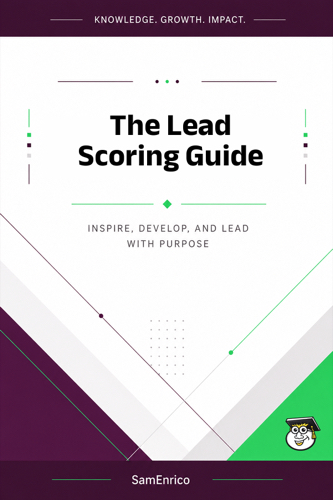
Non-FictionBusiness BriefLead Scoring
The Lead Scoring Guide eBook
Prioritize leads based on engagement and fit for s
Prioritize leads based on engagement and fit for sales follow-up.
Formats
Free sample
Chapter 1: The Million-Dollar Lie--Every sales leader has heard it. Most have said it. Many have built their entire careers around it. The lie sounds so reasonable, so innocent, so obvious that no one ever thinks to question it."More leads equals more sales."It rolls off the tongue like gravity or supply and demand—an immutable law of commercial physics. If you want to grow, you need more leads.
If you're not growing, you're not generating enough leads. The solution is always the same: increase volume. Buy more ads. Run more campaigns. Capture more email addresses.
Fill the top of the funnel until it overflows.And so companies pour millions of dollars into lead generation. They celebrate record-breaking months of "leads generated." They high-five when the CRM hits a new high-water mark. They pat themselves on the back for a job well done.Then they wonder why revenue isn't moving.The 5,000-Lead Disaster Let me tell you about a company I'll call Cloud Sprint. They were a mid-sized B2B Saa S business selling project management software to enterprise teams. In January of 2022, they launched their most ambitious marketing campaign ever: a multi-channel blitz of Linked In ads, Google search, content syndication, and a free webinar series.The results were spectacular.
In thirty days, Cloud Sprint generated 5,182 leads. The marketing team threw a party. The CEO sent a company-wide email celebrating the "demand explosion." The board approved a larger marketing budget for Q2.Here's what happened next.The sales team of twelve account executives was already drowning in their existing pipeline. Now they had five thousand new names to sort through. They tried everything: round-robin assignment, automated email sequences, a team of temporary SDRs brought in just to handle the volume.
Nothing worked.By the end of Q1, Cloud Sprint had closed exactly two deals from those 5,182 leads.Two.The average deal size was $24,000. Total revenue from the campaign: $48,000. Total cost of the campaign, including ads, content production, webinar platform, and temporary SDRs: $187,000.They lost $139,000 on a campaign that generated "more leads than ever before."The problem wasn't the volume. The problem was a concept so fundamental, so elementary, that its absence seems almost absurd: Cloud Sprint had no way of knowing which leads were worth pursuing.They treated every lead identically. The CTO who downloaded a white paper at 2 AM received the same automated sequence as the intern who clicked a Facebook ad by accident.
The qualified buyer from a Fortune 500 company with an active budget waited the same three days for a response as the student doing research for a class project.The marketing team celebrated the number. The sales team suffered the consequences. And the company paid the price.The Fundamental Mistake Cloud Sprint's story is not an outlier. It is the rule.I have consulted with over two hundred companies across Saa S, professional services, manufacturing, financial services, and e-commerce. In nearly every case, the organization was suffering from the same delusion: that lead generation and lead qualification are the same thing.They are not.Lead generation is a volume game.
It answers the question: "How many humans can we get to raise their hand?"Lead qualification is a precision game. It answers the question: "Which of these humans should we actually talk to?"The first requires a budget. The second requires a system. Most companies have the first. Almost none have the second.Here is the uncomfortable truth that the lead generation industry does not want you to hear: The vast majority of leads are not just unqualified—they are actively harmful to your business.Think about what happens when a sales representative spends forty-five minutes on a discovery call with a prospect who has no budget, no authority, and no real need.
That is forty-five minutes they did not spend calling a qualified prospect. That is forty-five minutes of mental energy burned on a dead end. That is forty-five minutes of compounding frustration that slowly erodes their motivation, their confidence, and ultimately, their performance.Bad leads don't just waste time. They demoralize your team. They train your salespeople to expect rejection.
They create a learned helplessness where representatives stop believing that any lead is worth pursuing.And the worst part? The people celebrating the lead volume—usually marketing—are not the ones suffering the consequences. The sales team suffers. The company suffers. But the marketing director gets a bonus for "exceeding lead generation targets."This is the Million-Dollar Lie.
And it is time to expose it.The Two Pillars You've Been Ignoring If more leads do not equal more sales, what does?The answer is deceptively simple and profoundly difficult to execute: prioritization.Not all leads are created equal. Some are ready to buy. Some will be ready in six months. Some will never be ready. Some are actually your ideal customer but don't know it yet.
Some are tire-kickers who will waste infinite time if you let them.Your job is not to treat them all the same. Your job is to sort them into the right buckets and apply the right amount of effort to each bucket.This requires two distinct streams of information about every lead.Stream One: Fit. Does this person or company resemble your best customers? Do they have the budget, authority, need, and timeline that predict a successful, long-term relationship? This is the "who" and "what." It is explicit, declarative, and relatively stable over time.Stream Two: Engagement.
Is this person acting like someone who wants to buy? Are they visiting your pricing page? Opening your emails? Watching your demo videos? Returning to your site multiple times?
This is the "how" and "when." It is implicit, behavioral, and constantly changing.These two streams are independent. A lead can have high fit and low engagement—the perfect customer who is not yet ready. A lead can have low fit and high engagement—the enthusiastic tire-kicker who will never close. A lead can have both—the dream prospect you should call immediately. Or neither—the waste of time you should sunset immediately.Most companies only measure one of these streams.
Many only measure engagement (opens, clicks, form fills) and completely ignore fit. Others only measure fit (job title, company size, industry) and completely ignore the behavioral signals that indicate actual purchase intent.Both approaches fail.You need both. And you need a systematic way to combine them into a single, actionable score that tells you exactly what to do with every lead in your database.That is what this book will teach you.The Situational Buyer vs. The Intrinsic Buyer Before we dive into the mechanics of scoring, we need to understand a deeper distinction that will inform everything that follows. This distinction comes from my analysis of thousands of closed-won and closed-lost deals across multiple industries.There are two fundamentally different types of buyers.The Situational Buyer (The "Broken Furnace").
This prospect has an urgent problem that just emerged. Their furnace broke in the middle of winter. Their website was hacked. Their key employee just quit. They need a solution right now, and they are panicked.The Situational Buyer looks hot.
They respond quickly. They want a demo today. They ask for a proposal by end of week. They seem like…
This is the end of the free sample. Get the eBook to keep going. Buy now
About this book
Details
- Author
- Sauls Maragret
- Publisher
- SamEnrico
- Language
- English
- Genre
- Non-Fiction, Business Brief, Lead Scoring
- Released
- 2026-06-07
- Pages (approx.)
- 149
- Available as
- eBook, Audiobook

Read better in the ZLOADR app
Your eBooks on your phone or tablet. Sign in with your SamEnrico account and start reading.
More by Sauls Maragret
 Burnout and Cardiovascular HealthSauls Maragret$11.99
 Retail Customer Data Breach ScriptsSauls Maragret$11.99
 Workaholic Self Forgiveness ManualSauls Maragret$11.99
 IBS Essential Oil Remedy GuideSauls Maragret$11.99
 The Great Reset: How 2008 Rewrote the Rules of PowerSauls Maragret$11.99
 The Forgotten Navigator: Aku-Shima’s Pacific Odyssey (1760-1770)Sauls Maragret$11.99
 Understanding Circumscribed Cutaneous Aplasia of The VertexSauls Maragret$17.99
 Product Launch Post MortemSauls Maragret$12.99
 Investor Target List BuilderSauls Maragret$12.99
 Microlight FlyingSauls Maragret$11.99
 How to Become a Certification And Selection SpecialistSauls Maragret$11.99
You may also like
 Hong Kong Handover 1997Dunn Johnnie$11.99
 Zumba For Postnatal Recovery CourseNeal Christian$11.99
 Zumba for BeginnersLadner Nikia$11.99
 YouTube Comment Mining GuideHumes Pandora$12.99
 Worry Box MeditationCarlin Rudy$11.99
 Workplace Stress MeditationNguyen Lynn$11.99
 Workplace Stress and Sleep RepairHawley Ivory$11.99
 Workplace Perfectionism CureDelaney Jeffry$11.99
 Workplace Injustice Anger GuideWallen Isabelle$11.99
 Work Addiction and Burnout LinkGreenwood Ester$11.99
 Women in Yoga and WellnessBeattie Galina$11.99
 Women in Stand Up ComedyChun Evangeline$11.99