
Non-FictionSelf-HelpPositive Psychology
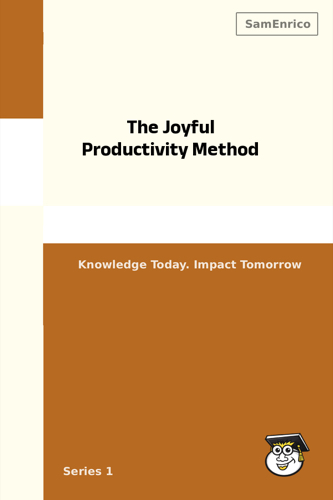
The Joyful Productivity Method eBook
Teaches how to find enjoyment in work tasks as a b
Teaches how to find enjoyment in work tasks as a buffer against burnout and disengagement.
Formats
Free sample
Chapter 1: The Pleasure Paradox...--–- What if the single worst piece of advice you have ever received about work is also the most widely repeated? What if the slogan chanted in corporate boardrooms, engraved on motivational posters, and whispered by well-meaning mentors—“No pain, no gain”—is not merely unhelpful but actively destructive? This chapter will dismantle that myth at its foundation and replace it with a truth that changes everything: joy is not a reward you earn after the work is done. Joy is the fuel that makes the work possible in the first place.For the last two decades, productivity advice has been dominated by a grim arithmetic. The equation looks like this: more hours plus more suffering equals more output.
Push through fatigue. Grind while others sleep. Hustle until it hurts. The implicit promise is that if you suffer enough today, tomorrow you will finally deserve to rest. But here is the devastating irony that the hustle culture never mentions: people who enjoy their work consistently outperform people who hate their work, by every measurable metric.
They produce higher quality output. They make fewer errors. They generate more creative solutions. They stay in their jobs longer. They get promoted faster.
And most importantly for this book’s purpose—they do not burn out.The Pleasure Paradox is the counterintuitive observation that seeking enjoyment in your work is not a distraction from productivity but the single most powerful productivity multiplier available to you. This chapter will introduce the scientific evidence behind that claim, walk you through the personal cost of buying into the “no pain” lie, and set the foundation for everything that follows in this book. By the time you finish reading, you will never look at a “hard work” slogan the same way again.The Mythology of Grinding Before we can build a joyful productivity method, we must first clear away the wreckage of the old model. And the old model is, quite literally, ancient. The idea that suffering builds character and leads to reward appears in virtually every culture’s wisdom traditions.
The Protestant work ethic fused labor with moral virtue. The Industrial Revolution turned human beings into interchangeable machine parts, where fatigue was a design flaw to be overcome, not a signal to be heeded. And in the last twenty years, the rise of startup culture and social media has amplified this myth into a deafening roar.Let us name the core lie explicitly: suffering is not a prerequisite for meaningful achievement. The belief that it is causes measurable harm. Researchers have documented the phenomenon of “grind culture” across multiple industries, from finance to tech to healthcare.
The common thread is an unspoken agreement that long hours, sleep deprivation, and chronic stress are badges of honor. To admit exhaustion is to admit weakness. To prioritize joy is to be unserious. To leave at 5 PM is to lack commitment.This mythology persists for several reasons, none of which hold up under scrutiny. First, there is the survivorship bias problem.
We hear stories of successful people who worked eighty-hour weeks and attribute their success to those hours. We do not hear stories of the thousands who worked eighty-hour weeks and collapsed—into illness, into divorce, into addiction, into early graves. The survivors are visible; the casualties are invisible. Second, there is the pain as proof fallacy. When something is difficult, we assume it must be valuable.
But difficulty and value are not the same thing. Digging a ditch with a spoon is difficult. It is not valuable. Third, there is the deferred life trap. We convince ourselves that if we suffer now, we will enjoy later.
But later never arrives. The suffering becomes a permanent state, and the promised rest recedes like a horizon.The data tells a different story. The most comprehensive study of workplace happiness and productivity, conducted by the University of Oxford’s Saïd Business School, found that happy workers are 13% more productive than their unhappy counterparts. Other studies have pushed that number even higher. A meta-analysis spanning more than 200 separate studies concluded that positive emotions at work correlate with a 31% increase in productivity, a 40% reduction in burnout symptoms, and a 50% decrease in turnover intention.
These are not small effects. These are staggering effects.If you were an investor evaluating two companies, and one had a 31% productivity advantage over the other, which would you fund? If you were an athlete choosing between two training regimens, and one reduced injury risk by 40%, which would you follow? And yet, when it comes to our own work lives, we routinely ignore this evidence in favor of a myth that has never been proven.The Science of Positive Emotions To understand why joy fuels productivity, we need to look under the hood at what positive emotions actually do to the human brain. This is where the late psychologist Barbara Fredrickson enters the story with her Broaden-and-Build Theory, one of the most influential contributions to positive psychology in the last thirty years.Fredrickson observed that negative emotions and positive emotions serve fundamentally different evolutionary purposes.
Negative emotions—fear, anger, anxiety, disgust—narrow your attention. When you are afraid, your brain focuses exclusively on the threat. Your peripheral vision literally constricts. Your working memory shrinks. Your cognitive options reduce to a small set of pre-programmed responses: fight, flee, or freeze.
This is adaptive in a genuine emergency. If a predator is chasing you, you do not want to be creative. You want to run.But here is the problem that the grind culture ignores: your brain cannot distinguish between a predator and a deadline. It cannot tell the difference between a physical threat and an email from your boss. Chronic stress activates the same narrow-focus response, over and over, day after day.
Your brain remains in emergency mode. And when your brain is in emergency mode, it cannot do the kind of work that produces innovation, strategic thinking, or high-quality output. It can only execute routine, habitual, pre-programmed responses. You become a machine that does the same thing faster—not better, not more creatively, not more meaningfully.Positive emotions do the opposite. Fredrickson’s research demonstrated that joy, curiosity, gratitude, and love broaden your cognitive repertoire.
They expand your attention. They increase your working memory. They make you more likely to notice unusual patterns, generate novel solutions, and take in information from peripheral sources. In one famous experiment, participants who watched a short video that induced joy performed significantly better on creative problem-solving tasks than participants who watched a neutral or fear-inducing video. Their brains were literally more flexible.But the “broaden” effect is only half of the theory.
The second half is the build effect. Positive emotions do not just create a temporary state of expanded cognition; they build enduring psychological resources over time. When you experience joy regularly, you accumulate a reservoir of resilience, social connection, and coping skills that outlast the emotion itself. Think of it like exercise. A single workout temporarily elevates your heart rate and mood.
But consistent exercise builds cardiovascular health that persists even when you are not actively working out. Similarly, consistent positive emotions build psychological capital that protects you…
This is the end of the free sample. Get the eBook to keep going. Buy now
About this book
Details
- Author
- Schulz Jenifer
- Publisher
- SamEnrico
- Language
- English
- Genre
- Non-Fiction, Self-Help, Positive Psychology
- Released
- 2026-06-09
- Pages (approx.)
- 140
- Available as
- eBook, Audiobook

Read better in the ZLOADR app
Your eBooks on your phone or tablet. Sign in with your SamEnrico account and start reading.
More by Schulz Jenifer
 CNN Fear Greed IndexSchulz Jenifer$11.99
 Resentment After MistakeSchulz Jenifer$11.99
 Caregiver Stress and TelehealthSchulz Jenifer$11.99
 The Nautical Majesty of the Swahili Kings: Masters of the Indian OceanSchulz Jenifer$11.99
 How to Become a Lumber HandlerSchulz Jenifer$11.99
 UN Mission Support GuideSchulz Jenifer$12.99
 How to Produce Baby and Toddler OuterwearSchulz Jenifer$11.99
 PharmacistSchulz Jenifer$11.99
You may also like
 Hong Kong Handover 1997Dunn Johnnie$11.99
 Zumba For Postnatal Recovery CourseNeal Christian$11.99
 Zumba for BeginnersLadner Nikia$11.99
 YouTube Comment Mining GuideHumes Pandora$12.99
 Worry Box MeditationCarlin Rudy$11.99
 Workplace Stress MeditationNguyen Lynn$11.99
 Workplace Stress and Sleep RepairHawley Ivory$11.99
 Workplace Perfectionism CureDelaney Jeffry$11.99
 Workplace Injustice Anger GuideWallen Isabelle$11.99
 Work Addiction and Burnout LinkGreenwood Ester$11.99
 Women in Yoga and WellnessBeattie Galina$11.99
 Women in Stand Up ComedyChun Evangeline$11.99