
Non-FictionSelf-HelpWeekly Review
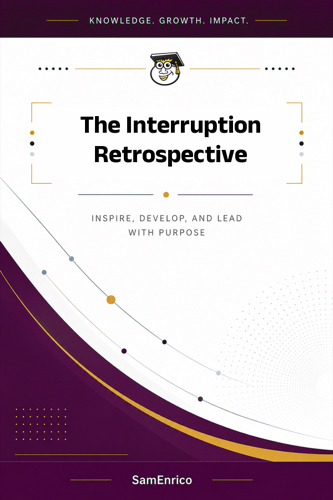
The Interruption Retrospective eBook
Weekly review of interruption log to improve next
by Ramey Elvie
Weekly review of interruption log to improve next week's defenses.
Formats
Free sample
Chapter 1: The Twenty-Three Minute Ghost...--–- It is three o'clock on a Tuesday afternoon, and you have just accomplished something that felt, for a brief and shimmering moment, like genuine progress. You have written two hundred words of a proposal that finally says what you meant to say. You have debugged a single line of code that has been failing for three days. You have balanced three rows of a spreadsheet that refused to add up correctly. Your mind is settled into the kind of focused groove that makes work feel meaningful rather than merely exhausting.
Your breathing has slowed. Your peripheral vision has narrowed. The world outside your screen has faded into a soft blur of unimportant background noise. You are in the flow state that every productivity book promises and that actually arrives, unannounced, perhaps twice a week if you are lucky.Then a Slack notification appears. Or a colleague taps your shoulder.
Or your own rebellious brain whispers a treacherous suggestion: just check the news for one second, just see if anyone replied to your email, just look at the weather for tomorrow. You look away from the screen. You answer the question. You read the headline. Ninety seconds pass, maybe two minutes, certainly no more than three.
You return to your original task, and something strange happens. The words will not come. The code looks like a foreign language you once studied and then forgot. The spreadsheet numbers have lost all meaning. You stare at the screen for what feels like an eternity, scrolling up and down, re-reading sentences you wrote ten minutes ago, trying to claw your way back into the mental space you occupied just two minutes earlier.
This is not a failure of discipline. This is not laziness. This is not a character flaw that requires more coffee or a stricter morning routine. This is the twenty-three minute ghost, and it is stealing far more from you than you realize.The Ghost That Lives Between Tasks Most people believe that interruptions are annoying but essentially harmless. The common assumption runs something like this: a two-minute interruption costs two minutes.
You lose the time you spent answering the question or reading the message, and then you resume your work exactly where you left off. The math is simple, intuitive, and catastrophically wrong. The error in this assumption lies in a concept that researchers call attention residue, first named and systematically studied by Sophie Leroy, a professor of management at the University of Washington Bothell. Leroy's experiments revealed something deeply counterintuitive about the architecture of human attention. When you switch from Task A to Task B, your mind does not make a clean break.
It cannot. The cognitive machinery that allows you to focus deeply on a problem also resists being turned off and on like a light switch.Instead, a portion of your brain remains stuck on Task A, like a drop of water clinging to a glass long after the glass has been poured out. This residue lingers even after you have physically turned away from the original task. It lingers even after you have answered the interruption completely. It lingers even after you have closed the document, switched applications, and started typing in a new window.
And it continues to consume mental energy, reducing your working memory, slowing your processing speed, increasing the likelihood of errors, and creating that awful sensation of wading through mental quicksand.Leroy's research showed that the intensity of attention residue depends on several factors. If you were deeply engaged in Task A, the residue is stronger, because your brain had invested more cognitive resources in maintaining that engagement. If you were close to completing Task A, the residue lingers longer, because your brain was in a state of anticipatory closure that resists disruption. If the interruption came without any warning, the residue is more disruptive, because your brain did not have the opportunity to begin a controlled shutdown of Task A before switching to Task B. In every case, across every study, the cost of switching is never zero.
It is never even small. It is a tax on every transition, collected in milliseconds that add up to minutes that add up to hours.Gloria Mark, a researcher at the University of California, Irvine, has spent more than a decade tracking knowledge workers in their natural environments. Her team equipped hundreds of office workers with sensors and screen recorders, watching them work in real time, second by second, interruption by interruption. The findings are sobering. After an interruption, it takes an average of twenty-three minutes and fifteen seconds to return to the original task with the same level of focus and cognitive engagement that existed before the interruption.
Twenty-three minutes. Not two minutes. Not five minutes. Not even ten minutes. Twenty-three minutes of mental thrashing, re-reading sentences, retracing steps, re-establishing context, and rebuilding the fragile architecture of concentration that the interruption destroyed in a matter of seconds.Let us pause here and do the math together, because the numbers are essential to everything that follows in this book.
If you experience ten interruptions in a single day, and each interruption costs you twenty-three minutes of refocusing time, you have lost nearly four hours to attention residue. That is not the time spent on the interruption itself. That is the time you spend trying to remember where you were, what you were doing, what you were about to think next, and why any of it mattered. Add the actual duration of the interruptions themselves, perhaps another hour across the day, and you have lost half of your working day to the gap between tasks. You are showing up at nine in the morning and effectively clocking out at noon, mentally speaking, while your body remains at the desk until five.
The remaining five hours are not rest. They are not recovery. They are the cognitive equivalent of running a car engine while stuck in traffic, consuming fuel, generating heat, going nowhere.This is the twenty-three minute ghost. It is invisible because you cannot see it. It is invisible because your brain is too busy struggling to notice that it is struggling.
It is invisible because we have collectively agreed to pretend that multitasking is a skill rather than a tax, and that the people who complain about interruptions are simply not tough enough to handle the demands of modern work. The ghost lives in the space between tasks, and it feeds on every transition.The Measurement Blind Spot Here is a second uncomfortable truth, and it is one that every reader should test on themselves before continuing with this chapter. Human beings are remarkably, almost comically bad at estimating how often they are interrupted. In study after study, when knowledge workers are asked to report how many interruptions they experienced in a given day, their estimates are off by a factor of nearly three hundred percent. A person who was interrupted fifty times will report perhaps fifteen.
A person who lost four hours to attention residue will report losing forty-five minutes. A person whose attention was fractured into tiny, useless shards will describe the day as busy…
This is the end of the free sample. Get the eBook to keep going. Buy now
About this book
Details
- Author
- Ramey Elvie
- Publisher
- SamEnrico
- Language
- English
- Genre
- Non-Fiction, Self-Help, Weekly Review
- Released
- 2026-06-08
- Pages (approx.)
- 129
- Available as
- eBook, Audiobook

Read better in the ZLOADR app
Your eBooks on your phone or tablet. Sign in with your SamEnrico account and start reading.
More by Ramey Elvie
 Messner Gasherbrum SoloRamey Elvie$11.99
 Overcoming Workaholism in ExecutivesRamey Elvie$11.99
 The EQ for Chefs GuideRamey Elvie$11.99
 Menachem Mendel SchneersonRamey Elvie$11.99
 Chiropractic for VertigoRamey Elvie$11.99
 Self Hypnosis For Writing FlowRamey Elvie$11.99
 Twelve Step Prison OutreachRamey Elvie$11.99
 Line of Credit ManagementRamey Elvie$11.99
 The Last Broadcast: How a Radio Show Saved Lives During 9/11Ramey Elvie$11.99
 The Sky Dancer of Takao: Japan's Forgotten Winged PioneerRamey Elvie$11.99
 Paddling the Frozen Frontier: The Antarctic Kayak OdysseyRamey Elvie$11.99
 The Mineral Guide to UmbiteRamey Elvie$11.99
You may also like
 Hong Kong Handover 1997Dunn Johnnie$11.99
 Zumba For Postnatal Recovery CourseNeal Christian$11.99
 Zumba for BeginnersLadner Nikia$11.99
 YouTube Comment Mining GuideHumes Pandora$12.99
 Worry Box MeditationCarlin Rudy$11.99
 Workplace Stress MeditationNguyen Lynn$11.99
 Workplace Stress and Sleep RepairHawley Ivory$11.99
 Workplace Perfectionism CureDelaney Jeffry$11.99
 Workplace Injustice Anger GuideWallen Isabelle$11.99
 Work Addiction and Burnout LinkGreenwood Ester$11.99
 Women in Yoga and WellnessBeattie Galina$11.99
 Women in Stand Up ComedyChun Evangeline$11.99