
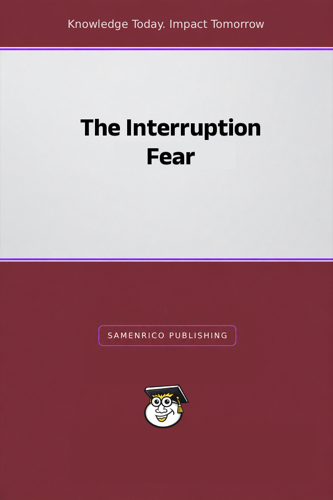
Non-FictionSelf-HelpAssertiveness
The Interruption Fear eBook
Teaches speaking when others talk over you.
by Turner Ora
Teaches speaking when others talk over you.
Formats
Free sample
Chapter 1: The Hidden Contract--–- You are about to learn something that most people never realize: the fear of being interrupted is not a personality flaw. It is not shyness. It is not a lack of confidence. It is a survival mechanism that your brain learned—and it can be unlearned.Every time someone talks over you, something happens inside your body. Your throat tightens.
Your face flushes. Your thoughts, which were clear just a moment ago, suddenly scatter like startled birds. You feel a flash of heat, then a wave of something that feels strangely like shame. And then you stop talking. You tell yourself it doesn't matter.
You tell yourself they wouldn't have listened anyway. You tell yourself that next time, you will speak louder, faster, sooner. But next time comes, and the same thing happens again.This is not weakness. This is biology meeting history.In this chapter, we are going to dismantle the psychology of interruption piece by piece. You will learn why being cut off feels like a physical violation, not just a social annoyance.
You will trace the origins of your personal silencing story—the moments in your past that taught your nervous system to anticipate being shut down. And you will meet the three types of interrupters who populate your world, so that you can begin to see them clearly, without the fog of personal injury.By the end of this chapter, you will understand that your fear is not the enemy. It is a signal. And signals can be read, interpreted, and eventually, overridden.The Hidden Conversation No One Told You About Every conversation is actually two conversations. The first is the surface exchange—the words, the facts, the back-and-forth of information.
This is the conversation everyone sees. But beneath it, running parallel like a underground river, is the Hidden Conversation. This is the internal dialogue about identity, respect, and belonging. It is where you silently ask yourself: Do they see me as competent? Do I matter in this room?
Am I allowed to take up space?When you are interrupted, the surface conversation is disrupted. But the Hidden Conversation is shattered.This distinction comes from the groundbreaking work on difficult conversations, which revealed that most conflicts are not about the surface disagreement at all. They are about the identities we feel are being threatened. When someone talks over you, your brain does not process it as a simple turn-taking violation. It processes it as a verdict on your worth.
The message you receive—whether or not it is intended—is: What you are saying is not as important as what I have to say. You do not deserve the floor. You are secondary here.That is why a single interruption can ruin your entire day. It is not the lost ten seconds of speaking time. It is the identity wound.Think about the last time you were interrupted in a meeting.
What was the first thought that ran through your head? Not the rational thought you told yourself afterward, but the split-second flash before you could filter it. Perhaps it was: See? They don't respect you. Or: You should have known better than to speak.
Or: Just stop. It's not worth it.That flash is the Hidden Conversation. And it has been running for a very long time.The Identity Story: Where Your Silence Began You were not born afraid of being interrupted. Infants have no such fear. They cry, they coo, they demand attention without a moment's hesitation.
The fear of being silenced is learned. And it is learned through a series of moments that stack on top of each other like stones, eventually building a wall between you and your own voice.Psychologists call this your "Identity Story"—the narrative you carry about who you are in relation to other people. This story is not written by you alone. It is co-authored by every significant person who has ever responded to your voice.For some readers, the story began in childhood. Perhaps you had a parent who was always busy, always distracted, who waved you away with a "Not now, I'm working." Perhaps you had a sibling who was louder, funnier, more charismatic, and you learned that trying to compete was futile.
Perhaps you were the quiet one, praised for being "so well-behaved" precisely because you did not demand attention. And so you learned: My voice is an imposition. Silence is safety.For others, the story was written in school. You raised your hand, but the teacher called on someone else. You gave an answer, and a classmate laughed.
You started a sentence, and the popular kid finished it—incorrectly, mockingly. You learned: Speaking is risky. It is better to be right and silent than wrong and loud.For many readers, especially those in marginalized groups, the story is written in the workplace. Women are interrupted three times more often than men in professional settings, according to research from Georgetown and George Washington universities. People of color report being talked over at nearly twice the rate of their white colleagues.
Non-native English speakers describe the exhausting calculus of waiting for the perfect moment to speak—only to have that moment never arrive. The message is systemic: You do not automatically have the floor. You must earn it, fight for it, or accept that it will not be given.And for almost everyone, the story is reinforced daily in meetings, on calls, at dinner tables, and in group texts. Each interruption adds another stone to the wall. Each silenced sentence thickens the belief that speaking is not worth the cost.Here is what you need to understand: that story is not the truth.
It is a pattern. And patterns can be broken.The Biology of Being Silenced Before we go any further, let us look at what actually happens inside your body when someone talks over you. This is not psychology. This is physiology. And understanding it is the first step to overriding it.When you are speaking and someone cuts you off, your brain detects a social threat.
From an evolutionary perspective, being excluded from a conversation—especially a conversation that affects resources, status, or group belonging—was a genuine danger to survival. Your brain does not know the difference between being interrupted in a boardroom and being shunned from the tribe. It reacts the same way.The amygdala, the brain's alarm system, sounds the alert. In less than a second, it signals the hypothalamus to release a cascade of stress hormones—cortisol and adrenaline. Your heart rate spikes.
Your breathing becomes shallow. Blood rushes away from your prefrontal cortex (the rational, planning part of your brain) and toward your limbs, preparing you to fight, flee, or freeze.This is the Amygdala Hijack. And it explains everything about why you cannot think clearly after being interrupted.You are not stupid. You are not slow. You are flooded.
Your executive function has been temporarily overridden by a survival response that evolved hundreds of thousands of years ago. In that moment, you cannot access the clever comeback, the calm re-assertion, the graceful "Let me finish" that you practiced in your head.…
This is the end of the free sample. Get the eBook to keep going. Buy now
About this book
Details
- Author
- Turner Ora
- Publisher
- SamEnrico
- Language
- English
- Genre
- Non-Fiction, Self-Help, Assertiveness
- Released
- 2026-06-10
- Pages (approx.)
- 137
- Available as
- eBook, Audiobook

Read better in the ZLOADR app
Your eBooks on your phone or tablet. Sign in with your SamEnrico account and start reading.
More by Turner Ora
 The Stress Free Apology MethodTurner Ora$11.99
 Listening In User ResearchTurner Ora$11.99
 Energizing Breath AwarenessTurner Ora$11.99
 Policy Change for Mental HealthTurner Ora$11.99
 Dream Journal for BeginnersTurner Ora$11.99
 Appreciation Meditation for SleepTurner Ora$11.99
 The Footprints on the TrailTurner Ora$11.99
 Lionel Messi GeniusTurner Ora$11.99
 The Whispering Wilds: The Lost Journals of Dr. James Africanus Beale HortonTurner Ora$11.99
 Montcalm's Gambit: The Engineer Who Shaped the Fate of North AmericaTurner Ora$11.99
 Pillars of Greed: The Johnson & Johnson Baby Powder ScandalTurner Ora$11.99
 How to Start a Hobby in ElectronicsTurner Ora$11.99
You may also like
 Hong Kong Handover 1997Dunn Johnnie$11.99
 Zumba For Postnatal Recovery CourseNeal Christian$11.99
 Zumba for BeginnersLadner Nikia$11.99
 YouTube Comment Mining GuideHumes Pandora$12.99
 Worry Box MeditationCarlin Rudy$11.99
 Workplace Stress MeditationNguyen Lynn$11.99
 Workplace Stress and Sleep RepairHawley Ivory$11.99
 Workplace Perfectionism CureDelaney Jeffry$11.99
 Workplace Injustice Anger GuideWallen Isabelle$11.99
 Work Addiction and Burnout LinkGreenwood Ester$11.99
 Women in Yoga and WellnessBeattie Galina$11.99
 Women in Stand Up ComedyChun Evangeline$11.99