
Non-FictionBiographyElectric Vehicles
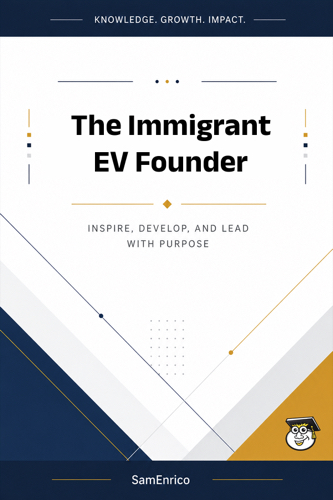
The Immigrant EV Founder eBook
Chronicles a foreign-born engineer who built an el
Chronicles a foreign-born engineer who built an electric vehicle startup challenging Tesla.
Formats
Free sample
Chapter 1: The Scarcity Algorithm...--The first time Arjun Mehta rebuilt a motor, he was nine years old, and his father told him he had wasted an afternoon that could have been spent studying mathematics.The motor belonged to a ceiling fan. It was a standard 1200-millimeter model from Crompton Greaves, made in 1992, and it had served the Mehta family for eleven years before the copper winding burned out. A replacement fan cost 2,400 rupees. A replacement motor cost 1,800 rupees. A spool of copper wire cost 400 rupees.
Arjun’s mother, Meena, did the math silently while looking at the family’s monthly budget. Then she looked at her son.“Can you fix it?” she asked.Arjun had never fixed a motor. He had never held a soldering iron. He had watched exactly three You Tube videos on a neighbor’s smartphone, buffering over a 2G connection, each video taking twenty minutes to load. But he understood something that most nine-year-olds did not: the fan was already broken.
If he tried to fix it and failed, they would buy a new fan. If he did nothing, they would also buy a new fan. There was no downside to attempting the impossible.“Yes,” he said. “I can fix it.”That single word—yes—would become the most expensive word of his life. It would cost him sleep, money, dignity, and nearly his right to remain in the United States.
But it would also build a company valued at fourteen billion dollars, create two thousand five hundred jobs in a dying Ohio steel town, and force the global automotive industry to reconsider what a car was supposed to cost.He did not know any of that when he unscrewed the fan’s housing and stared at the charred remnants of its copper winding. He only knew that he had promised his mother something, and now he had to figure out how to keep that promise.The City of Iron Jamshedpur, India, is not a place that produces dreamers. It produces welders, metallurgists, truck drivers, and shop-floor supervisors. It produces people who can look at a broken axle and tell you exactly what torque specification was violated, down to the newton-meter. It does not produce billionaires.The city was built by Jamsetji Tata in 1907, a planned industrial utopia of steel plants and company housing.
Every family in Jamshedpur has someone who works at Tata Steel or one of its subsidiaries. The air smells of iron and coal smoke. The streets are named after British colonizers and Indian industrialists in equal measure. The school curriculum emphasizes mathematics and physics because those are the subjects that lead to engineering degrees, and engineering degrees lead to jobs at the plant, and jobs at the plant lead to pensions, and pensions lead to a dignified old age.Arjun’s father, Vijay Mehta, was a shop-floor supervisor at the Tata Motors truck plant. He had started as a line worker in 1985, worked twelve-hour shifts for seventeen years, and eventually been promoted to a position that required him to wear a tie twice a week.
Vijay did not dream of anything larger than a modest house in the company quarter, a reliable scooter, and a retirement party where his colleagues would say he was a fair man.He did not understand his son.“You take things apart too much,” Vijay said, watching Arjun spread the ceiling fan’s components across the living room floor. “Why can’t you leave things as they are?”“Because things break,” Arjun said. “And if I don’t fix them, they stay broken.”“That’s what repairmen are for.”“Repairmen cost money we don’t have.”Vijay fell silent. This was the argument he could never win: the brutal arithmetic of the Mehta household budget. Vijay earned 18,000 rupees per month—about three hundred dollars at the exchange rate of the time.
Meena earned another 8,000 rupees teaching mathematics at the local government school. Together, they supported two children, one aging mother-in-law, and a savings account that never seemed to grow. Every broken appliance was a crisis. Every medical expense was a negotiation with fate.Arjun learned this arithmetic before he learned long division. He learned that a leaking pipe was not an emergency—it was an opportunity to learn plumbing from a You Tube video.
He learned that a dead battery was not a trip to the shop—it was a chance to revive it with distilled water and a slow charge. He learned that the difference between poverty and comfort was often a single skill: the ability to repair what others would replace.This is the first lesson of the Scarcity Algorithm, though Arjun would not name it for another thirty years: When you cannot afford to buy a new part, you learn to understand the old part better than the person who designed it.The Wobble The ceiling fan took him three days.Day one: Arjun removed the motor casing, identified the burned winding, and measured the gauge of the copper wire using a caliper borrowed from a neighbor who worked at the steel plant. He wrote the measurement on his forearm because he did not have a notebook.Day two: He walked forty-five minutes to the electrical supply market in Sakchi, the commercial district of Jamshedpur, and bought two hundred grams of enameled copper wire for 380 rupees. The vendor tried to sell him a pre-wound coil for 1,200 rupees. Arjun declined.
He had done the math: the raw wire was cheaper by a factor of three, and he had time but not money.Day three: He rewound the stator. This was the hardest part. He had to wrap the copper wire around the iron core in a precise pattern—twenty-four slots, each requiring exactly fifty-three turns of wire, each turn laid flat against the previous one to prevent short circuits. His fingers blistered. His eyes crossed from focusing on the fine wire.
He made a mistake on slot fourteen and had to unwind everything and start again.At 7:32 PM, he finished. He reassembled the motor, mounted it back on the fan, and flipped the switch.The fan spun. It was not smooth. It had a wobble, a slight oscillation that made the housing rattle against the ceiling. But it moved air.
It worked.His mother looked at the spinning fan, then at her son. “It wobbles,” she said.“I know.”“Can you fix the wobble?”“I can try.”“Then try.”The wobble took another two days. Arjun learned that the oscillation came from an imbalance in the winding: he had inadvertently wrapped slot fourteen with fifty-four turns instead of fifty-three, creating a micro-discrepancy in the magnetic field. He unwound slot fourteen, rewound it correctly, and the wobble disappeared.His mother did not praise him. She simply turned on the fan and went back to grading math homework.
But the next morning, when Arjun came down for breakfast, the fan was running. His mother had left it on all night, testing it. It was still running.His father said nothing. But that evening, Vijay came home with a broken toaster from the factory break room. “See if you can fix this,” he said, and walked away.The Hierarchy of…
This is the end of the free sample. Get the eBook to keep going. Buy now
About this book
Details
- Author
- Mooney Tennille
- Publisher
- SamEnrico
- Language
- English
- Genre
- Non-Fiction, Biography, Electric Vehicles
- Released
- 2026-06-11
- Pages (approx.)
- 141
- Available as
- eBook, Audiobook

Read better in the ZLOADR app
Your eBooks on your phone or tablet. Sign in with your SamEnrico account and start reading.
More by Mooney Tennille
 C 2 Greyhound PilotMooney Tennille$11.99
 Instant Pot Meal PrepMooney Tennille$11.99
 Ideation Methods HandbookMooney Tennille$11.99
 Overcoming Loneliness Without PetsMooney Tennille$11.99
 Writer Morning RoutineMooney Tennille$11.99
 Resilience for LawyersMooney Tennille$11.99
 Focus Commitment DeviceMooney Tennille$11.99
 The Iron Will of Eddie Arcaro: How a Jockey Mastered the Mind Game of Horse RacingMooney Tennille$11.99
 How to Produce Laundry AppliancesMooney Tennille$11.99
 Service Providers Guide to Directory PublishingMooney Tennille$11.99
 How to Produce Video Camera LensesMooney Tennille$11.99
 A Collector's Handbook to the Marmon Big EightMooney Tennille$11.99
You may also like
 Hong Kong Handover 1997Dunn Johnnie$11.99
 Zumba For Postnatal Recovery CourseNeal Christian$11.99
 Zumba for BeginnersLadner Nikia$11.99
 YouTube Comment Mining GuideHumes Pandora$12.99
 Worry Box MeditationCarlin Rudy$11.99
 Workplace Stress MeditationNguyen Lynn$11.99
 Workplace Stress and Sleep RepairHawley Ivory$11.99
 Workplace Perfectionism CureDelaney Jeffry$11.99
 Workplace Injustice Anger GuideWallen Isabelle$11.99
 Work Addiction and Burnout LinkGreenwood Ester$11.99
 Women in Yoga and WellnessBeattie Galina$11.99
 Women in Stand Up ComedyChun Evangeline$11.99