
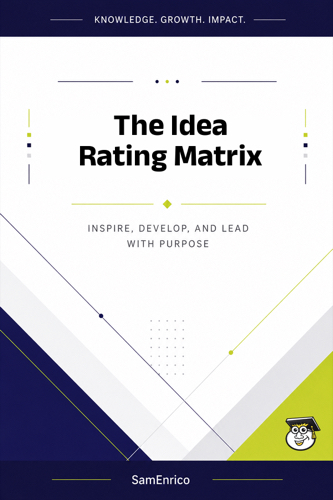
Non-FictionSelf-HelpDecision Making
The Idea Rating Matrix eBook
Team tool for evaluating creative concepts on impa
Team tool for evaluating creative concepts on impact and feasibility.
Formats
Free sample
Chapter 1: The Whiteboard Graveyard...–- The conference room smelled of stale coffee and desperation. On the whiteboard, forty-seven sticky notes clung to the surface like desperate survivors on a life raft. Each one represented an idea—some scribbled in frantic Sharpie, others typed and printed with careful precision. The team had spent three hours generating them, fueled by pizza and the manic energy that comes before a deadline. Now came the question that silenced the room: “Which one do we do first?”No one answered.
The product manager looked at the engineers. The engineers looked at the designers. The designers looked at the floor. Forty-seven ideas, and not a single person willing to make the first cut.This scene plays out every day in offices around the world. The whiteboard becomes a graveyard—not because the ideas are bad, but because the team lacks a system to separate the gold from the gravel.
Creativity without a decision framework is not innovation. It is chaos wearing a clever disguise.The Paradox of Plenty In 2000, psychologists Sheena Iyengar and Mark Lepper conducted a now-famous experiment at a California grocery store. They set up a tasting booth for gourmet jams. On some days, they offered customers a selection of six jams. On other days, they offered twenty-four.
The booth with six jams attracted fewer customers, but those who stopped were ten times more likely to make a purchase than those who faced the twenty-four-jam display.The researchers concluded that more choice does not lead to better decisions. It leads to paralysis, regret, and ultimately, inaction. They called this the “paradox of choice.”Ideas work the same way. A team with three options moves quickly. A team with thirty options freezes.
The brain, faced with an abundance of possibilities, defaults to safety—or worse, to the loudest voice in the room.Consider the startup that spent six months debating two feature ideas. Two! Not forty-seven. Two. They could not decide whether to build a chat feature or a search feature.
They ran surveys, held meetings, commissioned market research. In the end, they built neither. A competitor launched both features in eight weeks and ate their lunch.The problem was not a lack of data. The problem was a lack of structure for interpreting that data. They had no matrix, no scoring system, no common language for comparing one idea against another.
Every opinion carried equal weight, which meant no opinion carried enough.The Three Killers of Good Decisions Before we introduce the solution, we must understand the disease. Three forces consistently sabotage team decision-making. Recognize them, and you are halfway to curing them.Killer One: Hi PPO Syndrome In the jungles of corporate life, the Hi PPO reigns supreme. Hi PPO stands for the Highest Paid Person’s Opinion. It is not a formal role, but its influence is absolute.
When the senior vice president says, “I think we should pursue this,” the conversation ends. Junior team members nod. Engineers suppress their concerns. Designers abandon their user research. The idea moves forward not because it is the best, but because disagreeing carries a cost.I have watched a Hi PPO kill a superior idea in under thirty seconds.
The scene is always the same. A junior team member presents data. The Hi PPO listens, nods, and says, “Interesting. But I’ve been doing this for twenty years, and I think…”The data does not stand a chance.Hi PPO syndrome is not malice. It is human nature.
We defer to authority because authority has historically kept us safe. But in creative work, authority is a terrible predictor of success. The best ideas rarely come from the person with the most impressive title. They come from the person who has spent the most time with the problem.Killer Two: Groupthink In 1961, President John F. Kennedy and his advisors planned the Bay of Pigs invasion.
The plan was flawed, the intelligence was shaky, and several advisors had private doubts. But no one spoke up. The group was cohesive, confident, and completely wrong. The invasion failed spectacularly.The psychologist Irving Janis, who studied this disaster, coined the term “groupthink.” It occurs when a team values harmony over honesty. Members self-censor to avoid conflict.
They pressure dissenters to conform. They collectively rationalize away warning signs. The result is a decision that no one individually believes in but everyone collectively supports.Whiteboard sessions are breeding grounds for groupthink. The first person to speak sets the tone. If the first opinion is enthusiastic, everyone else suppresses their skepticism.
If the first opinion is skeptical, everyone else suppresses their excitement. The team converges not on the truth, but on whatever emerged first.Killer Three: The Ownership Trap Humans are irrational about their own ideas. In a famous experiment, researchers asked participants to estimate the value of a coffee mug. Some participants were given the mug and asked how much they would sell it for. Others were asked how much they would pay to buy it.
The mug owners demanded roughly twice as much as the buyers were willing to pay.This is the “endowment effect.” We overvalue what we already possess. The same applies to ideas. The person who suggested an idea believes it is brilliant. The person who did not is skeptical. Neither is objective.
Both are trapped by ownership.Now imagine a whiteboard with forty-seven sticky notes. Each note has an owner—the person who wrote it. Every suggestion for eliminating a note is taken as a personal attack. The team spends hours defending notes, not evaluating them. The decision process becomes a negotiation, not an investigation.Why Brainstorming Fails Without a Follow-Through Alex Osborn, the advertising executive who invented brainstorming in the 1940s, had a rule.
He called it “defer judgment.” During the idea generation phase, no one is allowed to criticize or evaluate. The goal is quantity, not quality. Judgment comes later.Osborn was right about one thing: generation and evaluation must be separate. But he assumed that the evaluation phase would naturally follow. In practice, it rarely does.
Teams generate enthusiastically and then… stop. They have no structured method for the second half of the process.The result is what I call the “Whiteboard Graveyard.” Ideas are born with fanfare and then abandoned to the conference room wall. Weeks pass. The sticky notes curl at the edges. Eventually, an admin removes them during a cleaning.
No decision is ever made.A friend of mine worked at a Fortune 500 company that prided itself on innovation. They held quarterly “idea jams” where employees submitted hundreds of concepts. The best ideas won prizes. Then nothing happened. The ideas went into a spreadsheet and never emerged.
After three years, employees stopped participating. They had learned that their ideas went to die.The problem was not a lack of creativity. It was a lack of closure. The company had no system for moving from idea to action. They had a generator but no filter, no matrix, no decision framework.The Cost of Not Choosing Every hour spent debating which idea to pursue is an hour not spent building anything.
The cost of indecision is not neutral. It is negative. While you deliberate, your competitors act. While you run surveys…
This is the end of the free sample. Get the eBook to keep going. Buy now
About this book
Details
- Author
- Burkett Cleveland
- Publisher
- SamEnrico
- Language
- English
- Genre
- Non-Fiction, Self-Help, Decision Making
- Released
- 2026-06-09
- Pages (approx.)
- 136
- Available as
- eBook, Audiobook

Read better in the ZLOADR app
Your eBooks on your phone or tablet. Sign in with your SamEnrico account and start reading.
More by Burkett Cleveland
 Academic Stress Reduction GuideBurkett Cleveland$11.99
 The Gacy Victim AutopsiesBurkett Cleveland$11.99
 Diamond Heist Tool Kit RevealedBurkett Cleveland$11.99
 Memory Pegs for LanguagesBurkett Cleveland$11.99
 Retirement Assets RemarriageBurkett Cleveland$11.99
 Bipolar Substance Use Dual GuideBurkett Cleveland$11.99
 Adenomyosis Period ReliefBurkett Cleveland$11.99
 RLS Sleep Study GuideBurkett Cleveland$11.99
 Silent Echoes of the Silk Road: The Lost Caravans of SerindiaBurkett Cleveland$11.99
 The Unbreakable Streak: How Cal Ripken Jr. Defied the OddsBurkett Cleveland$11.99
 The Grand Banquet of the Iron Masters: Brunel, Stephenson, and the Railway RevolutionBurkett Cleveland$11.99
 The Dancer's Guide to KarsilamaBurkett Cleveland$11.99
You may also like
 Hong Kong Handover 1997Dunn Johnnie$11.99
 Zumba For Postnatal Recovery CourseNeal Christian$11.99
 Zumba for BeginnersLadner Nikia$11.99
 YouTube Comment Mining GuideHumes Pandora$12.99
 Worry Box MeditationCarlin Rudy$11.99
 Workplace Stress MeditationNguyen Lynn$11.99
 Workplace Stress and Sleep RepairHawley Ivory$11.99
 Workplace Perfectionism CureDelaney Jeffry$11.99
 Workplace Injustice Anger GuideWallen Isabelle$11.99
 Work Addiction and Burnout LinkGreenwood Ester$11.99
 Women in Yoga and WellnessBeattie Galina$11.99
 Women in Stand Up ComedyChun Evangeline$11.99