
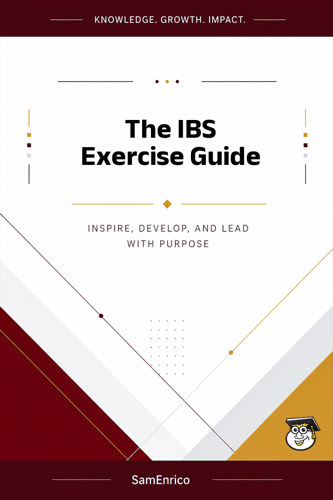
The IBS Exercise Guide eBook
Use physical activity to improve motility and redu
Use physical activity to improve motility and reduce stress related flares.
Formats
Free sample
Chapter 1: Beyond the Plate--For years, you have been told that your irritable bowel syndrome is primarily a food problem. You have eliminated gluten, dairy, onions, garlic, apples, and half a dozen other foods that well-meaning articles and well-meaning doctors have pointed to as the villains. You have kept food diaries so detailed that they could be submitted as evidence in a court of law. You have tried low-FODMAP diets, high-fiber diets, no-fiber diets, gluten-free diets, sugar-free diets, and at least one diet that required you to drink something that looked like swamp water and tasted like regret. And yet, here you are, still bloated, still cramping, still rushing to find a bathroom at the worst possible moments, or still sitting on that same toilet for forty-five minutes praying for something—anything—to move.The hidden truth that the diet industry does not want you to know is this: IBS is not primarily a digestive disease.
It is a disease of the gut-brain axis, a disorder of communication between your central nervous system and your enteric nervous system—the so-called "second brain" that lines your digestive tract. Food triggers are real, yes. You probably have several of them, and learning to manage them is important. But food triggers are the messengers, not the root cause. The root cause, in the vast majority of cases, is one of two things: a motility problem or a stress reactivity problem.
Most people with IBS have both, in varying proportions.This book makes a radical proposition: what if the most powerful medicine for your gut is not another elimination diet, but something you already know how to do, something that costs nothing, something that has no negative side effects when done correctly? That medicine is physical activity. Not punishing workouts, not marathon training, not high-intensity interval classes that leave you gasping on a rubber mat. But strategic, symptom-specific, scientifically-grounded movement designed to either wake up a lazy gut or calm down a hyper-reactive one.Let me tell you about Sarah. Sarah came to me after twelve years of IBS-D, the diarrhea-predominant type.
She had seen four gastroenterologists, two naturopaths, an acupuncturist, and a chiropractor who claimed he could realign her digestive energy meridians through her left ankle. She had done the low-FODMAP diet three times, each time with less success. She was terrified of eating in restaurants, terrified of long car rides, terrified of the thirty-minute subway commute to her job as a high school teacher. She was also terrified of exercise, because every time she tried to jog or take a spin class, she ended up sprinting to the bathroom within fifteen minutes. Her doctors told her to keep exercising anyway.
It is good for stress, they said. So she did, and she kept having accidents, and eventually she stopped exercising altogether. She gained weight, her energy plummeted, and her anxiety about her gut became so severe that she was diagnosed with panic disorder.Sarah's story is not unusual. It is, in fact, the story of millions of people with IBS who have been failed by conventional advice. The conventional approach says: eat less of the foods that bother you, exercise more for general health, and take these antispasmodics or antidepressants for the symptoms.
But this approach ignores the fundamental question: what type of exercise, for what type of IBS, at what intensity, at what time of day, in relation to meals, and with what modifications for flare days?When Sarah and I finally sat down and created a movement protocol tailored to her specific subtype—IBS-D with stress-predominant triggers—everything changed. We started not with jogging, but with supine breathing exercises that she could do lying on her bedroom floor. We added a five-minute walking protocol that she did only on days when her morning heart rate variability was in the green zone. We built in explicit permission to stop at any time, without guilt, without shame, without the toxic voice of the no pain, no gain culture. Within three weeks, she was able to walk for twenty minutes without urgency.
Within eight weeks, she tried a gentle yoga class for the first time in years. Within twelve weeks, she jogged for ten consecutive minutes—not because she had to, but because she wanted to. Her panic attacks stopped. Her reliance on antidiarrheal medication dropped by seventy percent. She still had bad days, because IBS does not disappear entirely.
But she was no longer controlled by her gut. She had become the expert on her own body.You can have this same transformation. Not because you are special, though you are, but because the physiology of IBS follows predictable patterns. The gut responds to movement in ways that are measurable, repeatable, and teachable. When you understand the two targets—motility and stress reactivity—you can choose the right tool for the right job.The Two Root Causes of IBS That No One Told You About Let us begin with a fundamental distinction that will guide everything in this book.
If you remember nothing else from this chapter, remember this: there are two separate problems that cause IBS symptoms, and they require two separate solutions.Mechanical Motility refers to the physical movement of stool through your intestines. Your colon is a long, muscular tube lined with smooth muscle that contracts in rhythmic waves called peristalsis. These waves are generated by an electrical pacemaker system similar to the one in your heart, but much slower. In a healthy gut, these waves move stool from the small intestine through the colon and into the rectum at a steady pace. In IBS with constipation, those waves are too weak, too slow, or too disorganized.
Stool sits in the colon for too long, water is reabsorbed excessively, and what should be soft becomes hard, dry, and difficult to pass. In medical terms, this is called slow transit constipation, and it affects approximately one-third of people with IBS.Neurological Motility is something else entirely. This refers to the brain's ability to regulate the sensitivity of the gut. Your gut contains more nerve endings than your spinal cord. These nerves are constantly sending signals to your brain about what is happening inside your digestive tract: gas is accumulating, stool is moving, the stomach is stretching.
In a healthy person, most of these signals never reach conscious awareness. In a person with IBS, the brain-gut axis becomes hypersensitized. Normal amounts of gas feel like painful bloating. Normal peristalsis feels like cramping. The brain interprets neutral signals as threats, and it responds by activating the sympathetic nervous system—the fight-or-flight response—which then causes more gut symptoms, which then cause more brain activation, which then causes more symptoms.
This is the infamous IBS feedback loop, and it is hell to escape without the right tools.Here is where it gets complicated, and where most self-help books get it wrong. Some people have primarily a mechanical motility problem. These are the IBS-C patients who can go three, four, five days without a bowel movement, who feel constantly full and bloated, who get partial relief from laxatives but hate the cramping they cause. Other people have primarily a neurological motility problem. These are the IBS-D…
This is the end of the free sample. Get the eBook to keep going. Buy now
About this book
Details
- Author
- Wadsworth Jordan
- Publisher
- SamEnrico
- Language
- English
- Genre
- Non-Fiction, Health & Wellness, Exercise
- Released
- 2026-06-12
- Pages (approx.)
- 141
- Available as
- eBook, Audiobook

Read better in the ZLOADR app
Your eBooks on your phone or tablet. Sign in with your SamEnrico account and start reading.
More by Wadsworth Jordan
 Maternal Rage and Recovery PrimerWadsworth Jordan$11.99
 DBT Online Course GuideWadsworth Jordan$11.99
 Active Listening For UX ResearchersWadsworth Jordan$11.99
 The Maria Goeppert Mayer ShellWadsworth Jordan$11.99
 The Merger That Shook the World: How a 19th-Century Corporate Marriage Created Modern CapitalismWadsworth Jordan$11.99
 India Customer Support BPO GuideWadsworth Jordan$12.99
 Central African Payment ChannelsWadsworth Jordan$12.99
 Understanding Thomas–jewett–raines SyndromeWadsworth Jordan$17.99
 How to Start a Door Frames Made of Wood Business (Beginners Guide)Wadsworth Jordan$11.99
 ProfessorWadsworth Jordan$11.99
You may also like
 The Winter Exercise SAD GuideLoomis Thanh$11.99
 Endometriosis and ExerciseWhitman Dusty$11.99
 IBS Exercise Protocol GuideJustus Sunday$11.99
 Exercise For GADChilders Terica$11.99
 The Cardio Exercise ED GuideRivas Ressie$11.99
 Shift Work Exercise Timing GuideSlocum Jona$11.99
 Menopause Exercise PrescriptionHolder Delmer$11.99
 Exercise as Antidepressant GuideStaley Yuri$11.99
 The Exercise Adrenal GuideCloud Ethelene$11.99
 Mediterranean and ExerciseGarvin Annamae$11.99
 IBS Exercise Guidelines HandbookBolin Alisia$11.99
 Winter Exercise for MoodNew Leeanna$11.99