
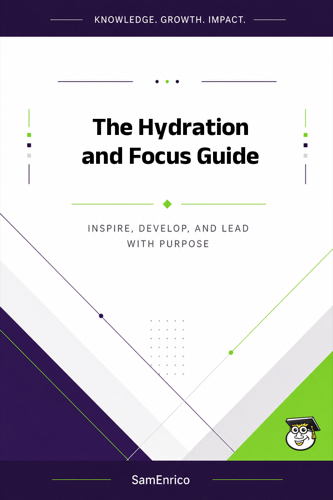
The Hydration and Focus Guide eBook
Stay hydrated to maintain concentration and mental
by Mathias Mel
Stay hydrated to maintain concentration and mental clarity.
Formats
Free sample
Chapter 1: The Silent Epidemic--–- The morning sun streams through your window, and you’ve already had two cups of coffee. You’ve checked your email, reviewed your calendar, and prepared for the day ahead. But by 10:30 AM, a familiar fog descends. Your thoughts feel sluggish. Words don’t come easily during that conference call.
The spreadsheet that should take twenty minutes has stretched into an hour. You tell yourself you didn’t sleep well, or that this project is particularly demanding, or that you’re just “not a morning person.” You reach for another coffee. You power through. And you never once consider that the problem might be simpler than you imagine: you are dry.This is the silent epidemic of mild dehydration. It is the most common, most overlooked, and most fixable cause of poor focus in the modern world.
And almost no one is talking about it.We live in an era of extraordinary cognitive demands. Knowledge workers juggle multiple streams of information, switch tasks every few minutes, and are expected to produce creative, high-stakes output on demand. Students sit for hours of examinations. Executives make decisions that affect hundreds of people. Yet the average person walks through their day in a state of constant, low-grade dehydration—and mistakes the symptoms for something else entirely.The truth is that you are not lazy, distracted, or unfocused.
You are simply underhydrated. And the solution costs almost nothing, requires no special equipment, and can be implemented starting with your very next sip of water.The 2% Rule: Your Brain on Empty Let’s begin with a fact that sounds alarming because it is: losing just 1-2% of your body weight in water triggers measurable brain shrinkage, elevates stress hormones, and impairs cognitive performance. This is called the 2% Rule, and it is one of the most replicated findings in the science of hydration and cognition.To understand what this means in practical terms, consider a person who weighs 150 pounds. Two percent of that is three pounds. Water weighs approximately one pound per pint.
So losing just three pints of water—48 ounces—is enough to push you across this threshold. Now consider how easily this happens. You lose water constantly through breathing, sweating, and waste elimination. Overnight, while you sleep, you lose approximately 16-24 ounces through insensible losses alone. A morning workout can easily add another 16-32 ounces.
Sitting in a dry, air-conditioned office for four hours can strip another 8-12 ounces. By the time you feel thirsty, you may already be down 32-48 ounces—well into the danger zone.What happens inside your brain at this level of dehydration is dramatic. Magnetic resonance imaging studies show that brain tissue actually shrinks away from the skull when fluid levels drop. This mechanical change affects everything from neurotransmitter release to neural firing speed. Your neurons, which are normally plump and efficient like grapes, become shriveled and slow like raisins.
We will explore this “grape to raisin” transformation in detail in Chapter 2. For now, understand this: a dehydrated brain is a slower brain.But the physical changes are only part of the story. Dehydration also triggers a hormonal stress response. Cortisol—the body’s primary stress hormone—rises significantly even with mild fluid loss. Elevated cortisol impairs memory formation, reduces impulse control, and makes it harder to regulate emotions.
This is why you become irritable during afternoon slumps. This is why small frustrations feel overwhelming when you’re tired. Your brain is not betraying you; it is under chemical siege from dehydration.Symptoms vs. Signs: What Your Body Is Telling You One of the greatest challenges in recognizing dehydration is that the body’s warning system is evolutionarily outdated. Thirst is a late signal.
By the time you feel thirsty, you are already dehydrated. This mismatch exists because our ancestors lived in environments where water was scarce and the sensation of thirst needed to be strong enough to motivate action. Today, we live surrounded by clean drinking water, but our bodies still operate on ancient programming.This means that most people walk around in a state of mild dehydration without ever feeling thirsty. Instead, they experience a constellation of symptoms that they attribute to other causes. Let’s draw a critical distinction between symptoms and signs.Symptoms are what you feel.
These include headaches, dry mouth, fatigue, and the obvious sensation of thirst. The problem is that these symptoms often appear only after dehydration has already begun to impair cognitive function. Relying on symptoms alone is like waiting for the check-engine light to flash red before adding oil to your car.Signs are what you can observe—if you know what to look for. These include subtle afternoon slumps that no amount of coffee can fix, unexplained irritability with colleagues or family members, difficulty starting tasks that should be routine, and a general sense of mental slowness. These signs appear earlier than symptoms and are more reliable indicators of hydration status.Consider a typical workday.
You arrive at 9 AM feeling reasonably alert. By 11 AM, you notice that your productivity has dropped. By 2 PM, you are scrolling social media instead of working on that report. By 4 PM, every email feels like an insult. You blame the project, your sleep, your coworkers, your diet.
But the culprit may simply be that you started the day already slightly dehydrated and never caught up.Defining Brain Fog: A Shared Language Throughout this book, we will use the term “brain fog” repeatedly. To avoid confusion and ensure that we are all describing the same experience, let us define it operationally. Brain fog is not a medical diagnosis but a cluster of cognitive symptoms that includes three measurable dimensions:First, word recall difficulty. You know the word you want to say. It is on the tip of your tongue.
But it does not come. You end up saying “thing” or pausing awkwardly. This is a classic sign of mild cognitive impairment from dehydration.Second, sustained attention lapses. You are reading a paragraph, and suddenly realize you have no idea what the last two sentences said. You re-read them.
Your eyes move across the page, but the meaning does not land. This is not boredom; it is your brain struggling to maintain focus due to low energy availability.Third, perceived mental processing speed. You are solving a problem that should be straightforward, but it feels like wading through water. Each step takes longer than it should. You double-check your work repeatedly because you do not trust your own calculations.Rate yourself on a scale of 1 to 10 for each of these three dimensions, with 1 being severe impairment and 10 being perfect clarity.
Add the three scores for a total brain fog score out of 30. A score below 20 suggests that dehydration may be playing a significant role in your cognitive challenges. Throughout this book, we will return to this self-assessment as a tool for tracking your progress.The Daily Water Formula: Personalizing Your Target Now that we understand the stakes, let us establish a practical target. The outdated “eight glasses a day” rule has no scientific basis. It originated from a 1945 recommendation that included water from all sources—including food—and was never intended…
This is the end of the free sample. Get the eBook to keep going. Buy now
About this book
Details
- Author
- Mathias Mel
- Publisher
- SamEnrico
- Language
- English
- Genre
- Non-Fiction, Self-Help, Health
- Released
- 2026-06-10
- Pages (approx.)
- 145
- Available as
- eBook, Audiobook

Read better in the ZLOADR app
Your eBooks on your phone or tablet. Sign in with your SamEnrico account and start reading.
More by Mathias Mel
 Dream Health Indicator LogMathias Mel$11.99
 Bay Village Bludgeoning MysteryMathias Mel$11.99
 Pet Loss and HoardingMathias Mel$11.99
 Downsizing Sentimental Items GuideMathias Mel$11.99
 Addiction Conversation GuideMathias Mel$11.99
 Goal Setting For AnxietyMathias Mel$11.99
 Cope With EmotionsMathias Mel$11.99
 The Black Death's Silent WitnessMathias Mel$11.99
 The Golden Scrolls of Timbuktu: Africa's Forgotten ScholarsMathias Mel$11.99
 Service Providers Guide to Video ProductionMathias Mel$11.99
 How to Produce VacuumsMathias Mel$11.99
 Create a Spreadsheet Product FastMathias Mel$12.99
You may also like
 Hong Kong Handover 1997Dunn Johnnie$11.99
 Zumba For Postnatal Recovery CourseNeal Christian$11.99
 Zumba for BeginnersLadner Nikia$11.99
 YouTube Comment Mining GuideHumes Pandora$12.99
 Worry Box MeditationCarlin Rudy$11.99
 Workplace Stress MeditationNguyen Lynn$11.99
 Workplace Stress and Sleep RepairHawley Ivory$11.99
 Workplace Perfectionism CureDelaney Jeffry$11.99
 Workplace Injustice Anger GuideWallen Isabelle$11.99
 Work Addiction and Burnout LinkGreenwood Ester$11.99
 Women in Yoga and WellnessBeattie Galina$11.99
 Women in Stand Up ComedyChun Evangeline$11.99