
Non-FictionSelf-HelpRumination
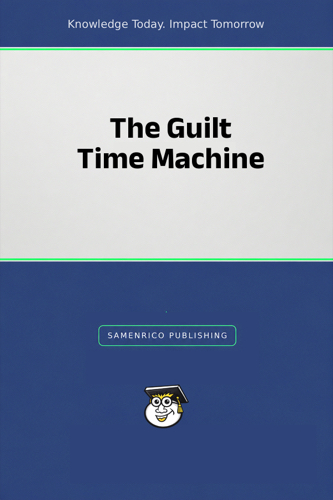
The Guilt Time Machine eBook
Stops ruminating on past actions by contextualizin
by New Kathrine
Stops ruminating on past actions by contextualizing them in past self's limitations.
Formats
Free sample
Chapter 1: The Two Faces of Guilt--The first time you felt guilty, you were probably too young to name it. Maybe you took a cookie before dinner and lied about it. Maybe you pushed a younger sibling and watched them cry. The feeling arrived like a small, hot stone in your stomach—uncomfortable but clear. You did something wrong.
The feeling told you so. And then, if you were lucky, someone helped you repair it: you apologized, you returned the cookie, you made it right. The hot stone cooled. You moved on.That was adaptive guilt. It served its purpose and left.But if you are reading this book, you have also experienced the other kind.
The guilt that does not leave. The guilt that arrives unbidden at 2 a.m., that attaches itself to a memory from ten years ago, that plays the same scene on repeat like a movie you cannot turn off. This guilt does not feel like a hot stone. It feels like a jail sentence. And unlike the childhood cookie incident, there is no adult standing by to help you make it right.
There is only you, alone with the memory, trying to figure out why you cannot let it go.This chapter is about the difference between these two faces of guilt. Because that difference is the single most important distinction you will make in this entire book. Confuse them, and you will spend years trying to “fix” guilt that was never meant to be fixed, or ignoring guilt that was trying to tell you something important. Get them right, and you will know, for the first time, whether to listen to your guilt or dismantle it.The Problem with Calling All Guilt “Bad”Let us start with a confession that most self-help books avoid: guilt is not always the enemy.In fact, guilt is one of the most sophisticated emotional technologies humans have ever evolved. No other animal experiences guilt, because no other animal has a moral sense—an internal map of how they should behave versus how they actually behaved.
Guilt is the feedback mechanism that alerts you when you have drifted off that map. Without guilt, you would never apologize, never repair, never grow. You would be a sociopath, not a seeker of self-help books.The problem is not guilt itself. The problem is when guilt outlives its usefulness.Think of guilt like a smoke alarm. A smoke alarm that goes off when there is actual smoke is doing its job perfectly.
It alerts you, you check for fire, you address the problem, and then you turn off the alarm. But a smoke alarm that keeps screaming after the fire is out—or worse, a smoke alarm that goes off because you burned toast—is not helpful. It is noise. And if you do not know the difference between real smoke and burnt toast, you will either ignore every alarm (dangerous) or live in a state of constant panic (exhausting).Most people who struggle with chronic guilt are not struggling with the real fires of their past. They are struggling with a smoke alarm that never learned how to turn off.Adaptive Guilt: The Signal You Want to Keep Let us look closely at the first face of guilt: adaptive guilt.
Psychologists sometimes call this “appropriate guilt” or “prosocial guilt,” because it serves a social function. It keeps you connected to other people by alerting you when you have caused harm.Adaptive guilt has four distinct characteristics.First, it is specific. Adaptive guilt attaches to a concrete action, not to your entire identity. You feel guilty about what you did—not about who you are. The voice sounds like: “I feel bad about snapping at my partner this morning.” It does not sound like: “I am a terrible person who ruins every relationship.”Second, it is time-limited.
Adaptive guilt arises shortly after the event, and it begins to fade once you take corrective action. It does not linger for years. It does not ambush you at random moments. It shows up, delivers its message, and—if you listen—it leaves.Third, it leads to repair. This is the most important feature.
Adaptive guilt produces a clear action impulse: apologize, make amends, change the behavior, ask for forgiveness. The guilt feels uncomfortable, but the discomfort has a direction. It points toward something you can actually do.Fourth, it is proportional. Adaptive guilt matches the size of the infraction. You feel a little guilty for being five minutes late.
You feel moderately guilty for forgetting a friend’s birthday. You feel intensely guilty for betraying a confidence. The intensity is calibrated to the harm. It does not blow small mistakes into catastrophic moral failures.When you experience adaptive guilt, you know what to do. The path is clear.
The discomfort is temporary. And when you take the repair action, the guilt resolves.If that sounds foreign to you—if your guilt has never felt specific, time-limited, action-oriented, or proportional—then you have been dealing with the second face.Nonadaptive Guilt: The Loop That Never Ends Nonadaptive guilt is what happens when the smoke alarm gets stuck in the “on” position.It has the opposite characteristics of adaptive guilt. It is global—you feel guilty about being a certain kind of person, not about doing a specific thing. It is persistent—it lasts for months, years, or decades, long after any possible repair is complete. It leads to paralysis, not action—instead of knowing what to do, you feel stuck, frozen, unable to move forward.
It is wildly disproportionate—a small mistake feels like a capital crime.Nonadaptive guilt is not a signal. It is a loop.Here is how the loop works. A memory surfaces—maybe something you did five years ago, maybe fifteen. The memory triggers a wave of guilt. That guilt feels unbearable, so you try to push it away.
You distract yourself with work, with social media, with alcohol, with anything that will make the feeling stop. But suppressing a thought does not eliminate it. In fact, research on thought suppression—pioneered by psychologist Daniel Wegner—shows that trying not to think about something makes you think about it more. The thought becomes intrusive, insistent, louder than before. So you feel guilty not only about the original event but also about your inability to “get over it.” Now you have two guilt feelings layered on top of each other.
The memory returns again, stronger. You suppress it again. It returns stronger still.This is the NAGS Cycle: Nonadaptive Guilt and Shame feeding each other in a loop that has no natural off-ramp.And while the NAGS cycle is running, something else is happening in parallel. Each time you revisit the memory without resolution, you add another layer of shame on top of it. You tell yourself new stories about what the memory means: “I should have known better.” “What kind of person does that?” “I never learn.” “Everyone who knows about this thinks I’m horrible.” These are not facts.
They are bricks. And over time, those bricks build a structure that psychologists call the Wall of Awful.The NAGS cycle is the…
This is the end of the free sample. Get the eBook to keep going. Buy now
About this book
Details
- Author
- New Kathrine
- Publisher
- SamEnrico
- Language
- English
- Genre
- Non-Fiction, Self-Help, Rumination
- Released
- 2026-06-08
- Pages (approx.)
- 153
- Available as
- eBook, Audiobook

Read better in the ZLOADR app
Your eBooks on your phone or tablet. Sign in with your SamEnrico account and start reading.
More by New Kathrine
 Burnout Prevention For Customer ServiceNew Kathrine$11.99
 Hoffa Case Solved By Amateur Sleuths GuideNew Kathrine$11.99
 Virtual Team Time CourseNew Kathrine$11.99
 Commission Income AnxietyNew Kathrine$11.99
 Letterboxd Film Snobbery TrapNew Kathrine$11.99
 Home Gym SetupNew Kathrine$11.99
 Sundown Serenade: The Last Blues of Robert JohnsonNew Kathrine$11.99
 Vanished Masterpiece: The Phantom of the LouvreNew Kathrine$11.99
 How to Produce Multipurpose LubricantNew Kathrine$11.99
 A Collector's Handbook to the Rover 2000tcNew Kathrine$11.99
 Nigeria VAT on Imported ServicesNew Kathrine$12.99
 Paraphrasing Citation Rules GuideNew Kathrine$12.99
You may also like
 Hong Kong Handover 1997Dunn Johnnie$11.99
 Zumba For Postnatal Recovery CourseNeal Christian$11.99
 Zumba for BeginnersLadner Nikia$11.99
 YouTube Comment Mining GuideHumes Pandora$12.99
 Worry Box MeditationCarlin Rudy$11.99
 Workplace Stress MeditationNguyen Lynn$11.99
 Workplace Stress and Sleep RepairHawley Ivory$11.99
 Workplace Perfectionism CureDelaney Jeffry$11.99
 Workplace Injustice Anger GuideWallen Isabelle$11.99
 Work Addiction and Burnout LinkGreenwood Ester$11.99
 Women in Yoga and WellnessBeattie Galina$11.99
 Women in Stand Up ComedyChun Evangeline$11.99