
Non-FictionSelf-HelpEmotional Calibration
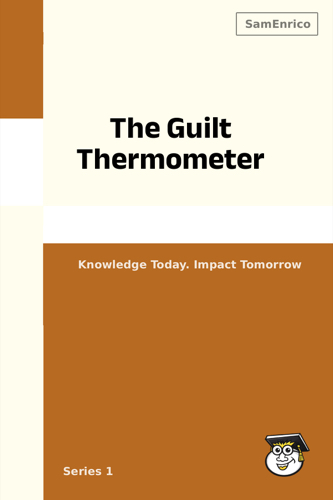
The Guilt Thermometer eBook
Rates guilt intensity to match proportional respon
Rates guilt intensity to match proportional response instead of overreaction.
Formats
Free sample
Chapter 1: The Guilt Gap...--–- Marta pressed send on the email, then immediately regretted it. Not because of what it said—a routine project update, cc’ing her boss—but because she had written it at 4:52 PM on a Friday. Eight minutes before official closing time. As she gathered her bag and headed for the elevator, a familiar weight settled into her chest. By the time she reached the parking garage, her internal monologue had escalated from mild concern to full indictment: Everyone noticed you left early.
Your boss is going to think you’re lazy. You should have pretended to work until 5:00 like everyone else. What is wrong with you?The actual transgression? Leaving eight minutes early on a slow Friday when all work was complete. The guilt intensity Marta felt?
A crushing 9 out of 10.Across town that same Friday, David received a text from his best friend of fifteen years: “Hey, I heard you told Sarah about my job interview. I specifically asked you not to share that with anyone.” David read the message, felt a flicker of something he couldn’t quite name, and put his phone face-down on the table. It’s not a big deal, he told himself. The interview was weeks ago. Anyway, Sarah doesn’t even know his boss.
What’s done is done. He never responded to the text, never apologized, and by Saturday morning, had forgotten the exchange entirely.The actual transgression? Breaking an explicit confidence that could cost his friend a job opportunity. The guilt intensity David felt? Zero.Two people.
Two versions of guilt. Both wrong.Marta and David are not characters in a novel. They are composites of thousands of people the author has worked with—people whose guilt thermometers are so badly calibrated that they suffer from chronic overload (Marta) or guilt numbness (David). Most of us fall into one of these two camps. And here is the strange, uncomfortable truth that this entire book rests upon: The intensity of your guilt is not a reliable indicator of the seriousness of your wrongdoing.Your guilt feelings lie to you.
Systematically. Repeatedly. And until you learn to read them differently, you will continue to overreact to minor infractions (apologizing seven times for being two minutes late) while underreacting to significant ones (ignoring the friend whose trust you just violated).This is not a moral failing. It is a calibration problem. And calibration problems have solutions.The Central Discovery: The Guilt Gap Let us name the phenomenon that Marta and David illustrate.
Call it the Guilt Gap—the distance between what you actually did wrong (the objective size of the transgression) and how guilty you feel about it (your subjective emotional experience). When these two things align, you experience what this book will call proportional guilt. When they do not align, you experience either guilt numbness (feeling too little for what you did) or guilt overload (feeling too much for what you did).Here is what decades of clinical research and thousands of therapy sessions have revealed: most people’s guilt gap is enormous. And it is enormously costly.Consider the costs of guilt overload. The person who feels 9/10 guilt for an 2/10 infraction lives in a state of chronic low-grade self-flagellation.
They apologize excessively, which exhausts their friends and colleagues. They ruminate, losing hours of sleep and focus to replaying minor social missteps. They make disproportionate amends—buying expensive gifts for small slights, overworking to compensate for normal human limitations—which leads to burnout and resentment. They are highly susceptible to manipulation because anyone who wants something from them knows that a small guilt-inducing comment will produce massive compliance. In short, the overload person suffers constantly for sins that do not exist.Now consider the costs of guilt numbness.
The person who feels 0/10 guilt for a 6/10 infraction does not apologize when apology is warranted. They do not repair relationships after causing harm. They do not grow from their mistakes because they do not acknowledge their mistakes at all. Over time, this pattern erodes trust, alienates loved ones, and creates a reputation for unreliability or selfishness. The numbness person is not malicious—they are often genuinely unaware of the harm they cause because their guilt thermometer never registers the signal.
But the effects on their relationships are indistinguishable from selfishness.Here is the paradox that drives this book: Both the overload person and the numbness person are trying, in their own distorted ways, to protect themselves from discomfort. The overload person preemptively punishes themselves to ward off imagined criticism from others. The numbness person preemptively dismisses their own wrongdoing to ward off the discomfort of accountability. One leans into the pain of guilt; the other leans away. Both end up trapped.The solution is not to feel less guilt.
The solution is to feel the right amount of guilt—calibrated to the actual event, proportional to the actual harm, and followed by a response that matches the intensity of what you actually did, not what you fear you did.This is where the Guilt Thermometer comes in.Introducing the Guilt Thermometer Think about how a medical thermometer works. When you feel feverish, you do not simply guess whether you are sick or not. You do not assume that because you feel terrible, you must have a 104-degree fever. You do not assume that because you feel only slightly warm, your temperature must be normal. Instead, you insert a thermometer, wait sixty seconds, and read the actual number.
That number tells you whether to ignore the symptom (99.1), treat it at home with rest and fluids (100.4), or go to the emergency room (103.5).The Guilt Thermometer works exactly the same way. It is a 0-to-10 scale with specific behavioral anchors for each number. It allows you to measure your guilt objectively, separate from the emotional noise of fear, shame, or defensive rationalization. And once you have the actual number, it tells you precisely what kind of response is proportional.Throughout this book, you will learn to use the thermometer in increasing detail. Chapter 2 covers the cognitive distortions that break your thermometer (the reasons you get the wrong reading).
Chapter 3 provides the complete 0-to-10 index with examples for every point. Chapters 5 through 8 walk you through each zone—numbness, mild, moderate, and overload—with specific protocols for each. Chapter 9 teaches you to defend your thermometer against people who try to manipulate your guilt. Chapters 10 through 12 give you the Audit, the maintenance practices, and the 30-day training plan.But before we can fix the thermometer, we must understand why it is broken in the first place. And that requires a deeper look at the two pathological patterns that most people fall into: the Numbness Spiral and the Overload Spiral.The Two Broken Patterns: Numbness and Overload Most people do not drift randomly between guilt states.
They develop stable, self-reinforcing patterns that push them consistently toward one extreme or the other. Understanding which pattern you currently inhabit is the first step toward calibration.The Numbness Spiral The numbness spiral begins with an action that warrants some guilt—say, snapping at your partner, missing a deadline, breaking a promise. Instead of feeling the appropriate discomfort (which would motivate an…
This is the end of the free sample. Get the eBook to keep going. Buy now
About this book
Details
- Author
- Merchant Janita
- Publisher
- SamEnrico
- Language
- English
- Genre
- Non-Fiction, Self-Help, Emotional Calibration
- Released
- 2026-06-08
- Pages (approx.)
- 152
- Available as
- eBook, Audiobook

Read better in the ZLOADR app
Your eBooks on your phone or tablet. Sign in with your SamEnrico account and start reading.
More by Merchant Janita
 Worry Time Containment PracticeMerchant Janita$11.99
 The Working Memory for SeniorsMerchant Janita$11.99
 Post Acute Withdrawal Syndrome HelpMerchant Janita$11.99
 Gratitude for Comparison CureMerchant Janita$11.99
 Purpose For Illness GuideMerchant Janita$11.99
 Islamic Medicine Golden AgeMerchant Janita$11.99
 Divorce and Alimony GuideMerchant Janita$11.99
 The Ghost of the Great North Road: Kenya's Prohibition-Era VigilantesMerchant Janita$11.99
 The Bloodied Fields of Nördlingen: Sweden’s Last Stand in the Thirty Years' WarMerchant Janita$11.99
 How to Produce Motorcycle Helmet Parts and AccessoriesMerchant Janita$11.99
 Generative AI Creative Brief GuideMerchant Janita$12.99
 Co Founder Reddit CommunitiesMerchant Janita$12.99
You may also like
 Hong Kong Handover 1997Dunn Johnnie$11.99
 Zumba For Postnatal Recovery CourseNeal Christian$11.99
 Zumba for BeginnersLadner Nikia$11.99
 YouTube Comment Mining GuideHumes Pandora$12.99
 Worry Box MeditationCarlin Rudy$11.99
 Workplace Stress MeditationNguyen Lynn$11.99
 Workplace Stress and Sleep RepairHawley Ivory$11.99
 Workplace Perfectionism CureDelaney Jeffry$11.99
 Workplace Injustice Anger GuideWallen Isabelle$11.99
 Work Addiction and Burnout LinkGreenwood Ester$11.99
 Women in Yoga and WellnessBeattie Galina$11.99
 Women in Stand Up ComedyChun Evangeline$11.99