
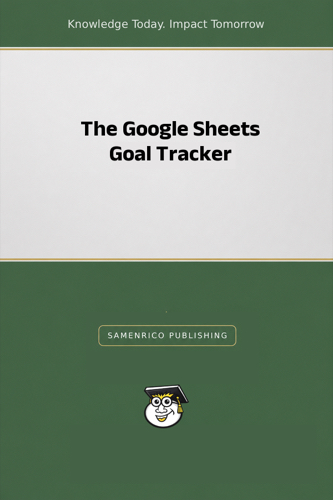
The Google Sheets Goal Tracker eBook
Collaborate on OKRs with real time sharing and com
Collaborate on OKRs with real time sharing and commenting.
Formats
Free sample
Chapter 1: The Accountability Gap--–- In the summer of 2018, a mid-sized marketing agency in Chicago lost its biggest client. The reason wasn't poor work quality, missed deadlines, or budget overruns. The client left because the agency consistently failed to do one simple thing: tell them what was happening with their own projects.The agency had a goal-tracking system. Every Monday, the project manager sent out a spreadsheet with thirty-seven rows of data: tasks, owners, due dates, statuses, and notes. The client received a copy every Tuesday.
But here's what the agency didn't know until the exit interview: the client had stopped opening the spreadsheet in week three. "Every week, I got a wall of numbers," the client said. "I had no idea what was urgent, what was blocked, or what you needed from me. So I stopped reading. And when I stopped reading, I stopped caring."The agency founder told me this story six months later, over coffee, after she had fired the project manager and rebuilt her entire operations system from scratch.
"We were measuring everything," she said. "We just weren't communicating anything. The spreadsheet was a data cemetery, not a command center."That conversation stuck with me. Over the next several years, as I consulted with dozens of companies on their goal-tracking practices, I saw the same pattern again and again. Teams meticulously set OKRs, built elaborate spreadsheets, and then watched those spreadsheets become digital mausoleums—perfectly preserved, beautifully formatted, and completely ignored.The problem was never the goals.
The problem was never the spreadsheet. The problem was the gap between setting a goal and achieving it, and the complete absence of a bridge to get from one side to the other.I call this The Accountability Gap.The Anatomy of a Breakdown Before we can close the Accountability Gap, we need to understand how it opens in the first place. The process is so common that it has become a predictable pattern across organizations of every size and industry.Phase One: Enthusiasm. A team reads Measure What Matters or attends an OKR workshop. They are energized.
They believe that this time will be different. They spend two days crafting the perfect set of Objectives and Key Results. The CEO declares that OKRs will be "the operating system of our company."Phase Two: Abandonment. By week three of the quarter, the OKR spreadsheet has been opened exactly twice—once when it was created, and once when someone accidentally clicked the wrong bookmark. The team is busy.
The quarter's real work has taken over. The spreadsheet sits in a shared drive, unvisited and unloved.Phase Three: Panic. In week eleven, the CEO sends an email: "Please update your OKRs for the quarterly review by Friday." A flurry of activity ensues. People guess at their progress. They inflate numbers to look good.
They deflate numbers to manage expectations. They type vague status updates like "on track" or "need to discuss." The spreadsheet fills with data of questionable accuracy.Phase Four: Disillusionment. The quarterly review meeting arrives. The CEO projects the spreadsheet. Red cells outnumber green ones.
No one can explain why. The conversation turns to blame, then excuses, then silence. Someone says, "Maybe OKRs don't work for our kind of work." Everyone silently agrees. The spreadsheet is archived. The team goes back to business as usual.Phase Five: Repeat.
Next quarter, someone suggests trying OKRs again. "But this time," they say, "we'll use a different template." The cycle begins anew.This pattern is so common that it has a name in organizational psychology: the implementation dip. It happens whenever a team adopts a new practice without also adopting the supporting behaviors that make the practice work. You can have the world's best OKR framework, but if you don't have a weekly check-in habit, the framework will fail. You can have a perfectly designed spreadsheet, but if you don't have a commenting culture, the spreadsheet will sit empty.The Accountability Gap is the space between "we set goals" and "we achieve goals." In most organizations, that space is a void.
No one is responsible for bridging it. No process exists to cross it. Goals are set on one side, and results are measured on the other, with nothing in between except hope.Hope is not a strategy.The Three Pillars of Accountability Over years of studying teams that successfully close the Accountability Gap, I have identified three pillars that must be in place. Without any one of these pillars, the gap will reopen. With all three, goals transform from abstract aspirations into concrete outcomes.Pillar One: Visibility.
A goal that is hidden is a goal that is ignored. This sounds obvious, but most teams hide their goals without realizing it. The OKR spreadsheet is stored in a shared drive that no one checks. The link is buried in a Slack channel from three months ago. The goals are discussed in meetings, but those meetings happen once a quarter, not once a week.True visibility means that every person on the team can see every goal, every status, and every comment, in real time, without asking permission or navigating through folders.
It means that the goal tracker is one click away from your team's daily workflow. It means that when someone updates their progress, everyone sees that update immediately.Google Sheets, with its link-based sharing and real-time collaboration, is uniquely suited to provide this level of visibility. But the tool alone is not enough. You must also create the habits that keep the sheet visible: a pinned browser tab, a daily glance, a weekly meeting where the sheet is the only agenda.Pillar Two: Conversation. A goal without conversation is a wish.
This is the most underappreciated truth in all of goal-setting literature. Goals are not static targets; they are dynamic negotiations between what we want to achieve and what reality allows. That negotiation happens through conversation.When a Key Result is turning red, the most important action is not updating the color; it's starting a conversation. When a team member is blocked, the most important action is not suffering in silence; it's writing a comment that @mentions the person who can help. When a goal becomes obsolete, the most important action is not deleting it; it's documenting the pivot so everyone understands why.Google Sheets comments are the perfect vehicle for these conversations.
They are threaded, so context is preserved. They are cell-linked, so everyone knows exactly which number or goal the conversation refers to. They are permanent, so the audit trail is automatic. They are visible to everyone, so no one is left out of the loop.But comments alone are not enough. You must also create the norms that make comments useful: the Syntax of Accountability, the Two-Comment Rule, the expectation that every @mention receives a reply within 24 hours.
We will cover all of these in Chapter 4.Pillar Three: Rhythm. Visibility and conversation are necessary, but they are not sufficient. You also need a regular cadence of check-ins, reviews, and retrospectives. Goals are living things, and living things need consistent attention.The rhythm that works for most teams is weekly, monthly, and quarterly. Every week, a fifteen-minute tactical check-in to…
This is the end of the free sample. Get the eBook to keep going. Buy now
About this book
Details
- Author
- Parkinson Mitch
- Publisher
- SamEnrico
- Language
- English
- Genre
- Non-Fiction, Self-Help, Google
- Released
- 2026-06-07
- Pages (approx.)
- 141
- Available as
- eBook, Audiobook

Read better in the ZLOADR app
Your eBooks on your phone or tablet. Sign in with your SamEnrico account and start reading.
More by Parkinson Mitch
 Outsourcing for Event PlannersParkinson Mitch$11.99
 Group Idea Rating GuideParkinson Mitch$11.99
 Growth Mindset For Kids GuideParkinson Mitch$11.99
 Road Rage Thought ChallengeParkinson Mitch$11.99
 Assertiveness Scripts HandbookParkinson Mitch$11.99
 Mindfulness for Students BeginnersParkinson Mitch$11.99
 Arabian Desert Bedouin GuideParkinson Mitch$11.99
 The Scorched Earth: Saddam's Folly and the Iran-Iraq War's Descent into MadnessParkinson Mitch$11.99
 The Cape Town Gold Conspiracy: A Victorian-Era Boiler Room ScamParkinson Mitch$11.99
 Sorghum: Grain, Sweet & BroomParkinson Mitch$11.99
 The Essential Guide to ChristmasParkinson Mitch$11.99
 How to Produce a Quarry TubParkinson Mitch$11.99
You may also like
 Hong Kong Handover 1997Dunn Johnnie$11.99
 Zumba For Postnatal Recovery CourseNeal Christian$11.99
 Zumba for BeginnersLadner Nikia$11.99
 YouTube Comment Mining GuideHumes Pandora$12.99
 Worry Box MeditationCarlin Rudy$11.99
 Workplace Stress MeditationNguyen Lynn$11.99
 Workplace Stress and Sleep RepairHawley Ivory$11.99
 Workplace Perfectionism CureDelaney Jeffry$11.99
 Workplace Injustice Anger GuideWallen Isabelle$11.99
 Work Addiction and Burnout LinkGreenwood Ester$11.99
 Women in Yoga and WellnessBeattie Galina$11.99
 Women in Stand Up ComedyChun Evangeline$11.99