
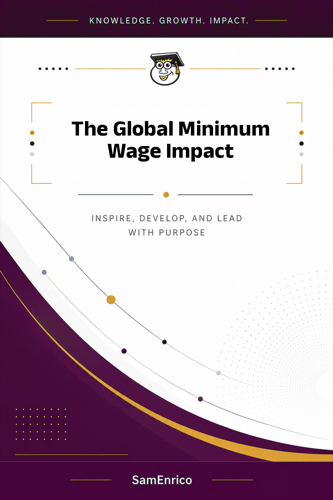
Non-FictionForecast & OutlookLabor Economics
The Global Minimum Wage Impact
Analyze how wage differentials drive talent migrat
by Andre Divina
Analyze how wage differentials drive talent migration patterns.
Formats
About this book
Free sample
Chapter 1: The Selection Shadow...--–- The young doctor from Manila had two job offers. One was in a public hospital in Quezon City, paying the equivalent of $800 per month. The other was a night shift nursing position in Birmingham, England, offering $3,200 monthly plus housing. She did the math in under thirty seconds. But she did not move.
Not for six months. What held her back was not the wage gap—that was overwhelmingly in favor of Birmingham. What delayed her was something economists rarely measure: fear. Fear that her Philippine nursing credentials would be dismissed as inferior. Fear that the "minimum wage" advertised for NHS nurses would somehow shrink after taxes, agency fees, and the crushing cost of London rent.
Fear that she would become a statistic—the overqualified immigrant driving a taxi or stocking shelves while her license gathered dust in a drawer.This chapter is about why that fear is rational. It is about the single most important question in migration economics: Who moves? Not everyone who could benefit from a higher minimum wage actually migrates. And crucially, the ones who do move are not a random cross-section of the population. They are selected.
They are filtered. And the filter is ruthless.For decades, economists have tried to understand how wage differentials—the gaps in pay between countries or regions—drive the flow of human beings across borders. The simplest theory, often called the "neoclassical" view, is seductive in its clarity: people move from low-wage places to high-wage places until wages equalize. If a nurse in Manila earns $800 and a nurse in Birmingham earns $3,200, then nurses should flood into Birmingham until the surplus of labor drives wages down or the shortage in Manila drives wages up. The model is clean.
It is elegant. And it is catastrophically wrong.What the simple model misses is that migration is not a frictionless flow of identical workers. It is a sorting mechanism. The people who leave are different from the people who stay. And the direction of that difference—whether migrants tend to be more skilled or less skilled than those they…
This is the end of the free sample. Get the eBook to keep going. Buy now
Contents
- Chapter 1
- Chapter 2
- Chapter 3
- Chapter 4
- Chapter 5
- Chapter 6
- Chapter 7
- Chapter 8
- Chapter 9
- Chapter 10
- Chapter 11
- Chapter 12
Details
- Author
- Andre Divina
- Publisher
- SamEnrico
- Language
- English
- Genre
- Non-Fiction, Forecast & Outlook, Labor Economics
- Released
- 2026-06-08
- Pages (approx.)
- 154
- Available as
- eBook, Audiobook

Read better in the ZLOADR app
Your eBooks on your phone or tablet. Sign in with your SamEnrico account and start reading.
More by Andre Divina
 Intuitive Eating Grocery Shopping GuideAndre Divina$11.99
 Personal Ing For Success Creator GuideAndre Divina$11.99
 Moral Inventory Step Four WorkbookAndre Divina$11.99
 Benzodiazepine Pain WithdrawalAndre Divina$11.99
 When the Sky Bleed Ruby: The 1883 Krakatoa Eruption's Forgotten AftermathAndre Divina$11.99
 Seams of Power: The Untold Story of Vivienne Westwood’s Punk RevolutionAndre Divina$11.99
 How to Start a Power-driven Loading and Unloading Derricks Business (Beginners Guide)Andre Divina$11.99
 European Bootcamp Degree GuideAndre Divina$12.99
 US Credit Card for Foreign LLCsAndre Divina$12.99
 Records ManagerAndre Divina$11.99
 Understanding Biemond Syndrome Type 2Andre Divina$17.99
You may also like
 Hong Kong Handover 1997Dunn Johnnie$11.99
 Zumba For Postnatal Recovery CourseNeal Christian$11.99
 Zumba for BeginnersLadner Nikia$11.99
 YouTube Comment Mining GuideHumes Pandora$12.99
 Worry Box MeditationCarlin Rudy$11.99
 Workplace Stress MeditationNguyen Lynn$11.99
 Workplace Stress and Sleep RepairHawley Ivory$11.99
 Workplace Perfectionism CureDelaney Jeffry$11.99
 Workplace Injustice Anger GuideWallen Isabelle$11.99
 Work Addiction and Burnout LinkGreenwood Ester$11.99
 Women in Yoga and WellnessBeattie Galina$11.99
 Women in Stand Up ComedyChun Evangeline$11.99