

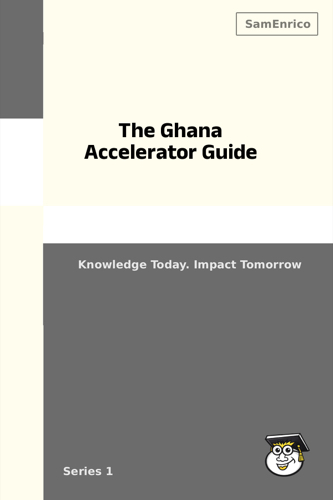
Non-FictionStartup GuideAccelerator
The Ghana Accelerator Guide eBook
Apply to MEST, Ghana Climate Innovation Centre, an
by Orta Delcie
Apply to MEST, Ghana Climate Innovation Centre, and other programs.
Formats
Free sample
Chapter 1: The Ecosystem Trap--Most entrepreneurs who apply to accelerators in Ghana fail before they finish writing their first sentence. They fail not because their idea is weak, not because their team is inexperienced, and not because Ghana lacks funding. They fail because they treat every accelerator as if it were the same door with a different label. That mistake is more expensive than any application fee.Imagine a young founder named Adjoa. She has built a fintech platform that helps small-scale farmers save money through mobile wallets.
She is brilliant, hardworking, and has traction—five hundred users in the Eastern Region. She applies to MEST, GCIC, and Orange Corners using the exact same application. She copies her pitch, her problem statement, and her financial projections. She hits submit three times and waits.Six weeks later, she receives three rejection emails. She is devastated.
She tells herself that Ghana just does not have real opportunities. She gives up.What Adjoa never understood is that she walked into three different buildings, each with a different door, a different lock, and a different key. She tried to open all three with the same key. That is the Ecosystem Trap.This chapter is your key maker. By the time you finish reading, you will never again confuse MEST for GCIC or Orange Corners for UNICEF Lab.
You will know exactly which door to knock on, what they want to hear, and—most importantly—which doors you should never approach at all.The Four Doors of Ghana’s Accelerator Landscape Ghana has one of the most vibrant entrepreneurial support systems in West Africa. Over the past decade, more than a dozen accelerators, incubators, and fellowship programs have launched. But quantity is not quality. Most founders waste months applying to programs that were never designed for them.The ecosystem is not one market. It is four distinct markets operating under the same roof.After analyzing acceptance data, interviewing program managers, and tracking the outcomes of over two hundred applicants, a clear pattern emerges.
There are four major players that dominate the landscape. Every other program is either a smaller version of one of these four or a specialized niche.Let me introduce you to the Big Four.Door One: MEST (The Software Scaler)MEST—the Meltwater Entrepreneurial School of Technology—is the most competitive and most transformative program in Ghana. Founded in 2008, MEST has trained over four hundred entrepreneurs and invested in more than one hundred startups. Their alumni include companies like Kudigo, Express Pay, and Saya.But here is what most people get wrong about MEST. They think it is a general entrepreneurship program.
It is not.MEST has evolved. In recent years, they have pivoted hard toward AI-first software. They want startups that are building scalable technology products—Saa S platforms, marketplace apps, AI tools, developer tooling. They are less interested in hardware, social enterprises that do not have a tech backbone, or traditional brick-and-mortar businesses.If your startup does not have a software component that can scale across Africa, MEST is the wrong door.The application process is brutal. It includes an aptitude test that covers logic, basic algorithms, and business reasoning.
Then comes a group interview where you are judged on coachability as much as intelligence. Then a final panel. Less than five percent of applicants make it in.But the reward is significant. MEST offers a fully sponsored twelve-month program—seven months in-residence training followed by four months of incubation—with a living stipend and seed funding in exchange for equity. Their alumni network is a who's who of African tech.Key takeaway for MEST: They want software, scale, and coachability.
If you cannot explain your technical architecture in one sentence, you are not ready.Door Two: GCIC (The Climate Builder)The Ghana Climate Innovation Centre is not MEST with a green label. It is an entirely different animal.GCIC was established in 2016 with support from the World Bank and is hosted at Ashesi University. Their mandate is narrow and specific: climate resilience and green innovation. They fund and accelerate startups that address climate adaptation, mitigation, or both.If MEST is a scalpel for software, GCIC is a bulldozer for climate impact.GCIC works across five subsectors: smart agriculture (drought prediction, pest management), water management (filtration, distribution efficiency), energy efficiency (off-grid solar, appliance retrofits), solar (installation and financing models), and waste management (recycling, plastic-to-fuel, circular economy).Notice what is missing. Fintech is not here.
E-commerce is not here. General social enterprise is not here.Here is the nuance that most founders miss. GCIC does accept some fintech—but only fintech that directly enables climate action. Think pay-as-you-go solar financing platforms, carbon credit trading marketplaces, or micro-insurance for climate-affected farmers. If your fintech does not have a measurable environmental outcome, GCIC will reject you.The application process is less about aptitude tests and more about documentation.
GCIC wants proof of concept, environmental impact assessments, and data. They partner with Ashesi University, which means they value academic rigor and ethical business models. A sloppy slide deck is rejected immediately.GCIC offers grants, not equity. That is a massive advantage. You keep ownership of your company.
However, the reporting requirements are strict. You will need to track liters of water saved, tons of CO2 reduced, or tons of waste diverted. If you cannot measure your impact, you cannot apply.Key takeaway for GCIC: They want measurable climate impact, academic discipline, and a clear theory of change. Pick your metric before you write a single word of your application.Door Three: Orange Corners Ghana (The Generalist’s Path)Orange Corners is the most accessible of the Big Four—and that is both its strength and its weakness.Funded by the Dutch government, Orange Corners Ghana focuses on general entrepreneurship and agribusiness. They are less picky about sector than MEST or GCIC.
They accept retail, logistics, manufacturing, services, and yes, some tech. If you have a viable business and a coachable founder, you have a shot.But accessibility comes with trade-offs.Orange Corners offers low-interest loans, not grants or equity. That means you have to pay the money back even if your business fails. For founders who are risk-averse or early-stage, this can be a dealbreaker. For founders who are confident in their revenue model, it is a fair trade for mentorship and network access.The application timeline is different too.
While MEST and GCIC have rigid annual cycles, Orange Corners opens applications twice a year, typically in July–September and January–March. Their interview process is less technical and more sales-focused. They want to see that you can convince customers, partners, and investors. They are looking for hustle.Key takeaway for Orange Corners: They want sales ability, coachability, and a viable business. They do not need you to save the planet or build the next unicorn.
They need you to pay back your loan.Door Four: UNICEF Start Up Lab (The SDG Specialist)UNICEF Start Up Lab is often overlooked by founders who focus only on MEST and GCIC. That is a mistake.UNICEF Lab focuses on technology solutions for children and youth. Their mandate is SDG-aligned: education tech, health tech, child protection, and social protection. They are…
This is the end of the free sample. Get the eBook to keep going. Buy now
About this book
Details
- Author
- Orta Delcie
- Publisher
- SamEnrico
- Language
- English
- Genre
- Non-Fiction, Startup Guide, Accelerator
- Released
- 2026-06-08
- Pages (approx.)
- 153
- Available as
- eBook, Audiobook

Read better in the ZLOADR app
Your eBooks on your phone or tablet. Sign in with your SamEnrico account and start reading.
More by Orta Delcie
 Reddit JonBenét TheoriesOrta Delcie$11.99
 Self Hypnosis for Fear of GhostsOrta Delcie$11.99
 Body Image in Men GuideOrta Delcie$11.99
 Divorce After DecadesOrta Delcie$11.99
 Hearing Simulation for FamiliesOrta Delcie$11.99
 Andrew Jackson DemocracyOrta Delcie$11.99
 Adjuvant Vaccine Safety GuideOrta Delcie$11.99
 The Master of the Medieval Game: Giovanni de' Medici and the Birth of Tactical FootballOrta Delcie$11.99
 Kabaddi in the Andes: How a South Asian Sport United Latin American VillagesOrta Delcie$11.99
 How to Produce a Set-n-forget CookerOrta Delcie$11.99
 A Collector's Handbook to the Bianchi S8Orta Delcie$11.99
 Business Climate Risk Model Validation HandbookOrta Delcie$12.99
You may also like
 Hong Kong Handover 1997Dunn Johnnie$11.99
 Zumba For Postnatal Recovery CourseNeal Christian$11.99
 Zumba for BeginnersLadner Nikia$11.99
 YouTube Comment Mining GuideHumes Pandora$12.99
 Worry Box MeditationCarlin Rudy$11.99
 Workplace Stress MeditationNguyen Lynn$11.99
 Workplace Stress and Sleep RepairHawley Ivory$11.99
 Workplace Perfectionism CureDelaney Jeffry$11.99
 Workplace Injustice Anger GuideWallen Isabelle$11.99
 Work Addiction and Burnout LinkGreenwood Ester$11.99
 Women in Yoga and WellnessBeattie Galina$11.99
 Women in Stand Up ComedyChun Evangeline$11.99