
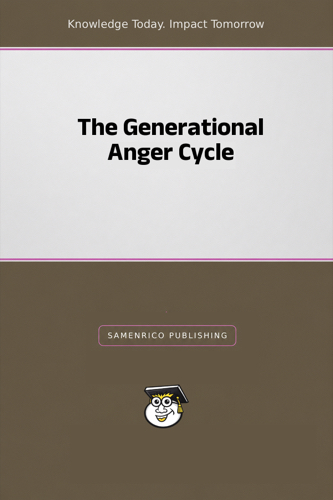
Non-FictionSelf-HelpGenerational
The Generational Anger Cycle eBook
Break the pattern of angry parenting passed down f
Break the pattern of angry parenting passed down from your childhood.
Formats
Free sample
Chapter 1: The Ghost in the Nursery--There is a moment, just after you have yelled—really yelled—at your child, when the house goes quiet. Not a peaceful quiet. A shocked quiet. You see their face crumple, or go blank, or harden into something that looks nothing like a child should look. And in that silence, a voice inside you says something terrible.
It says: I have become my mother. I have become my father. I have become the person I swore I would never be.If you have felt this, you are not broken. You are not a monster. You are not a bad parent pretending to be a good one.
You are, quite simply, haunted.Not by ghosts in the gothic sense—no specters rattling chains in the attic. You are haunted by something far more ordinary and far more persistent: the invisible inheritance of anger patterns that traveled from your grandparents to your parents to you, often without anyone’s conscious awareness. This is the Ghost in the Nursery, and it is the central metaphor of this book.The phrase comes from the work of psychoanalyst Selma Fraiberg, who observed that parents who had unresolved trauma from their own childhoods often reenacted that trauma with their infants—not because they wanted to hurt their children, but because the past was living inside them, unbidden, like a ghost. These parents were not evil or indifferent. They were, in Fraiberg’s words, “possessed” by visitors from their own unremembered past.This chapter is about naming that ghost.
Not to banish it with a single wave of a self-help wand—that is not possible—but to see it clearly for the first time. Because you cannot break a cycle you cannot name. And you cannot change a pattern you refuse to recognize as inherited.The Inheritance You Did Not Choose Let us begin with a difficult truth: most angry parents are not bad people. They are people running old software.Imagine for a moment that your brain is a computer. When you were born, it was not a blank slate.
It came with basic operating instructions encoded in your DNA—tendencies toward reactivity, sensitivity, impulsivity, or calm. But the real programming happened in the first ten years of your life, as you watched, absorbed, and mimicked the adults around you. By the time you were seven years old, you had already learned, with stunning accuracy, how anger worked in your family. You learned what made people explode. You learned what made them go silent.
You learned who apologized and who never did. You learned whether anger led to repair or to days of icy distance.And then you grew up, had children of your own, and your nervous system—faithful to its earliest programming—began running those same scripts.This is not a metaphor for weakness or failure. It is a description of how every human brain learns. Social learning theory, one of the most robust findings in developmental psychology, shows that children do not learn primarily from what they are told. They learn from what they witness.
A parent can say “Use your words” a thousand times, but if that same parent screams when frustrated, the child learns screaming. A parent can read every peaceful parenting book on the shelf, but if that parent withdraws into cold silence when overwhelmed, the child learns that love is conditional on good behavior.Here is the painful irony: you are likely reading this book because you are already a more reflective, more self-aware parent than your own parents ever were. The very fact that you feel guilt after yelling is proof that the cycle is already cracking. Unreflective parents do not read books about generational anger. They do not lie awake at night replaying the moment they lost their temper.
They do not whisper into the dark, I don't want to be like this.You are here because you want to be different. And wanting to be different is the first and most essential qualification for actually becoming different.The Three-Generation Rule In my synthesis of the top books on generational trauma and angry parenting, one pattern emerges with striking consistency: unresolved anger rarely skips a generation. It transforms, but it persists.Consider the following family trajectory, which I have seen in dozens of variations:Generation One (Great-Grandparents): They lived through economic collapse or war. They had no access to therapy, no language for trauma, and no margin for emotional reflection. They were surviving, not thriving.
Anger in their household was explosive but short-lived—a thunderstorm that cleared quickly because there was work to do.Generation Two (Grandparents): They inherited the nervous system of Generation One but grew up in slightly more stable times. They vowed never to be as volatile as their own parents. So they did the opposite: they became silent. They withdrew when angry. They used coldness as punishment.
Their anger did not roar; it froze. The children in this household learned that anger meant abandonment.Generation Three (You): You inherited a nervous system primed for both explosion (from Generation One) and withdrawal (from Generation Two). Depending on the trigger, you might yell like your great-grandparents or go cold like your grandparents. You might even do both in the same argument—first the volcano, then the glacier. And you are confused because your anger seems inconsistent, unpredictable, and entirely outside your control.Generation Four (Your Children): This is where you have the chance to stop the cycle.
But first, you have to see it.The Three-Generation Rule is not a curse. It is a map. Once you can trace your anger back through the generations—once you can say, “Ah, that reaction came from my grandmother’s fear, not from my child’s behavior”—you gain something precious: distance. And distance is the beginning of choice.Emotional Immaturity and the Default of Anger Why do so many parents default to anger, even when they know better? The answer is uncomfortable but liberating: because anger works.Anger stops unwanted behavior faster than any other emotional response.
When you yell “Stop that right now!” your child often does stop, at least momentarily. When you slam a cabinet, your child freezes. When you use a cold, quiet voice, your child learns to walk on eggshells. Anger is efficient. It requires no vocabulary lessons, no patience, no tolerance for messy emotions.
It is the path of least resistance for a tired, overstimulated, dysregulated parent.And herein lies the connection to emotional immaturity. Psychologist Lindsay Gibson, author of Adult Children of Emotionally Immature Parents, defines emotional immaturity as the inability to hold two opposing feelings at once—to be angry and still loving, to be frustrated and still kind, to be exhausted and still present. Emotionally immature parents do not have a wide emotional vocabulary. They have anger, sadness, and fear. And they use these three tools for every problem, the way a carpenter uses only a hammer: every problem looks like a nail.If you grew up with emotionally immature parents, you likely learned that anger was the primary—sometimes the only—tool for solving interpersonal problems.
You did not see your parents say, “I’m feeling frustrated right now, so I’m going to take a minute to…
This is the end of the free sample. Get the eBook to keep going. Buy now
About this book
Details
- Author
- Mcclintock Claudine
- Publisher
- SamEnrico
- Language
- English
- Genre
- Non-Fiction, Self-Help, Generational
- Released
- 2026-06-06
- Pages (approx.)
- 143
- Available as
- eBook, Audiobook

Read better in the ZLOADR app
Your eBooks on your phone or tablet. Sign in with your SamEnrico account and start reading.
More by Mcclintock Claudine
 Validation After BetrayalMcclintock Claudine$11.99
 Lifestyle ED ReversalMcclintock Claudine$11.99
 The Price Increase Communication GuideMcclintock Claudine$11.99
 Step Seven Humility CourseMcclintock Claudine$11.99
 Jade Serpent Ascends: The Architect of the Celestial SpireMcclintock Claudine$11.99
 PR Calendar for StartupsMcclintock Claudine$12.99
 Minority Joint Venture GuideMcclintock Claudine$12.99
 Lip Movement Recognition TechnicianMcclintock Claudine$11.99
 How to Start a Blotting Paper Business (Beginners Guide)Mcclintock Claudine$11.99
 The Breeder's Guide to Modern Game ChickensMcclintock Claudine$11.99
You may also like
 Hong Kong Handover 1997Dunn Johnnie$11.99
 Zumba For Postnatal Recovery CourseNeal Christian$11.99
 Zumba for BeginnersLadner Nikia$11.99
 YouTube Comment Mining GuideHumes Pandora$12.99
 Worry Box MeditationCarlin Rudy$11.99
 Workplace Stress MeditationNguyen Lynn$11.99
 Workplace Stress and Sleep RepairHawley Ivory$11.99
 Workplace Perfectionism CureDelaney Jeffry$11.99
 Workplace Injustice Anger GuideWallen Isabelle$11.99
 Work Addiction and Burnout LinkGreenwood Ester$11.99
 Women in Yoga and WellnessBeattie Galina$11.99
 Women in Stand Up ComedyChun Evangeline$11.99