
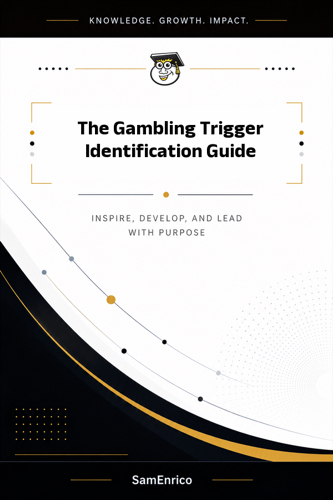
Non-FictionSelf-HelpTrigger Management
The Gambling Trigger Identification Guide eBook
Helps log and avoid emotional states, locations, a
Helps log and avoid emotional states, locations, and times that prompt betting.
Formats
Free sample
Chapter 1: The Willpower Trap--–- You have told yourself “never again” more times than you can count. You have promised yourself on payday mornings, after sleepless nights, standing in parking lots, and sitting in front of blank screens. You have meant it every single time. And yet, here you are. Not because you are weak.
Not because you lack moral fiber. Not because you secretly want to destroy your life. You are here because you have been trying to solve a conditioned reflex with a promise. And promises do not work on reflexes.This chapter will dismantle the single most damaging myth in gambling recovery: the myth that willpower is the answer. You will learn why your brain ignores your best intentions, why “just stopping” sets you up for failure, and why the most successful recoveries come from people who stop trying to be stronger and start trying to be smarter.
By the end of this chapter, you will understand the difference between an urge and a decision, the architecture of the addiction loop, and why awareness—not willpower—is the only tool that has ever reliably stopped a trigger in its tracks.The Myth of the Moral Failure Let us begin with a simple question. If you broke your leg, would you try to walk it off? Would you tell yourself to “be stronger” as you attempted to climb stairs on a fractured femur? Of course not. You would recognize that a broken leg requires a cast, crutches, physical therapy, and time.
You would not moralize about it. You would not call yourself a failure for needing help to stand.Gambling addiction is a broken neural pathway, not a broken character. Yet almost every person who picks up this book has been told—or has told themselves—that their relapses are evidence of laziness, stupidity, or moral failure. You have heard it from family members: “Why can’t you just stop?” You have heard it from friends: “Just have some self-control.” And you have certainly heard it from the voice inside your own head: “What is wrong with me?”Here is the answer that no one has given you: nothing is wrong with you that is not also wrong with every other person who has ever been caught in an addiction loop. Your brain is doing exactly what it was designed to do.
It is seeking reward. It is avoiding pain. It is responding to cues in your environment with automated, lightning-fast predictions about where dopamine might come from next. The problem is not that your brain is broken. The problem is that your brain has learned something that is hurting you.
And what has been learned can be unlearned. But not through shame. Not through willpower. Through awareness.The Three-Second Gap There is a moment that every gambler knows but almost no one can describe. It happens between the trigger and the bet.
It lasts maybe three seconds. In that gap, something shifts. You are standing in the grocery store, and you see the lottery machine. You are driving home from work, and your hands turn the wheel toward the casino before your conscious mind has approved the route. You are lying in bed, and your thumb has already opened the betting app before you have decided to gamble.That three-second gap is where your addiction lives.
It is not a failure of willpower. It is a failure of awareness. Your brain has learned to bypass your conscious decision-making entirely. By the time you “decide” to gamble, your body is already in motion. Your wallet is already open.
Your finger is already tapping the screen.Let me say that again because it is the most important sentence in this book: By the time you think you are deciding to gamble, the decision has already been made by a part of your brain that does not consult you.This is not philosophy. This is neuroscience. The basal ganglia, the part of your brain responsible for habit formation and automatic behavior, learns to execute sequences without input from the prefrontal cortex, the part of your brain responsible for rational decision-making and long-term planning. After enough repetitions of the loop—trigger, urge, gamble, guilt—the basal ganglia takes over. It says, in effect: “I have seen this cue before.
I know what comes next. I will save us time by skipping the deliberation.”The result is what gamblers call “going on autopilot.” The result is the sickening feeling of watching yourself place a bet that you swore you would never place again. The result is the question: “Why did I just do that?”The answer: because you were not aware of the trigger before the autopilot engaged.The Loop That Runs You Every gambling episode follows the same four-step sequence. I call it the Loop, and once you see it, you will never unsee it. You will begin to notice it in your own life, in the lives of other gamblers, and in the mechanics of every relapse you have ever had.Step One: The Trigger A trigger is any cue that your brain has learned to associate with gambling.
Triggers can be internal (a feeling of boredom, a spike of anger, a wave of loneliness) or external (a specific street corner, a paycheck notification, a phone alert, a particular time of night). Triggers can also be social (a friend’s text, a family member’s mention of “luck,” walking into a bar where machines are present).The trigger is the match. It is the moment your brain says, “Ah, I know this situation.” You may not even notice the trigger consciously. That is the point. By the time you feel the first flicker of an urge, the trigger has already landed.Step Two: The Urge The urge is the fire.
It is a biological wave of craving that builds over five to ten minutes, peaks for two to five minutes, and then crashes over the next ten to fifteen minutes. The urge is not a thought. It is a physical sensation. It might feel like tension in your chest, a hollow ache in your stomach, a pulling sensation in your hands, or a racing in your thoughts. The urge is your brain’s emergency broadcast system saying, “We need dopamine now.
I know a reliable source. Go there immediately.”Here is the most important thing you will learn about urges: they always pass. Not sometimes. Not if you are strong enough. Always.
An urge is a wave. It builds, it peaks, it crashes. No urge in the history of human craving has ever lasted forever. The longest urges rarely exceed forty-five minutes. Most are over in fifteen to twenty.
You do not need to defeat the urge. You only need to outlast it.Step Three: The Gamble The gamble is the payoff—or what your brain believes will be the payoff. When you place a bet, your brain releases dopamine not primarily when you win, but in anticipation of the win. The uncertainty is the drug. The spin of the wheel, the turn of the card, the final score—that moment of not knowing is when your dopamine spikes highest.
This is why gambling is so addictive. Variable rewards (unpredictable wins) are neurologically more potent than guaranteed rewards. Your brain…
This is the end of the free sample. Get the eBook to keep going. Buy now
About this book
Details
- Author
- Himes Kimberely
- Publisher
- SamEnrico
- Language
- English
- Genre
- Non-Fiction, Self-Help, Trigger Management
- Released
- 2026-06-10
- Pages (approx.)
- 153
- Available as
- eBook, Audiobook

Read better in the ZLOADR app
Your eBooks on your phone or tablet. Sign in with your SamEnrico account and start reading.
More by Himes Kimberely
 Resentment After Betrayal GuideHimes Kimberely$11.99
 Infant Microbiome Brain DevelopmentHimes Kimberely$11.99
 Sales Executive Quota Stress CourseHimes Kimberely$11.99
 Body Language for Casino StaffHimes Kimberely$11.99
 The Silk Road Heist: How a Shadowy Syndicate Stole Billions from the Dark WebHimes Kimberely$11.99
 BookstoreHimes Kimberely$11.99
 India Green Technology GuideHimes Kimberely$12.99
 Test Failure Analyzer ManualHimes Kimberely$12.99
 Understanding Landau–kleffner SyndromeHimes Kimberely$17.99
 How to Start a Stenotype Service BusinessHimes Kimberely$11.99
You may also like
 Hong Kong Handover 1997Dunn Johnnie$11.99
 Zumba For Postnatal Recovery CourseNeal Christian$11.99
 Zumba for BeginnersLadner Nikia$11.99
 YouTube Comment Mining GuideHumes Pandora$12.99
 Worry Box MeditationCarlin Rudy$11.99
 Workplace Stress MeditationNguyen Lynn$11.99
 Workplace Stress and Sleep RepairHawley Ivory$11.99
 Workplace Perfectionism CureDelaney Jeffry$11.99
 Workplace Injustice Anger GuideWallen Isabelle$11.99
 Work Addiction and Burnout LinkGreenwood Ester$11.99
 Women in Yoga and WellnessBeattie Galina$11.99
 Women in Stand Up ComedyChun Evangeline$11.99