
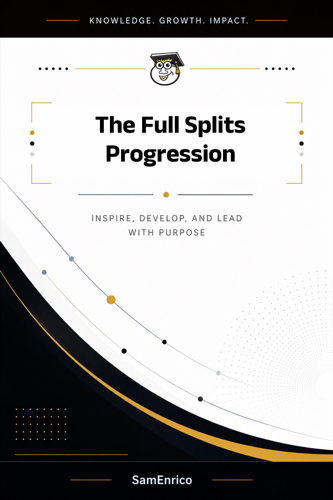
Non-FictionHealth & WellnessAdvanced Flexibility
The Full Splits Progression eBook
Gradual program to achieve front and side splits.
by Klein Brett
Gradual program to achieve front and side splits.
Formats
Free sample
Chapter 1: The Protective Prison--–- Every time you push harder into a stretch, your body actively fights back. This is not a design flaw. It is not evidence that you are “naturally inflexible” or that you have “short muscles.” It is proof that your nervous system is doing exactly what it evolved to do: protect you from injury. The problem is that the same protective mechanism that keeps you from tearing a hamstring while sprinting also keeps you from touching your toes or sliding into a comfortable side split. You have been living inside a protective prison built by your own reflexes, and the key to escaping that prison is not more effort—it is understanding how to temporarily disable the guard.This chapter will fundamentally change how you think about flexibility.
You will learn why forcing a stretch creates more resistance, not less. You will discover the three distinct ways to stretch, and why only one of them creates permanent change. You will perform your first neurological stretch protocol and feel what happens when your nervous system stops fighting and starts allowing. And you will understand why the next ninety days will succeed where years of frustrated stretching have failed. The answer is not in your muscles.
It is in your spinal cord.The Moment Everything Changes Picture a common scene. A woman in a gym class sits on the floor, legs spread in a straddle. She leans forward, reaches for her left foot, and feels a deep pull in her inner thigh. She breathes, tries to relax, and leans a little further. The pull becomes sharper.
She pushes through the discomfort because she believes that “no pain, no gain” applies to stretching. Her muscles tremble. Her lower back rounds. She holds for thirty seconds, releases, and feels… exactly the same as before. She has been doing this for months, and the floor is still inches away.Now imagine a different approach.
The same woman lies on her back with her legs resting against a wall. She gently opens her legs into a wide straddle, using gravity instead of force. She contracts her inner thigh muscles for five seconds, then relaxes completely. On the exhale, her legs fall open another inch with no additional effort. She feels a sensation of release rather than resistance.
She repeats this cycle three times, and by the end, her legs are several inches wider than when she started. She has not pushed harder. She has pushed smarter.The difference between these two scenarios is not genetics, age, or body type. It is the difference between working against your nervous system and working with it. The first approach triggers the stretch reflex, the second temporarily overrides it.
Every person who has ever achieved the splits after years of failure has discovered this secret, often by accident. This book delivers it to you on purpose.The Stretch Reflex: Your Body's Overprotective Guard Deep within every muscle in your body lies a tiny sensory receptor called the muscle spindle. It is no larger than a grain of rice, but it wields enormous power over your flexibility. The muscle spindle’s sole job is to detect changes in muscle length. When a muscle lengthens, the spindle stretches and fires a signal along a nerve fiber that travels directly to your spinal cord.
The signal does not go all the way to your brain first—it takes a shortcut, because speed is critical. Within milliseconds, the spinal cord sends a return signal ordering that same muscle to contract.This loop—stretch detected, contraction ordered—is the stretch reflex. It is why a doctor taps your knee with a rubber hammer and your leg kicks forward. The tap stretches the quadriceps muscle, the spindle fires, and your leg extends before you even know what happened. The reflex is automatic, unconscious, and incredibly fast.The stretch reflex exists to prevent injury.
Imagine you are running and your foot catches on a root. Your hamstring stretches suddenly and violently. Without the stretch reflex, that muscle might tear. With the reflex, the hamstring contracts instantly, pulling your leg back underneath you and averting disaster. The reflex is a brilliant piece of evolutionary engineering.But the reflex does not know the difference between a life-threatening fall and a conscious attempt to improve your flexibility.
When you lean into a front split, you are lengthening your hamstrings and hip flexors. The muscle spindles detect this lengthening and fire their warning signal. Your spinal cord responds by contracting the very muscles you are trying to stretch. You feel this contraction as tension, tightness, or even pain. The more aggressively you stretch, the more strongly the reflex fires.
You are quite literally fighting against your own spinal cord.Most people respond to this resistance by pushing harder. They grit their teeth, hold their breath, and force their way deeper. This is exactly the wrong response. Pushing harder triggers an even stronger stretch reflex, creating a vicious cycle of effort and resistance. The sensation of “tightness” that you feel is not primarily the physical limit of your muscle fibers.
It is the neurological limit of your stretch reflex.The Golgi Tendon Organ: The Forgotten Ally If the muscle spindle is the warden of your protective prison, the Golgi tendon organ is the guard who can be bribed. Located at the junction where your muscle meets your tendon, the Golgi tendon organ monitors tension rather than length. Its job is to detect dangerously high forces that could tear a tendon or pull a muscle off the bone. When tension exceeds a certain threshold, the Golgi tendon organ triggers a reflex that causes the muscle to relax completely. This is called the lengthening reaction, and it is the body’s emergency brake for extreme tension.The lengthening reaction rarely activates during normal stretching because the tension required is very high—close to the point of actual tissue damage.
However, there is a clever way to trigger it intentionally. If you contract a muscle isometrically (without changing its length) at a high intensity, the Golgi tendon organ detects the tension generated by the contraction and activates its relaxation response. The muscle does not know that the tension came from your voluntary contraction rather than from an external stretch. It only knows that tension is high, and it responds by releasing.This is the physiological basis for Proprioceptive Neuromuscular Facilitation, or PNF. You deliberately create high tension in the muscle you want to stretch, triggering the Golgi tendon organ’s relaxation reflex.
Then, during the window of relaxation that follows, you stretch the muscle further than before. The stretch reflex is temporarily silenced because the Golgi tendon organ’s signal overrides it. You have effectively bribed the guard to look the other way.The window of relaxation lasts only five to fifteen seconds. If you do not stretch during that window, the muscle spindle regains control and the stretch reflex returns. But if you time your movement correctly, you can achieve a depth of stretch that would be impossible if you simply tried to force your way there.
This is not cheating. It is neurology.Static, Dynamic, and PNF: The Three Tools Now that you understand the neurological players…
This is the end of the free sample. Get the eBook to keep going. Buy now
About this book
Details
- Author
- Klein Brett
- Publisher
- SamEnrico
- Language
- English
- Genre
- Non-Fiction, Health & Wellness, Advanced Flexibility
- Released
- 2026-06-06
- Pages (approx.)
- 136
- Available as
- eBook, Audiobook

Read better in the ZLOADR app
Your eBooks on your phone or tablet. Sign in with your SamEnrico account and start reading.
More by Klein Brett
 Legal Checklist For Business PlanKlein Brett$11.99
 Communication Self EsteemKlein Brett$11.99
 Video Persuasion TechniquesKlein Brett$11.99
 The Last Emperor of the Sun: Puyi’s Forgotten ReignKlein Brett$11.99
 How to Start a Bowling Center BusinessKlein Brett$11.99
 LinkedIn Recommendations GuideKlein Brett$12.99
 Medical DirectorKlein Brett$11.99
 Learn to Play the KudyapiKlein Brett$11.99
You may also like
 Hong Kong Handover 1997Dunn Johnnie$11.99
 Zumba For Postnatal Recovery CourseNeal Christian$11.99
 Zumba for BeginnersLadner Nikia$11.99
 YouTube Comment Mining GuideHumes Pandora$12.99
 Worry Box MeditationCarlin Rudy$11.99
 Workplace Stress MeditationNguyen Lynn$11.99
 Workplace Stress and Sleep RepairHawley Ivory$11.99
 Workplace Perfectionism CureDelaney Jeffry$11.99
 Workplace Injustice Anger GuideWallen Isabelle$11.99
 Work Addiction and Burnout LinkGreenwood Ester$11.99
 Women in Yoga and WellnessBeattie Galina$11.99
 Women in Stand Up ComedyChun Evangeline$11.99