
Non-FictionSelf-HelpPriority Setting
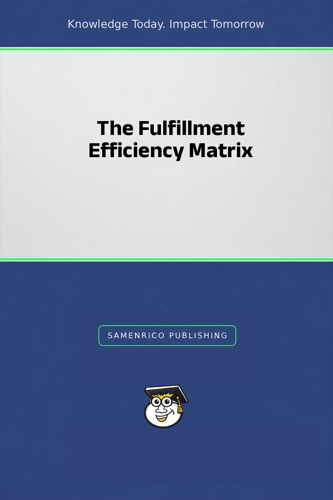
The Fulfillment Efficiency Matrix eBook
Teaches how to prioritize tasks that bring both re
Teaches how to prioritize tasks that bring both results and satisfaction, dropping draining work.
Formats
Free sample
Chapter 1: The Burnout Bargain--–- Melissa had done everything right. By age thirty-four, she had been promoted to senior director at a mid-sized tech firm, earned an MBA from a respected program, owned a modest but beautiful home, and ran a half-marathon every spring. Her calendar was a masterpiece of color-coded efficiency. She used a Pomodoro timer, batch-processed her emails, and had read every productivity book in print. Her team loved her.
Her boss praised her. Her bonus that year was $47,000.And on the night she deposited that bonus, Melissa sat in her parked car in the garage for forty-five minutes, engine off, and cried.Not tears of joy. Not the relieved exhaustion of a difficult project completed. It was the slow, confused weeping of someone who had climbed every ladder placed in front of her only to discover that the rooftop was empty. She told me later, “I couldn’t figure out what was wrong with me.
I had everything I was supposed to want. But I felt like a ghost operating a machine.”Melissa is not unusual. She is the rule.For the past decade, I have studied high-achieving professionals—executives, doctors, lawyers, software engineers, entrepreneurs, teachers, and parents who run their households like military operations. Again and again, I have watched people master the mechanics of productivity while failing at the one thing productivity is supposed to deliver: a life they actually want to live.This is the Burnout Bargain. It is the unspoken trade we make when we pursue efficiency without fulfillment.
We trade our energy for output, our joy for accomplishment, our presence for progress. And we are told that this is success.It is not. It is depletion dressed in a suit.The Lie of “More, Faster”The modern productivity movement has sold us a simple proposition: if you can just get more done in less time, you will finally be happy. The implicit promise is that happiness lives on the other side of completion. Finish the inbox.
Close the deal. Clean the house. Hit the goal. Then, and only then, you may rest.But rest never comes. Because the goalposts move.This is not an accident.
The systems we have inherited were designed for a different era—one of factories, assembly lines, and measurable widgets per hour. Frederick Winslow Taylor, the father of scientific management, believed that workers were fundamentally lazy and needed to be optimized like machines. He timed men with stopwatches, broke their movements into micro-tasks, and paid them strictly for output. Efficiency was the god; the worker was a replaceable vessel.We have traded the factory floor for the open office and the laptop, but the logic remains. We still measure ourselves in outputs per hour: emails sent, tasks checked, hours logged.
We still treat exhaustion as a status symbol and busyness as a virtue. We still believe, deep down, that if we could just find the right system—the right app, the right calendar, the right morning routine—we would finally feel whole.But here is the truth that no productivity guru wants you to hear: you cannot out-organize a life that lacks personal reward.The evidence is everywhere. A 2021 study by the American Psychological Association found that nearly three in five employees reported negative impacts of work-related stress, including lack of interest, motivation, and energy. Burnout is now classified as an occupational phenomenon by the World Health Organization. And yet, the average professional checks their email seventy-seven times per day.
We have more tools for efficiency than ever before. We are also more exhausted than ever before.This is the paradox at the heart of the Burnout Bargain: the more efficient you become at tasks that do not fulfill you, the faster you run toward emptiness.The Result-Satisfaction Gap Let me introduce a concept that will guide everything that follows: the Result-Satisfaction Gap.Results are what you produce. They are measurable, observable, and often rewarded by others. A closed sale. A passed exam.
A cleaned garage. A report submitted before deadline. A child fed and bathed. Results are the currency of the external world. They are real.
They matter.Satisfaction is what you feel. It is the internal experience of meaning, joy, energy, and alignment with your values. Satisfaction is not the same as happiness in the fleeting sense—it is deeper, more durable. It is the feeling that what you just did was worth doing, not just for what it produced, but for how it felt while you were doing it.The Result-Satisfaction Gap is the distance between what you achieve and how you feel about achieving it. When the gap is small, you experience what psychologists call “congruence”—your actions and your emotions are aligned.
You feel tired at the end of a good day, but it is the good tired of a life well spent.When the gap is large, you experience the Burnout Bargain. You achieve plenty. You check the boxes. You earn the rewards. And you feel nothing.
Or worse, you feel emptier than before you started.Consider the research of Dr. Andrew Steptoe at University College London, who studied nearly 10,000 civil servants and found that subjective well-being was only weakly correlated with objective measures of success like income and job status. In other words, having more does not reliably predict feeling better. In some cases, the correlation reversed: higher earners reported higher rates of anxiety and lower rates of daily enjoyment.Or consider the famous Harvard Study of Adult Development, which followed 724 men for nearly eighty years. The study’s director, Dr.
Robert Waldinger, summarized the findings simply: “The people who were the most satisfied in their relationships at age 50 were the healthiest at age 80.” Not the wealthiest. Not the most productive. The most connected.The Result-Satisfaction Gap is not a personal failing. It is a design flaw in how we have been taught to measure a life.Three Stories of the Gap Let me tell you about three people I have worked with. Their names and identifying details are changed, but their stories are real.David was a tax attorney at a top-tier firm.
He billed 2,400 hours a year—nearly fifty hours a week of recorded, client-facing work, plus untold hours of administrative tasks, business development, and firm citizenship. He made $380,000 annually. He drove a Porsche. His office had a view of the river.One evening, after finishing a complex merger filing at 11 PM, he walked to the parking garage and realized he could not remember a single thing his daughter had said to him in the past week. He tried to recall her voice and came up blank.
He sat in his car and wept.David’s results were extraordinary. His satisfaction was zero.Priya was a software engineer who had automated herself out of any meaningful challenge. She was brilliant—she had built systems that required almost no human intervention. Her manager loved her because nothing ever broke. Her teammates loved her because she made their jobs easier.
But Priya spent her days clicking “approve” on automated reports and scrolling social media. She told me she felt like a zoo animal receiving food pellets.She had achieved the dream of…
This is the end of the free sample. Get the eBook to keep going. Buy now
About this book
Details
- Author
- Boynton Stasia
- Publisher
- SamEnrico
- Language
- English
- Genre
- Non-Fiction, Self-Help, Priority Setting
- Released
- 2026-06-08
- Pages (approx.)
- 147
- Available as
- eBook, Audiobook

Read better in the ZLOADR app
Your eBooks on your phone or tablet. Sign in with your SamEnrico account and start reading.
More by Boynton Stasia
 Crypto Sentiment GreedBoynton Stasia$11.99
 Role Play Resentment ReleaseBoynton Stasia$11.99
 Caregiver Burnout for Cerebral PalsyBoynton Stasia$11.99
 The Phantom of the Andes: South America's Highway EmbezzlerBoynton Stasia$11.99
 Remote First Agile Ceremonies GuideBoynton Stasia$12.99
 QSR Supervisor TraineeBoynton Stasia$11.99
 How to Produce Baby Bathtubs and Bath SeatsBoynton Stasia$11.99
 How to Start a Photography Schools (except Commercial) Business (Beginners Guide)Boynton Stasia$11.99
You may also like
 Hong Kong Handover 1997Dunn Johnnie$11.99
 Zumba For Postnatal Recovery CourseNeal Christian$11.99
 Zumba for BeginnersLadner Nikia$11.99
 YouTube Comment Mining GuideHumes Pandora$12.99
 Worry Box MeditationCarlin Rudy$11.99
 Workplace Stress MeditationNguyen Lynn$11.99
 Workplace Stress and Sleep RepairHawley Ivory$11.99
 Workplace Perfectionism CureDelaney Jeffry$11.99
 Workplace Injustice Anger GuideWallen Isabelle$11.99
 Work Addiction and Burnout LinkGreenwood Ester$11.99
 Women in Yoga and WellnessBeattie Galina$11.99
 Women in Stand Up ComedyChun Evangeline$11.99