
Non-FictionBusiness BriefLeadership
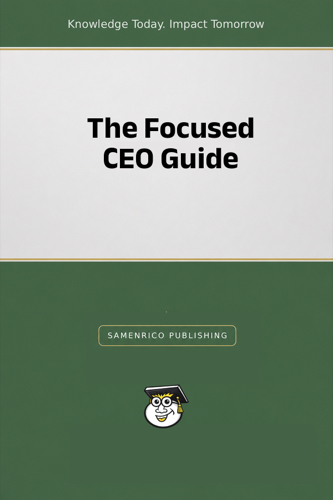
The Focused CEO Guide eBook
Lead effectively while protecting time for strateg
by Gross Larry
Lead effectively while protecting time for strategic thinking.
Formats
Free sample
Chapter 1: The Reflection Test--–- Your calendar is not a schedule. It is a mirror. And right now, if you are like most CEOs, that mirror is showing you something you have been trained to ignore: an organization that cannot function without you.Look at your calendar for the past week. Not the idealized version you planned. Not the blocked hours for strategic thinking that got overrun.
The actual calendar. The meetings that happened. The interruptions that filled the gaps. The decisions you made that someone else should have made. Now ask yourself a question that will determine whether this book changes your life or simply takes up space on your shelf: Why was I in that room?Most CEOs cannot answer this question honestly.
They will say they were there because the topic was important. Because their input was needed. Because the team requested their presence. Because it was a crisis. These are not answers.
These are justifications. And justifications are the language of a leader who has lost control of their own time without admitting it.Here is the truth that the best-selling books dance around but rarely state directly: You are not busy because you are important. You are busy because you have built an organization that requires you to be busy.The Reflection Test is simple. For every meeting you attended last week, for every decision you made, for every hour you spent “working,” ask: Did this activity require the CEO? Or did it require someone with authority, and the CEO happened to be the only person in the room with that authority?The distinction is everything.
When you confuse authority with necessity, you build a dependency machine. Your team learns that the path to resolution runs through you. Not because you are the best person to solve the problem, but because you are the only person with the power to say yes. You have become the bottleneck by design, not by accident.The Mirror Never Lies Every calendar tells a story. The story is not about how hard you work.
It is about how your organization is structured.Consider two hypothetical CEOs. Both work sixty hours a week. Both lead companies of similar size. Both would describe themselves as “too busy to think.”CEO A’s calendar shows thirty hours of meetings with direct reports. Another fifteen hours of customer calls.
Ten hours of internal reviews and approvals. Five hours of strategic thinking squeezed between dinner and bedtime.CEO B’s calendar shows ten hours of meetings with direct reports. Twenty hours of customer and market exposure. Fifteen hours of strategic thinking blocked in protected chunks. Fifteen hours of unstructured time for reflection, reading, and response.Both CEOs work sixty hours.
One is a Chief Problem Solver. The other is a Chief Judgment Officer. The difference is not work ethic, intelligence, or luck. The difference is organizational design.CEO A has built a system that requires their constant intervention. Decisions do not get made without them.
Problems do not get solved without them. The organization has learned that the CEO is the default owner of anything important or difficult. CEO A’s calendar reflects that reality.CEO B has built a system that distributes decision rights, clarifies accountability, and resolves problems at the lowest possible level. The CEO is not the default owner. The CEO is the final owner—only for the few decisions that genuinely require their judgment.
CEO B’s calendar reflects that reality.The Reflection Test reveals which CEO you are. Not which one you want to be. Which one you have built.The Three Questions That Change Everything Before you read another word, stop. Take out a pen. Write down the answers to these three questions based on your actual calendar from the past week, not your aspirations.Question One: What percentage of your meetings could have been emails or delegated to someone else?
Be honest. The research on executive time use suggests the answer is between forty and sixty percent. If your answer is lower, you are lying to yourself. If it is higher, you are already aware of the problem.Question Two: How many decisions did you make that someone else had the authority to make? Authority is the key word.
Not capability. Not intelligence. Not seniority. Authority. If someone else could have made the decision based on existing decision rights but chose to escalate to you, that is a system failure.
If no one else had the authority, that is also a system failure—yours.Question Three: When was the last time you had three consecutive hours without interruption to think about a single strategic problem? Not three hours scattered across a week. Three consecutive hours. If you cannot remember, you are not alone. You are also not leading strategically.
You are reacting.These three questions are the Reflection Test. Answer them honestly, and you will know exactly why you picked up this book. You will also know that the solutions you have tried before—time blocking, delegation, saying no—have failed because they addressed the symptoms, not the cause.The Architecture of Interruption To understand why your calendar looks the way it does, you must understand the architecture of interruption. Interruptions do not happen randomly. They follow patterns.
And those patterns are built into the way you have structured your organization.The Open Door Pattern. You have an open door policy because you want to be accessible. Your team appreciates this. They also abuse it. Every time you are in your office, you are interruptible.
Every interruption costs you not just the five minutes of the interruption itself, but the fifteen minutes it takes to return to deep focus. An open door is not accessibility. It is an invitation to be stolen from.The Approval Chain Pattern. Your organization requires your signature, your approval, or your input at multiple points in every process. Not because the process demands CEO involvement, but because no one has ever audited the approval chain.
Each approval point is a potential interruption. Each interruption fragments your attention. Your calendar is not full because you are essential. It is full because you have never removed yourself from processes that do not need you.The Crisis Escalation Pattern. Your team has learned that the fastest way to resolve a problem is to escalate it to you.
Not because you are the best problem-solver, but because you have the authority to override the system. Every time you solve an escalated problem quickly, you reinforce the behavior. You are training your team to bring you problems. And they are excellent students.The Status Update Pattern. You are in meetings where people tell you things you could have read in a five-minute memo.
You stay in these meetings because you want to be informed. But being informed is not the same as being necessary. Reading a status update takes five minutes. Sitting through a status update meeting takes sixty minutes. Fifty-five of those minutes are theft.These patterns are not inevitable.
They are choices. You made them. You can unmake them.The Hidden Cost of Heroic Leadership Many CEOs wear their busyness as a badge of honor. I…
This is the end of the free sample. Get the eBook to keep going. Buy now
About this book
Details
- Author
- Gross Larry
- Publisher
- SamEnrico
- Language
- English
- Genre
- Non-Fiction, Business Brief, Leadership
- Released
- 2026-06-07
- Pages (approx.)
- 145
- Available as
- eBook, Audiobook

Read better in the ZLOADR app
Your eBooks on your phone or tablet. Sign in with your SamEnrico account and start reading.
More by Gross Larry
 Kickboxer Hypnosis GuideGross Larry$11.99
 Campfire Night RelaxationGross Larry$11.99
 The Senior Confidence in PublicGross Larry$11.99
 Self Talk for SleepGross Larry$11.99
 Arctic Aurora VisualizationGross Larry$11.99
 Soccer Player's Self HypnosisGross Larry$11.99
 Remote Communication for Project ManagersGross Larry$11.99
 The Great Gold Robbery: The Victorian Heist That Shocked BritainGross Larry$11.99
 The Silk Road Conspiracy: Darius the Great's Secret WarGross Larry$11.99
 Umbrellabirds: Bird With CrestGross Larry$11.99
 How to Produce Pizza Cutter AccessoriesGross Larry$11.99
 Business Credit for Wholesale DistributorsGross Larry$12.99
You may also like
 Hong Kong Handover 1997Dunn Johnnie$11.99
 Zumba For Postnatal Recovery CourseNeal Christian$11.99
 Zumba for BeginnersLadner Nikia$11.99
 YouTube Comment Mining GuideHumes Pandora$12.99
 Worry Box MeditationCarlin Rudy$11.99
 Workplace Stress MeditationNguyen Lynn$11.99
 Workplace Stress and Sleep RepairHawley Ivory$11.99
 Workplace Perfectionism CureDelaney Jeffry$11.99
 Workplace Injustice Anger GuideWallen Isabelle$11.99
 Work Addiction and Burnout LinkGreenwood Ester$11.99
 Women in Yoga and WellnessBeattie Galina$11.99
 Women in Stand Up ComedyChun Evangeline$11.99