
Non-FictionSelf-HelpWorkspace Design
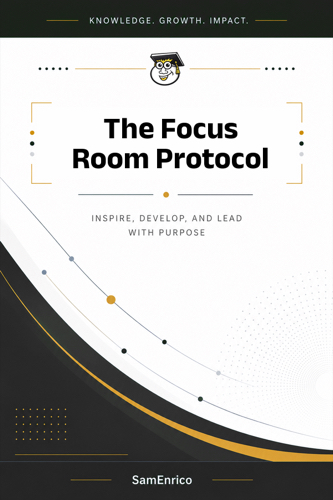
The Focus Room Protocol eBook
Reserves and equips dedicated silent spaces for in
by Worden Sandy
Reserves and equips dedicated silent spaces for interruption-free deep work.
Formats
Free sample
Chapter 1: The Stolen Mind--–- It begins as a faint pulse, barely noticeable against the rhythm of your thoughts. You are reading a report, drafting an email, or reviewing a spreadsheet when something shifts. The corner of your eye catches a notification banner. A smartphone buzzes face-down on the desk. A colleague’s voice carries over the cubicle wall.
And just like that, you are gone. Not physically—your body remains in the chair, your hands still on the keyboard—but mentally, you have left the building. The thread of your attention has snapped, and the work that mattered just moments ago now feels distant, almost foreign.You tell yourself it is nothing. A brief detour. You glance at the notification, answer the colleague, or simply let your mind wander for ten seconds.
Then you return to the report, the email, the spreadsheet. But something is wrong. The words that flowed easily before now feel sticky. The problem that was nearly solved now seems opaque. You have lost your place, your momentum, and—most crucially—your sense of being inside the work.
You are no longer immersed. You are merely present.This experience is so universal that we have stopped noticing it. We have built entire careers around the assumption that attention is infinitely renewable, that interruptions are minor inconveniences, and that the solution to distraction is simply trying harder. But the science tells a different story, and the story is alarming. Your attention is not renewable.
Interruptions are not minor. And trying harder is not a solution—it is a symptom of the very problem that needs solving.Welcome to the first chapter of The Focus Room Protocol. Before we build sanctuaries, before we design rituals, before we measure sprints and recoveries, we must confront the crisis that makes this book necessary. That crisis is the systematic theft of your attention by the architecture of modern work. Your mind has been stolen, not by a villain but by a thousand small design decisions embedded in your office, your devices, and your daily habits.
This chapter is the theft report. It is also the first step toward reclaiming what is rightfully yours.The Quiet Catastrophe Let us begin with a number that should terrify you: forty percent.According to research compiled by Gloria Mark at the University of California, Irvine, the average knowledge worker spends only about two and a half minutes on any given task before switching to something else. That is one hundred and fifty seconds of continuous focus before an email arrives, a message pings, a thought intrudes, or a colleague appears. Over the course of a day, this pattern of rapid switching consumes nearly forty percent of productive time. Not in the work itself, but in the cost of switching between tasks.Here is what that forty percent looks like in real terms.
Imagine an eight-hour workday. At the end of that day, you have been present for four hundred and eighty minutes. But of those minutes, only two hundred and eighty-eight were spent actively engaged in work—and even those were fragmented into tiny, inefficient slices. The remaining one hundred and ninety-two minutes—more than three hours—were burned as friction. You were not working.
You were not resting. You were recovering from interruptions. You were paying the neurological tax that modern work exacts on every shift of attention.Now multiply that by two hundred and fifty working days per year. You are losing nearly eight hundred hours annually to the hidden cost of task switching. That is twenty full workweeks.
Half a year of productive time, evaporated into the attentional abyss. And you have been taught to blame yourself for this loss. You have been told that you lack discipline, that you need better time management, that you should just focus harder. But the problem is not in you. The problem is in the system.This is the quiet catastrophe.
It does not announce itself with sirens or emergencies. It accumulates silently, day after day, until you wake up one morning realizing that you cannot remember the last time you did your best work. You have become a processor of interruptions rather than a creator of value. Your calendar is full, your inbox is empty, and your soul is exhausted. You have achieved the appearance of productivity while surrendering the substance of it.The Architecture of Distraction To understand how we arrived at this crisis, we must examine the physical and digital environments that most of us inhabit.
These environments were not designed by accident. They were designed by engineers, architects, and product managers who had specific goals in mind. Those goals, however, were rarely aligned with your ability to focus.Consider the open office. Conceived in Germany in the 1950s as a tool for democratic collaboration, the open plan has become the default configuration for offices worldwide. Its proponents argue that it fosters communication, transparency, and serendipity.
Its critics—and the evidence increasingly supports them—argue that it destroys concentration, increases stress, and actually reduces face-to-face interaction. When workers feel constantly observed and constantly interruptible, they retreat into headphones and avoid eye contact. The open office becomes a silent arena of mutual avoidance, not a bustling hub of collaboration.The data on open offices is damning. A comprehensive study of over forty-two thousand workers found that those in open offices reported lower levels of concentration, lower job satisfaction, and higher rates of turnover. Another study measured cognitive performance in open versus private offices and found that workers in open offices scored significantly lower on tests of attention, memory, and creative problem-solving.
The effect was so pronounced that some researchers have compared working in an open office to working in a state of chronic sleep deprivation.But the open office is only one layer of the architecture. The digital layer is even more pervasive. Email, instant messaging, project management software, and social media platforms are all designed to interrupt you. They are not designed to inform you; they are designed to engage you. And engagement, in the attention economy, is measured in seconds and clicks.
Every notification is a bid for your focus. Every banner is a trap. Every badge on every icon is a tiny scream for attention.The most insidious of these tools is the smartphone. The average person checks their phone ninety-six times per day. That is once every ten waking minutes.
But the checks themselves are not the primary problem. The primary problem is the anticipation of checks. Even when you are not looking at your phone, your brain is monitoring it. A phenomenon called "phantom vibration syndrome"—the sensation that your phone is buzzing when it is not—affects nearly ninety percent of smartphone users. Your brain has learned to expect interruption so thoroughly that it hallucinates the signal.This is not weakness.
This is conditioning. And like all conditioning, it can be unlearned. But unlearning requires first recognizing that you are not the architect of your own attention. You are a tenant in a building designed by people who profit from your distraction. The first step toward freedom is acknowledging the architecture.The Myth of Multitasking If the open…
This is the end of the free sample. Get the eBook to keep going. Buy now
About this book
Details
- Author
- Worden Sandy
- Publisher
- SamEnrico
- Language
- English
- Genre
- Non-Fiction, Self-Help, Workspace Design
- Released
- 2026-06-09
- Pages (approx.)
- 128
- Available as
- eBook, Audiobook

Read better in the ZLOADR app
Your eBooks on your phone or tablet. Sign in with your SamEnrico account and start reading.
More by Worden Sandy
 Mentorship for MusiciansWorden Sandy$11.99
 Recurring Dreams and DepressionWorden Sandy$11.99
 Loneliness Writing RecoveryWorden Sandy$11.99
 Window Down Deep BreathWorden Sandy$11.99
 Wholesaling Virtual Assistant GuideWorden Sandy$11.99
 The Sarah Everard of the WoodsWorden Sandy$11.99
 Spin Posture and Alignment FixWorden Sandy$11.99
 Antwerp Heist Loose EndsWorden Sandy$11.99
 Frozen in Time: The Mysterious Fate of the SS BaychimoWorden Sandy$11.99
 The Poisoned Chalice: The Deadly Race for Smallpox VaccineWorden Sandy$11.99
 Sands of the Heart: Love and War in the Desert Storm (1942-1943)Worden Sandy$11.99
 Growing MicromeriaWorden Sandy$11.99
You may also like
 Hong Kong Handover 1997Dunn Johnnie$11.99
 Zumba For Postnatal Recovery CourseNeal Christian$11.99
 Zumba for BeginnersLadner Nikia$11.99
 YouTube Comment Mining GuideHumes Pandora$12.99
 Worry Box MeditationCarlin Rudy$11.99
 Workplace Stress MeditationNguyen Lynn$11.99
 Workplace Stress and Sleep RepairHawley Ivory$11.99
 Workplace Perfectionism CureDelaney Jeffry$11.99
 Workplace Injustice Anger GuideWallen Isabelle$11.99
 Work Addiction and Burnout LinkGreenwood Ester$11.99
 Women in Yoga and WellnessBeattie Galina$11.99
 Women in Stand Up ComedyChun Evangeline$11.99