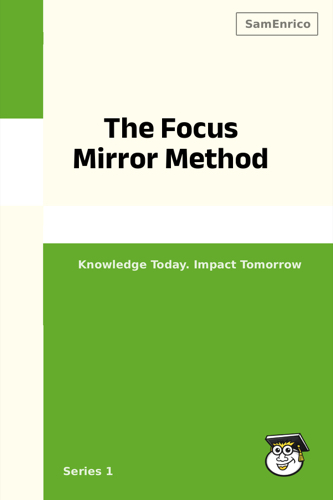
The Focus Mirror Method eBook
Places mirror facing desk to increase self-awarene
Places mirror facing desk to increase self-awareness when distracted.
Formats
Free sample
Chapter 1: The Empty Chair--–- Imagine sitting at your desk, deep in thought, when a colleague pulls up a chair and sits directly across from you, watching silently. They say nothing. They make no judgment. They simply sit there, present, observing. How long would you scroll through social media?
How long would you stare out the window? How long would you toggle between irrelevant tabs before feeling the weight of that gaze and returning to your work?You don't need a colleague. You need a mirror.This chapter introduces the core insight of the entire book: self-awareness is not a fixed personality trait you either have or lack. It is a state you can activate through environmental design. The Focus Mirror Method is deceptively simple—place a mirror facing your desk so that when you look up from your screen, you see your own reflection—but its implications are profound.
No app. No subscription. No complicated system. A mirror, positioned correctly, becomes an external witness to your attention. And the human brain responds to witnesses—even when the witness is yourself.The Distraction Epidemic Let us begin with a confession.
You are distracted right now. Not completely—you are reading these words, after all. But somewhere in the background, a notification is waiting. An email is unread. A tab is open to something you meant to check "real quick." A thought about what you will have for dinner is hovering at the edge of your consciousness.
This is not a failure. This is the normal state of the human brain in the twenty-first century.The average knowledge worker switches tasks every three minutes. Three minutes. That is less time than it takes to brew a cup of coffee, less time than it takes to read a single page of a book, less time than it takes to have a meaningful conversation. Every three minutes, something pulls your attention away from what you intended to do.
A notification. A memory. A worry. A sudden urge to check the news. And after each interruption, it takes an average of twenty-three minutes to fully return to the original task.Do the math.
If you work for eight hours and switch tasks every three minutes, you are interrupted 160 times per day. Each interruption costs twenty-three minutes of refocusing time. That is not a typo. The cost of distraction is not the three seconds it takes to glance at your phone. It is the twenty-three minutes of cognitive residue that follows—the time your brain spends slowly disengaging from the distraction and re-engaging with your work.Most people respond to this epidemic by trying harder.
They make resolutions. They install website blockers. They put their phones in another room. They tell themselves that tomorrow will be different. And tomorrow, they fail again.
Not because they are weak. Because they are fighting against the basic architecture of attention with the wrong weapons.The Audience Effect The Focus Mirror Method draws on a well-established psychological phenomenon called the "audience effect." In study after study, researchers have found that people perform differently when they believe they are being watched. They stand taller. They speak more carefully. They work more diligently.
They cheat less. They persist longer on difficult problems. The presence of an audience activates a part of the brain associated with self-monitoring and social evaluation—the medial prefrontal cortex, the anterior cingulate cortex, and the insula.Here is the fascinating discovery behind the Focus Mirror Method: the audience does not need to be another person. A mirror creates the same effect because the brain treats your own reflection as a separate social entity. When you see yourself, your brain does not think "that is me." It thinks "that is someone who is watching me." And it responds accordingly.Consider the research.
In one classic study, participants were placed in a room with a mirror and asked to complete a cognitive task. Compared to participants in a room without a mirror, they performed significantly better. They also reported higher levels of self-awareness and were more likely to align their behavior with their stated values. In another study, participants in front of a mirror ate less unhealthy food, exercised longer, and were less likely to cheat on a test. The mirror did not shame them.
It simply showed them the truth. And the truth, it turns out, is a powerful motivator.This is not magic. It is neuroscience. When you see your own reflection, your brain shifts from autopilot to self-aware mode. The Default Mode Network—the brain system responsible for mind-wandering, daydreaming, and distraction—quiets down.
The Task Positive Network—the system responsible for focused attention, goal-directed behavior, and executive control—activates. The shift happens automatically, without conscious effort. You do not need to tell yourself to focus. The visual cue of your own face triggers the transition.Why Willpower Is Not Enough You have tried to be more focused. You have tried to put away your phone.
You have tried to close unnecessary tabs. You have tried to resist the siren song of social media, news alerts, and the endless dopamine loop of notifications. And like everyone else, you have failed. Not because you are weak. Because willpower is a finite resource that depletes throughout the day, while distractions are infinite and strategically designed to capture your attention.The psychology of willpower is well understood.
Your capacity for self-control is like a muscle. It can be strengthened over time, but it also fatigues with use. Each act of resistance—each time you ignore a notification, close a distracting tab, or turn away from your phone—draws from the same limited pool of self-control resources. By late afternoon, your willpower is depleted. The distractions that you easily resisted in the morning become irresistible.
You are not failing. You are running out of fuel.The Focus Mirror Method does not rely on willpower. It relies on architecture. When you place a mirror facing your desk, you are not asking yourself to be stronger. You are changing the environment so that distraction becomes visibly, uncomfortably, obviously a choice.
You cannot mindlessly scroll when your own face stares back at you. You cannot rationalize that you are "just checking one thing" when your reflection shows you slouching, eyes glazed, thumb hovering over the app icon. The mirror introduces psychological friction. Not physical friction—you can still look away. But psychological friction.
You have to choose to ignore yourself. And that small pause, that moment of recognition, is often enough to break the trance of distraction.This is the difference between fighting your brain and working with it. Willpower is a sword. Environment is a fortress. Stop swinging.
Start building.The Empty Chair Principle The Focus Mirror Method takes its name from a concept I call the Empty Chair Principle. In psychotherapy, the "empty chair technique" invites a client to imagine someone sitting across from them—a person they have unresolved feelings toward—and to speak to that imagined presence as a way of accessing hidden emotions. The empty chair becomes a container for projection, a safe space for difficult conversations.The Focus Mirror Method inverts this. Instead of imagining someone who is not there, you…
This is the end of the free sample. Get the eBook to keep going. Buy now
About this book
Details
- Author
- Crowe Clarita
- Publisher
- SamEnrico
- Language
- English
- Genre
- Non-Fiction, Self-Help, Self-Awareness
- Released
- 2026-06-10
- Pages (approx.)
- 120
- Available as
- eBook, Audiobook

Read better in the ZLOADR app
Your eBooks on your phone or tablet. Sign in with your SamEnrico account and start reading.
More by Crowe Clarita
 International Networking Protocol GuideCrowe Clarita$11.99
 Loneliness Dance Fitness GuideCrowe Clarita$11.99Loneliness Dance Fitness GuideCrowe Clarita$11.99
 Washington GeneralCrowe Clarita$11.99
 Asking for MentorshipCrowe Clarita$11.99
 Senior Change AdaptationCrowe Clarita$11.99
 Control Release TranceCrowe Clarita$11.99
 The Recovery Movement GuideCrowe Clarita$11.99
 Magnetic Hands InductionCrowe Clarita$11.99
 The Day the Music Burned: The Lost Tapes of the National Recording RegistryCrowe Clarita$11.99
 The Black Rider of the CarpathiansCrowe Clarita$11.99
 Into the Abyss: The Forgotten Divers of the PacificCrowe Clarita$11.99