
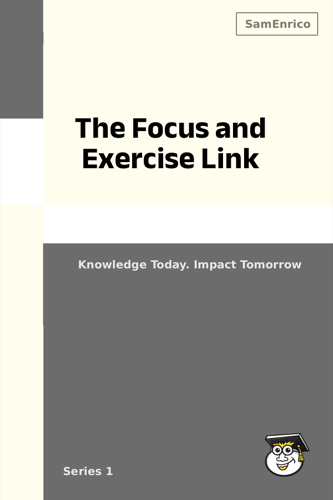
Non-FictionBusiness BriefExercise
The Focus and Exercise Link eBook
Use physical activity to boost attention and conce
Use physical activity to boost attention and concentration.
Formats
Free sample
Chapter 1: The Sitting Disease--The moment you sit down to read this chapter, you are already losing the battle for your attention. Not because the writing is dull, and not because you lack discipline, but because the chair beneath you is quietly starving your brain of the very fuel it needs to concentrate.Let that land for a moment.Every hour you spend seated—every meeting, every email marathon, every “quick check” of social media—is triggering a physiological cascade that directly undermines your ability to focus. And the cruel irony is that the more distracted you feel, the more you tend to sit still, trying to “power through.” You tell yourself to try harder. You drink more coffee. You open a second tab.
Meanwhile, your prefrontal cortex—the neural command center for attention, impulse control, and decision-making—is operating on a fraction of its optimal blood supply.This is not a metaphor. This is circulatory biology.The Prefrontal Cortex: Your Brain’s CEOBefore we can understand why sitting is so dangerous for attention, we need to meet the part of your brain that does the heavy lifting of focus. The prefrontal cortex (PFC) sits just behind your forehead, occupying roughly 10 percent of your brain’s total volume but commanding an outsized role in everything that makes you functionally intelligent.Think of your PFC as the CEO of your brain. It doesn’t handle every task directly, but it decides which tasks matter, suppresses irrelevant distractions, resists impulsive urges, and holds your goals in mind while your brain’s other departments execute the work. When your PFC is firing on all cylinders, you can sit down at 9 a.m., open a document, and write until noon without once checking your phone.
When your PFC is compromised, you find yourself staring at a blinking cursor, then at your email inbox, then at the weather app, then back at the cursor—twenty minutes gone, nothing accomplished.Here is what most people do not know: the PFC is exquisitely sensitive to blood flow and energy availability. It consumes more glucose and oxygen per unit volume than almost any other brain region. And unlike the parts of your brain that control breathing or heartbeat—which are designed to run automatically even under duress—the PFC is the first to power down when resources become scarce.This is an evolutionary relic. Your ancient ancestors did not need sustained attention for writing reports or coding software. They needed fight-or-flight responses.
When resources were low, the brain wisely preserved survival functions and sacrificed executive function. The problem is that your modern office chair triggers this same resource-conservation response every single day.The Hemodynamic Disaster of Prolonged Sitting Let me give you a number that should alarm you: fifteen to twenty percent.That is the estimated reduction in cerebral blood flow to the prefrontal cortex after sitting uninterrupted for four hours. After eight hours—a standard workday plus commute—the reduction can be even greater. Your brain’s CEO is working on four-fifths of its usual fuel. Would you expect a CEO to make sharp decisions after losing twenty percent of their budget?
Neither should you expect your own brain to focus.How does this happen? When you sit for extended periods, several mechanisms converge to reduce brain perfusion:First, hydrostatic pressure changes. Your heart has to work against gravity to pump blood up to your brain. When you are upright and moving, your leg muscles contract rhythmically, squeezing blood back toward your heart and creating a healthy pressure gradient. When you sit, those muscle pumps fall silent.
Blood pools in your lower extremities. Cardiac output drops slightly, and less blood reaches your brain.Second, vessel stiffening. Prolonged sitting triggers changes in the elasticity of blood vessels, particularly the carotid arteries that supply the brain. Within hours of uninterrupted sitting, arterial compliance decreases, meaning your vessels cannot expand as readily to accommodate each heartbeat’s rush of blood. The result is a less forceful, less efficient delivery of oxygen to neural tissue.Third, the compression effect.
Sitting compresses the major blood vessels in your hips and pelvis, particularly the iliac arteries. This compression creates a bottleneck that further reduces flow velocity to the lower body and, via a cascade of pressure adjustments, to the brain as well.These are not theoretical concerns. In a 2018 study published in the Journal of Applied Physiology, researchers used ultrasound to measure cerebral blood flow in healthy adults before and after four hours of uninterrupted sitting. The results showed significant reductions in middle cerebral artery velocity—a direct measure of blood delivery to the frontal lobes. Participants also performed worse on tests of executive function, particularly tasks requiring impulse control and task-switching.Let me translate the science into lived experience: that afternoon fog you feel around 2 p.m., when your brain feels stuffed with cotton and every email requires Herculean effort to read?
That is not just circadian rhythm. That is your PFC suffocating in slow motion.The Dopamine Lie: Why Scrolling Feels Good but Never Satisfies Blood flow is only half the story. The other half involves a molecule you have probably heard of: dopamine.Popular culture has reduced dopamine to a simple “pleasure chemical,” but the reality is far more interesting—and far more relevant to the argument of this chapter. Dopamine is not primarily about pleasure. It is about salience.
It is the molecule that says, “Pay attention to this; something important might happen.”Here is the critical distinction that most self-help books get wrong. There are two fundamentally different patterns of dopamine release: fragmented and sustained. Understanding the difference is the key to understanding why your phone feels addictive but never fulfilling.Fragmented dopamine release occurs when you receive rapid, unpredictable, low-information rewards. Checking your phone and seeing a new notification triggers a small dopamine spike. Scrolling to the next post triggers another.
Opening a text message triggers another. Each spike is real—you can measure it in a PET scanner. But each spike is also tiny, short-lived, and followed by a quick return to baseline. Over time, this pattern trains your brain to crave the anticipation of reward more than the reward itself. You are not checking your phone because you enjoy what you find.
You are checking because the possibility of a reward triggers dopamine, and the drop that follows triggers craving for the next spike.This is the mechanism behind the “scroll hole.” You open Instagram for “just a second.” Forty minutes later, you cannot remember a single post you saw, but you feel vaguely depleted and slightly ashamed. You were not enjoying yourself. You were trapped in a dopamine loop of diminishing returns.Sustained dopamine release occurs when you engage in prolonged, effortful activity that leads to a meaningful outcome. Running a 5k, finishing a difficult chapter of a book, solving a complex problem at work—these activities produce a slower, steadier rise in dopamine that sustains over minutes or hours. The peak may be lower than the spike from a notification, but the area under the curve—the total dopamine signal—is far larger.
More importantly, sustained dopamine release is accompanied by a sense of satisfaction rather than craving. You feel calm, not hungry.Exercise…
This is the end of the free sample. Get the eBook to keep going. Buy now
About this book
Details
- Author
- Broderick Dee
- Publisher
- SamEnrico
- Language
- English
- Genre
- Non-Fiction, Business Brief, Exercise
- Released
- 2026-06-06
- Pages (approx.)
- 132
- Available as
- eBook, Audiobook

Read better in the ZLOADR app
Your eBooks on your phone or tablet. Sign in with your SamEnrico account and start reading.
More by Broderick Dee
 Rainbow Bridge Calm GuideBroderick Dee$11.99
 Mango Tree NapBroderick Dee$11.99
 Flow Journal PromptsBroderick Dee$11.99
 Stress Cold Sores GuideBroderick Dee$11.99
 Self Talk for ExtrovertsBroderick Dee$11.99
 Eisenhower Matrix for ExecutivesBroderick Dee$11.99
 Powerlifting Hypnosis GuideBroderick Dee$11.99
 The Twilight Zone: Rod Serling's Vision That Defied the Cold WarBroderick Dee$11.99
 The Bloody Field of Marston Moor: Cromwell's Gambit and the Birth of a RepublicBroderick Dee$11.99
 Problem Solution SnapshotBroderick Dee$12.99
 Chinese Supplier Alternative Sourcing PlaybookBroderick Dee$12.99
 Woodlice: Pill BugBroderick Dee$11.99
You may also like
 Hong Kong Handover 1997Dunn Johnnie$11.99
 Zumba For Postnatal Recovery CourseNeal Christian$11.99
 Zumba for BeginnersLadner Nikia$11.99
 YouTube Comment Mining GuideHumes Pandora$12.99
 Worry Box MeditationCarlin Rudy$11.99
 Workplace Stress MeditationNguyen Lynn$11.99
 Workplace Stress and Sleep RepairHawley Ivory$11.99
 Workplace Perfectionism CureDelaney Jeffry$11.99
 Workplace Injustice Anger GuideWallen Isabelle$11.99
 Work Addiction and Burnout LinkGreenwood Ester$11.99
 Women in Yoga and WellnessBeattie Galina$11.99
 Women in Stand Up ComedyChun Evangeline$11.99