
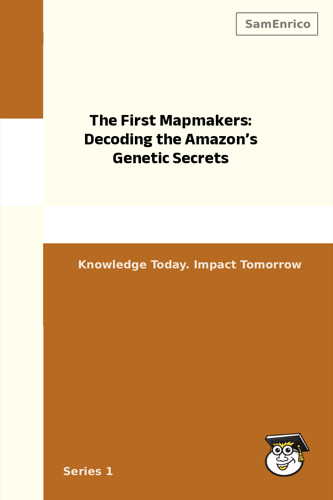
Non-FictionGenetics Revolution
The First Mapmakers: Decoding the Amazon’s Genetic Secrets eBook
Thousands of years ago, prehistoric European and i
Thousands of years ago, prehistoric European and indigenous Amazonian explorers ventured into the uncharted rainforest, uncovering genetic links between ancient migrations and the Amazon’s biodiversity. Their daring journeys laid the foundation for modern genetics and anthropology.
Formats
Free sample
Chapter 1: The Living Artifact...--–- The jungle, they told us, was eternal and empty. A green hell. A place where no civilization could rise, where man was merely a visitor, never a shaper. They were wrong about all of it.The lie began with Francisco de Orellana. In 1542, the Spanish conquistador became the first European to navigate the entire length of the Amazon River, from the Andes to the Atlantic.
He returned to Spain with tales of dense canopy, howling monkeys, biting insects, and occasional encounters with hostile tribes. His chroniclers described a wilderness so thick, so indifferent to human ambition, that it could never be tamed. For nearly five centuries, that image stuck. The Amazon was the "virgin jungle"—untouched, unclaimed, and until modern times, largely unmapped.But Orellana either lied or was defeated by the forest he could not see. Beneath his boats, hidden under the very canopy he cursed, lay evidence of a civilization so vast, so sophisticated, and so different from anything Europe had ever produced that it would take the invention of lasers from space to finally reveal it.This book is about that revelation.
It is about the people who came before—not just the explorers and conquistadors, but the true first mapmakers of the Amazon. They did not draw lines on parchment or carve coordinates into stone. They mapped the world through biology. They reshaped forests, engineered soils, domesticated plants, and decoded the genetic secrets of life without ever knowing what a gene was. Their map is written in the DNA of the trees, in the dark earth beneath our feet, and in the blood of their descendants who still live in the rainforest today.And now, for the first time in human history, we are learning to read it.The Discovery That Changed Everything In the early 2000s, a Brazilian archaeologist named Denis Schaan was scrolling through satellite images of the upper Amazon Basin when he noticed something odd.
The region, known as the Bolivian Amazon, had been heavily deforested for cattle ranching. Where the trees had been stripped away, the ground revealed strange geometric shapes—perfect circles, squares, and octagons connected by straight lines. They were hundreds of feet across, too regular to be natural, and completely invisible from the ground because the jungle had swallowed them.Schaan had discovered the geoglyphs of the Amazon. Over the next decade, using Li DAR (Light Detection and Ranging)—a technology that fires millions of laser pulses from an aircraft to map ground elevation beneath vegetation—archaeologists identified more than 500 of these massive earthworks scattered across a region the size of New Jersey. They dated to between 2,000 and 800 years ago, but some were far older.
The structures were not villages or fortresses. They were ceremonial spaces, gathering grounds, and what archaeologists call "earthworks of significance"—places where people came together to build, to worship, and to transform the land.The geoglyphs delivered the first blow to the "virgin jungle" myth. Here was proof that large populations had not only lived in the Amazon but had moved millions of cubic meters of earth to reshape it. These were not hunter-gatherers scraping by. These were organized societies with complex labor management, engineering knowledge, and a vision of the forest that was fundamentally different from the European one.But the geoglyphs were only the beginning.Terra Preta: The Soil That Should Not Exist While Schaan was mapping the geoglyphs from space, soil scientists were making an equally shocking discovery on the ground.
Scattered across the Amazon basin, often near riverbanks and still-occupied indigenous territories, were patches of black, fertile soil that stood in stark contrast to the surrounding red, nutrient-poor earth. The locals called it Terra Preta—"black earth" in Portuguese. Scientists called it a mystery.The Amazon's natural soil, known as oxisol, is terrible for agriculture. It is acidic, aluminum-rich, and so nutrient-poor that most crops wither within a season. This is why the "virgin jungle" myth seemed plausible: if the soil could not support farming, how could civilization exist?
But Terra Preta breaks every rule. It is dark, crumbly, and incredibly fertile. It retains nutrients for decades. It regenerates itself. And it was not made by nature.Chemical analysis revealed that Terra Preta contains high concentrations of charcoal (biochar), bone fragments, manure, and decomposed organic matter.
It was created by humans through a deliberate, sophisticated process: mixing waste with soil, burning it slowly at low temperatures to create biochar, and then letting microbial communities establish themselves. The result is a soil amendment that can sequester carbon for millennia—something modern agronomists are only beginning to understand.Terra Preta covers up to 10% of the Amazon basin, an area larger than France. The sheer volume of it—millions of tons—implies a population far larger than any previous estimate. The anthropologist Charles Mann, in his landmark book *1491*, argued that the pre-Columbian Amazon may have supported 8 to 10 million people, comparable to the population of medieval Europe. And they did it not despite the jungle, but because of it.The Orchard That Became a Forest If the geoglyphs and Terra Preta proved that people lived in the Amazon, the next discovery proved that they had engineered it from the ground up.
Ecologists began to notice something strange about the distribution of plant species in the "wild" rainforest. Certain valuable trees—the Brazil nut, the cacao, the acai palm—were suspiciously common, clustered in patterns that made no sense for natural dispersal. When they ran the numbers, they found that the Amazon's most abundant plant species were not wild at all. They had been domesticated.This is the bombshell that few outside of archaeology have fully absorbed: the Amazon rainforest is an artifact. It is a giant orchard, planted and managed by indigenous peoples over thousands of years.
The jungle that Orellana called "wild" was actually a carefully curated garden. The trees that seemed "natural" were, in many cases, the descendants of those selected by human hands for their fruit, their nuts, their wood, or their medicine.Take the Brazil nut tree (Bertholletia excelsa). It is one of the Amazon's most iconic species, towering up to 50 meters with a trunk as wide as a car. It produces heavy, cannonball-like pods that contain the nuts we eat. But the Brazil nut tree cannot reproduce without a specific bee—a large, solitary bee of the genus Euglossa—that is itself dependent on a specific orchid that blooms only in certain conditions.
This is not a coincidence. Indigenous peoples managed entire groves of Brazil nut trees, selecting for nut size and oil content, ensuring the bees had the orchids they needed, and creating a production system that required no fields, no plows, and no irrigation. The forest did the work. The people just guided it.Or consider manioc (Manihot esculenta), also known as cassava. Wild manioc is toxic, containing cyanogenic glycosides that can cause cyanide poisoning and death.
But indigenous farmers in the Amazon bred it over centuries into two safe varieties: sweet manioc (low toxicity) and bitter manioc (still toxic but processed to remove poison). Today, manioc feeds more than 800 million people worldwide. It is the third-largest source of calories…
This is the end of the free sample. Get the eBook to keep going. Buy now
About this book
Details
- Author
- Mccallum Ricki
- Publisher
- SamEnrico
- Language
- English
- Genre
- Non-Fiction, Genetics Revolution
- Released
- 2026-06-04
- Pages (approx.)
- 121
- Available as
- eBook, Audiobook

Read better in the ZLOADR app
Your eBooks on your phone or tablet. Sign in with your SamEnrico account and start reading.
More by Mccallum Ricki
 The Parental Resentment ResetMccallum Ricki$11.99
 Partner Dependency Rehab GuideMccallum Ricki$11.99
 Therapy For Nightmare DisorderMccallum Ricki$11.99
 Energy Journal Work PlanMccallum Ricki$11.99
 The Last Stand of the Honeybee WhispererMccallum Ricki$11.99
 CarrierMccallum Ricki$11.99
 Hundred Dollar Shopify Launch GuideMccallum Ricki$12.99
 Cloud ERP Outlook 2026Mccallum Ricki$12.99
 Understanding Hereditary PancreatitisMccallum Ricki$17.99
 How to Start a Pressboard Business (Beginners Guide)Mccallum Ricki$11.99
You may also like
 Hong Kong Handover 1997Dunn Johnnie$11.99
 Zumba For Postnatal Recovery CourseNeal Christian$11.99
 Zumba for BeginnersLadner Nikia$11.99
 YouTube Comment Mining GuideHumes Pandora$12.99
 Worry Box MeditationCarlin Rudy$11.99
 Workplace Stress MeditationNguyen Lynn$11.99
 Workplace Stress and Sleep RepairHawley Ivory$11.99
 Workplace Perfectionism CureDelaney Jeffry$11.99
 Workplace Injustice Anger GuideWallen Isabelle$11.99
 Work Addiction and Burnout LinkGreenwood Ester$11.99
 Women in Yoga and WellnessBeattie Galina$11.99
 Women in Stand Up ComedyChun Evangeline$11.99