
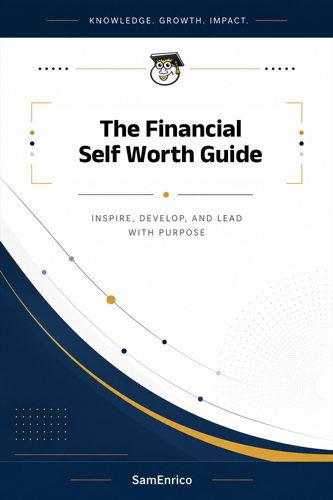
The Financial Self Worth Guide eBook
Avoid shame about reduced retirement income and fi
by Lara Robbi
Avoid shame about reduced retirement income and fixed budgets.
Formats
Free sample
Chapter 1: The Quiet Panic--–- It hit you on a Tuesday. Not during a dramatic market crash, not after a medical emergency, but on an utterly ordinary Tuesday morning. You checked your bank balance out of habit, the way you might check the weather, and you saw the number. It wasn't zero. It wasn't even low, by most standards.
But for the first time in forty years, you realized with a specific, cold clarity: no more paycheck was coming to rescue this number. What you saw is what you have. That's when the quiet panic began.Not the loud, Hollywood kind of panic with sirens and frantic phone calls. The quiet kind. The kind that lives in the back of your throat during dinner.
The kind that wakes you at 3:00 AM with a single, looping question: What if I run out?You are not alone. This chapter is not written for the destitute, nor for the obscenely wealthy. It is written for the vast, invisible middle – the retirees, the downshifters, the partially employed, and the suddenly-single – who look at their fixed, modest retirement income and feel a hot wash of shame they cannot name. You have done everything right. You saved.
You planned. You worked for decades. And yet, here you are, feeling poorer than you ever felt when you had nothing. This is the gap this book exists to close: the gap between your net worth and your self-worth.In this chapter, we will name the beast. We will dissect the psychological shock of moving from accumulation to withdrawal – a transition that financial books rarely discuss because it is emotional, not mathematical.
We will explore why a retiree with a million dollars can feel more anxious than a student with a hundred. We will introduce the concept of "accumulation-to-withdrawal shock" and, most importantly, we will separate two things that your brain has dangerously fused together: money and identity.By the end of this chapter, you will understand why you feel poor even when you are not, why the shame is not about the dollar amount, and how naming this feeling is the first – and most essential – step toward building a rich life on a fixed budget. Let us begin.The Tuesday Morning Math Let us be specific about that Tuesday morning. You are sixty-seven years old. You retired six months ago.
Your house is paid off – a fact you know you should feel grateful for, and you do, intellectually. Your car is ten years old but runs fine. You have no credit card debt. By every objective measure used by financial planners – debt-to-income ratio, net worth, withdrawal rate – you are solidly middle-class secure.And yet.Your monthly income now comes from three sources: Social Security ($2,200), a small pension from a job you left twenty years ago ($600), and a required minimum distribution from your 401(k) that you set up on autopilot ($1,200). Total: $4,000 per month.
Fixed. Predictable. Immovable.Before you retired, your monthly take-home pay was $8,500. You didn't feel rich then. You felt normal.
You worried about college tuition, roof repairs, and whether you could afford that trip to see your daughter. But you never felt the quiet panic. Because every two weeks, like clockwork, a deposit appeared. You didn't have to think about where the next money was coming from. It just came.Now, the math is different.
You have $4,000. It arrives on the first of the month. By the fifth, after mortgage (even paid-off houses have taxes and insurance), utilities, groceries, and one prescription, you have $2,200 left. By the fifteenth, after a haircut, a tank of gas, and a birthday gift for your grandson, you have $1,400. By the twenty-fifth, you are watching every dollar, mentally subtracting future expenses from a shrinking pool.
On the thirtieth, you exhale. You made it. But you didn't live.This is not a math problem. It is a perception problem. Here is the proof: if your monthly income were suddenly cut to $2,000, you would survive.
You would cut cable, eat more rice and beans, drive less. You would adapt. And if your monthly income were suddenly raised to $8,000, within six months you would feel exactly as anxious as you do now – because you would raise your spending to match. The human animal is remarkably adaptable, which is both our superpower and our curse. We adapt to abundance by wanting more.
We adapt to scarcity by surviving on less. But we do not adapt easily to the feeling of withdrawal itself.The Psychology of Withdrawal (Why It Hurts)Let us talk about the brain. Specifically, let us talk about loss aversion – a cognitive bias discovered by psychologists Daniel Kahneman and Amos Tversky, for which Kahneman won a Nobel Prize. Here is the finding in plain English: losing $100 feels about twice as painful as gaining $100 feels pleasurable. Your brain is asymmetrically wired to avoid loss.
This made excellent evolutionary sense. For our ancestors, losing food storage meant death. Gaining extra food storage meant a slightly more comfortable winter. The brain learned: loss is an emergency; gain is a footnote.Now apply this to retirement. For forty years, your brain watched your account balance go up.
Every paycheck was a gain. Even small gains felt good. Even flat months felt okay because you knew another gain was coming. Your brain relaxed into a pattern of expecting growth. Then, suddenly, the direction flipped.
Withdrawal began. Even if you planned for it. Even if your financial advisor told you it was safe. Even if you have enough money to last thirty years. Your brain does not care about the spreadsheet.
Your brain sees a withdrawal and screams: LOSS.This is the accumulation-to-withdrawal shock. It is not a character flaw. It is not a sign that you are bad with money. It is a neurological response to a fundamental change in the direction of your cash flow. And because loss feels twice as painful as gain feels pleasurable, a $4,000 withdrawal from your account feels roughly as bad as an $8,000 paycheck felt good.
You are not imagining the anxiety. It is real. It is physiological. And it is temporary – but only if you name it.Let me give you a concrete example. Imagine two retirees: Carol and Bob.
Both have $500,000 saved. Carol withdraws $2,000 per month. Bob withdraws $2,000 per month. By every financial metric, they are identical. But Carol spent thirty years as a high-earning executive with a $20,000 monthly paycheck.
Bob spent thirty years as a public school teacher with a $5,000 monthly paycheck. Who feels more anxious? Carol. Not because her math is worse, but because her gap is larger. She is not comparing her current spending to her current needs.
She is comparing her current withdrawal to her former salary. And that comparison is a knife.The Identity Theft No One Talks About Let us go deeper. The quiet panic is not really about money. It is about who you are now.For forty years, you introduced yourself by your job. "I'm a nurse." "I'm a regional manager." "I'm a small business owner." Your job gave you a tribe, a daily purpose, a reason to shower and put on clothes that buttoned.
And your paycheck was the proof that you mattered. Every two weeks, the market – that cold, impartial arbiter of…
This is the end of the free sample. Get the eBook to keep going. Buy now
About this book
Details
- Author
- Lara Robbi
- Publisher
- SamEnrico
- Language
- English
- Genre
- Non-Fiction, Self-Help, Financial
- Released
- 2026-06-09
- Pages (approx.)
- 133
- Available as
- eBook, Audiobook

Read better in the ZLOADR app
Your eBooks on your phone or tablet. Sign in with your SamEnrico account and start reading.
More by Lara Robbi
 Research Proposal Research Questions DesignLara Robbi$11.99
 The IVF Anxiety ProtocolLara Robbi$11.99
 Holocaust Survivor Family ReunitedLara Robbi$11.99
 Sector Assessment QuizLara Robbi$11.99
 Cannabis Use Disorder DSM CriteriaLara Robbi$11.99
 Warren Buffett GivingLara Robbi$11.99
 Self Esteem After NeglectLara Robbi$11.99
 The Last Supper of the Dinosaurs: A Feast That Never WasLara Robbi$11.99
 The Onibaba's Hollow: A Samurai's Descent into the Yokai MistsLara Robbi$11.99
 Growing Deuterocohnia Syn. AbromeitiellaLara Robbi$11.99
 Ecommerce One Page Plan GuideLara Robbi$12.99
 Budget Constraint Excel VisualizerLara Robbi$12.99
You may also like
 Hong Kong Handover 1997Dunn Johnnie$11.99
 Zumba For Postnatal Recovery CourseNeal Christian$11.99
 Zumba for BeginnersLadner Nikia$11.99
 YouTube Comment Mining GuideHumes Pandora$12.99
 Worry Box MeditationCarlin Rudy$11.99
 Workplace Stress MeditationNguyen Lynn$11.99
 Workplace Stress and Sleep RepairHawley Ivory$11.99
 Workplace Perfectionism CureDelaney Jeffry$11.99
 Workplace Injustice Anger GuideWallen Isabelle$11.99
 Work Addiction and Burnout LinkGreenwood Ester$11.99
 Women in Yoga and WellnessBeattie Galina$11.99
 Women in Stand Up ComedyChun Evangeline$11.99