
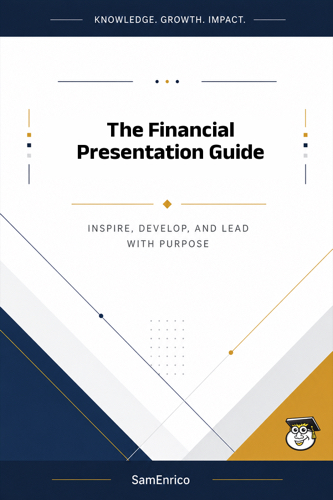
The Financial Presentation Guide eBook
Explain quarterly results, budgets, and forecasts
by Clanton Abe
Explain quarterly results, budgets, and forecasts to stakeholders.
Formats
Free sample
Chapter 1: Decisions, Not Data--–- Most finance professionals believe they are in the numbers business. They are wrong. You are not paid to produce accurate spreadsheets, tidy variance analyses, or GAAP-compliant footnotes. Those are table stakes—the minimum required to keep your job, not the work that advances your career or influences your organization. You are paid to enable better decisions.
Every board meeting, every quarterly review, every budget presentation has exactly one measure of success: Did the stakeholders in the room make a better decision because you presented than they would have without you?This is the core philosophy of this book, and it must become the core philosophy of your financial presentations. Yet almost no finance professionals operate this way. Walk into any corporate headquarters during budget season or earnings preparation, and you will find teams hunched over spreadsheets, obsessing over decimal places, formatting footnotes, and building slide decks that run to forty or fifty pages. They are working hard. They are technically correct.
And they are failing.The evidence is everywhere. How many times have you sat through a presentation where the CFO clicked through forty-three slides of detailed financials, only to have the CEO ask, "So what does this mean for our strategy?" Or worse, the board member who interrupts after slide three to say, "I don't care about the detailed bridge—just tell me if we're on track to hit our annual number." These interruptions are not signs of impatient stakeholders. They are symptoms of a fundamental mismatch between what finance professionals prepare and what decision-makers actually need.This chapter introduces the single most important shift you will make as a financial presenter: moving from a data-first mindset to a decisions-first mindset. It provides the frameworks, tools, and discipline required to transform how you build every financial presentation from this moment forward. By the end of this chapter, you will never again open Power Point and begin by pasting in your Excel exports.
You will begin by asking three questions that change everything.The Three Questions That Change Everything Before you create a single slide, before you run a single formula, before you decide what chart to use or what font size to select, you must answer three questions. Write them down. Post them above your desk. Require your entire team to answer them before any presentation work begins.Question One: What decision does this stakeholder need to make after my presentation?This is the most important question, and it is the one finance professionals most frequently skip. Notice the phrasing: "need to make." Not "might consider." Not "could think about." Need.
To. Make. A decision is a binding choice between two or more alternatives that commits resources, changes direction, or approves action. If no binding choice is required, you are not giving a presentation. You are sending an email.
Save everyone's time and do that instead.Examples of actual decisions: "Should we approve the Q3 marketing budget of $2.1 million?" "Should we revise our annual revenue forecast downward by 8%?" "Should we proceed with the acquisition of Company X at the proposed valuation?" "Should we reallocate headcount from Product A to Product B?" Each of these requires a yes/no vote, a signature, a resource commitment, or a public statement.Examples of non-decisions disguised as presentations: "Let me walk you through our Q2 results." (No decision required—just awareness.) "Here is our updated five-year strategic plan." (No decision required—just information.) "I'd like to share our new forecasting methodology." (No decision required—just education.) If you cannot identify a specific decision your stakeholder must make, stop. Do not build slides. Do not schedule a meeting. Send a memo or a recording. Your stakeholders will thank you.Question Two: What information does this stakeholder need to make that decision well?Notice what this question does not ask.
It does not ask, "What data do I have available?" It does not ask, "What information is interesting or informative?" It does not ask, "What did we present last quarter?" It asks only about what the stakeholder needs. This forces a brutal prioritization that most finance professionals resist because it requires leaving good information on the cutting room floor.For a decision about budget approval, the stakeholder needs: the total requested amount, the expected return on that investment, the key assumptions driving that return, the risks that could derail it, and the comparison to alternative uses of the same capital. The stakeholder does not need: detailed headcount by department, a line-by-line comparison to last year's actuals, the accounting treatment of depreciation, or seventeen backup slides with sensitivity analyses. Those can be available in an appendix or a follow-up document, but they do not belong in the main presentation.For a decision about revising revenue guidance, the stakeholder needs: the old forecast, the new forecast, the specific operational drivers causing the change, the confidence interval around the new forecast, and the action plan if the new forecast is also wrong. The stakeholder does not need: a restatement of every P&L line item, a detailed explanation of why the original forecast was wrong (beyond the key drivers), or a comparison to competitors who are also missing guidance.Question Three: What is the single most important thing my stakeholder must remember?If a stakeholder walks out of your presentation and can remember only one thing, what should it be?
This question forces you to identify the irreducible core of your message. The answer should be a single sentence that a stakeholder could repeat to a colleague who was not in the room. For example: "Our Q3 budget requests $2.1 million to launch in three new markets, and we expect $6 million in new revenue within twelve months." Or: "We are lowering our annual guidance by 5% because supply chain delays have pushed product launches from Q2 to Q3."Notice what these examples do not include. They do not include the word "quarter-over-quarter." They do not include percentages that require a calculator. They do not include jargon like "synergies," "leverage," or "optimize." They are plain English sentences that a non-finance executive could understand and repeat.
If you cannot reduce your presentation to one such sentence, you do not understand your own message well enough to present it.The So What Filter: Your Most Powerful Editing Tool The three questions above lead directly to the most practical tool in this chapter: the So What Filter. This is a disciplined, ruthless practice of reviewing every element of your presentation—every slide, every chart, every bullet point, every number—and asking one question: "So what?"The "So what" question is not rhetorical. It demands an answer that connects the data point to the stakeholder's decision. If you cannot articulate that connection within ten seconds, the data point does not belong in your presentation. Delete it.
Move it to an appendix. Put it in a follow-up email. But do not let it steal attention from the information that actually drives the decision.Apply the So What Filter at three levels.First, apply it to each slide. Before you build a slide, write down the single decision this slide supports. If you cannot write that down, do not build the slide.
For example: "This slide supports the decision to approve the marketing budget by showing the expected return on spend across…
This is the end of the free sample. Get the eBook to keep going. Buy now
About this book
Details
- Author
- Clanton Abe
- Publisher
- SamEnrico
- Language
- English
- Genre
- Non-Fiction, Self-Help, Finance
- Released
- 2026-06-11
- Pages (approx.)
- 147
- Available as
- eBook, Audiobook

Read better in the ZLOADR app
Your eBooks on your phone or tablet. Sign in with your SamEnrico account and start reading.
More by Clanton Abe
 Helplessness and AngerClanton Abe$11.99
 Trance for Phantom Limb PainClanton Abe$11.99
 The Natural Genius TrapClanton Abe$11.99
 Language Learning NapsClanton Abe$11.99
 Fibromyalgia and HypermobilityClanton Abe$11.99
 Caregiver End of Life DecisionsClanton Abe$11.99
 Team Wellbeing Check InsClanton Abe$11.99
 Property Management KPIsClanton Abe$11.99
 Zero Day Zero Hour: The Untold Story of Stuxnet’s Shadow WarClanton Abe$11.99
 The Ghosts of Cambrai: The Birth of the Tank in Blood and FireClanton Abe$11.99
 El Greco: The Visionary of ToledoClanton Abe$11.99
 New Zealand Scholarships AfricaClanton Abe$12.99
You may also like
 Hong Kong Handover 1997Dunn Johnnie$11.99
 Zumba For Postnatal Recovery CourseNeal Christian$11.99
 Zumba for BeginnersLadner Nikia$11.99
 YouTube Comment Mining GuideHumes Pandora$12.99
 Worry Box MeditationCarlin Rudy$11.99
 Workplace Stress MeditationNguyen Lynn$11.99
 Workplace Stress and Sleep RepairHawley Ivory$11.99
 Workplace Perfectionism CureDelaney Jeffry$11.99
 Workplace Injustice Anger GuideWallen Isabelle$11.99
 Work Addiction and Burnout LinkGreenwood Ester$11.99
 Women in Yoga and WellnessBeattie Galina$11.99
 Women in Stand Up ComedyChun Evangeline$11.99