
Non-FictionSelf-HelpAcademic Resilience
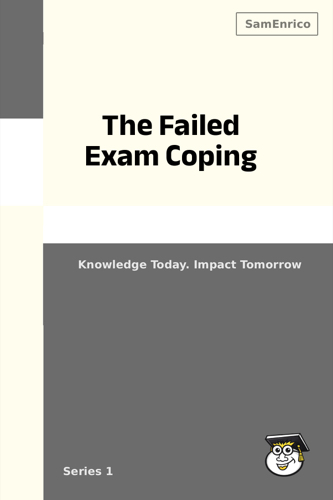
The Failed Exam Coping eBook
Recovers from poor test performance without giving
Recovers from poor test performance without giving up.
Formats
Free sample
Chapter 1: The Shattered Mirror...--The first time you see the grade, it doesn't feel real. It feels like a mistake. Your eyes scan the number or the letter—maybe it's a 54, maybe an F, maybe a score so low you didn't even know the test went that far down—and your brain refuses to process it. You look again. Then again.
Then you check the top of the page to make sure it's your name. It is. And somewhere in your chest, a door slams shut.This is not an overreaction. This is not weakness. This is biology.What you are feeling right now—the tunnel vision, the racing heart, the sudden urge to throw the paper across the room or bury it in a drawer and never look at it again—is a cascade of neurochemical events that has been honed by millions of years of evolution.
Your brain has just registered a threat. Not a physical threat like a predator, but a social and psychological threat: the fear that you have been exposed as inadequate, that your future is in jeopardy, that people will see you differently. And your ancient limbic system, which cannot tell the difference between a saber-toothed tiger and a failed midterm, has just flooded your body with cortisol and adrenaline.Your palms sweat. Your throat tightens. Your thoughts spiral.
And in that moment, you are not capable of strategic planning, rational analysis, or wise decision-making. Your prefrontal cortex—the part of your brain responsible for logic, foresight, and self-control—has been temporarily sidelined by the emergency broadcast system of your nervous system.This chapter exists for one reason: to get you through the next twenty-four hours without making things worse.Most advice about academic failure starts in the wrong place. It tells you to "learn from your mistakes" or "make a study plan" or "talk to your professor." Those are good strategies—for tomorrow. For today, they are useless, because you cannot learn from a mistake when you are still drowning in the shame of it. You cannot make a study plan when your hands are shaking.
You cannot talk to anyone when you cannot even look at yourself in the mirror.So we are going to do something different. We are going to honor the fact that you are in crisis—not because you are dramatic, but because your brain genuinely believes you are in danger—and we are going to give you a protocol for the next twenty-four hours that stabilizes the situation, prevents the domino effect, and positions you for actual recovery.The Single Most Dangerous Moment Let us be clear about what is at stake. The failed exam itself is not the disaster. The disaster is what happens next.In my years of working with students who have failed exams—and in my own painful experience of failing more than a few—I have observed a predictable pattern. The student receives a failing grade.
They feel terrible. They want to avoid the feeling. So they avoid everything associated with it: the class, the textbook, the professor, even their own study space. They skip the next class because they cannot bear to show their face. They fall behind.
The next exam comes, and they are even less prepared. They fail again. Now the shame is twice as heavy, so they avoid twice as much. Within a month, a single failing grade has metastasized into a failing semester. Within two months, the student is talking about dropping out.I call this the Domino Effect, and it is the single most dangerous consequence of a failed exam.
Not the grade itself—grades can be repaired. Not the impact on your GPA—GPAs can be rebuilt. The real danger is the chain reaction of avoidance behaviors that begins in the first few hours after you see that grade.Here is what the Domino Effect looks like in real time:Domino One: You receive the failing grade. Your brain interprets it as a threat to your social standing and future prospects. Cortisol spikes.Domino Two: You experience shame.
Shame is different from guilt. Guilt says, "I did something bad." Shame says, "I am bad." Guilt can be productive; shame is almost always destructive. Shame wants you to hide.Domino Three: You hide. You skip the next class. You do not answer emails from your professor.
You close your textbook and put it under your bed. You tell yourself you will deal with it later.Domino Four: You fall behind. While you are hiding, the class continues. New material is introduced. Assignments are due.
You are now digging a hole while also trying to climb out of one.Domino Five: The next exam arrives. You are less prepared than you were for the first one. You fail again, or barely pass. The shame doubles.Domino Six: You generalize. You start telling yourself that you are bad at this subject entirely, or bad at school, or just bad.
The single failure becomes an identity.Domino Seven: You quit. Maybe you drop the class. Maybe you take a leave of absence. Maybe you just stop trying, showing up, or caring. The failure that could have been contained to one exam has now consumed your entire academic trajectory.Here is the good news: you can stop the Domino Effect at any point.
But the easiest point—by far—is Domino One. Before you hide. Before you spiral. Before you turn a bad grade into a bad identity.This chapter is your tool for stopping the first domino.The Permission Slip: Your First Act of Self-Defense You are about to receive an instruction that may sound counterintuitive, even irresponsible. But I want you to trust it, because it comes from decades of clinical research on emotional regulation and crisis management.Here it is: For the next twenty-four hours, you are allowed to feel terrible without guilt or judgment.You are allowed to be angry.
You are allowed to cry. You are allowed to lie in bed and stare at the ceiling. You are allowed to eat junk food, watch mindless television, and complain to your friends. You are allowed to hate the exam, the professor, the class, and the entire educational system if that helps.The only thing you are not allowed to do—for the next twenty-four hours—is make a permanent decision based on a temporary emotion.Do not drop the class. Do not change your major.
Do not email your professor something you will regret. Do not tell yourself that you are stupid or worthless or incapable. Do not make any choice that cannot be unmade tomorrow.This is called a Permission Slip. It is a deliberate, structured interval of emotional release, followed by a strict and non-negotiable move-by date. You are giving yourself permission to feel everything—but only for a defined period.
After that, you move.Why twenty-four hours? Because research on emotional recovery shows that most acute stress responses begin to subside within about a day. The cortisol that flooded your system will start to metabolize. The initial shock will fade. You will not feel good tomorrow—but you will feel less bad.
And "less bad" is enough to begin rational decision-making.Without this Permission Slip, most students do one of two things. Either…
This is the end of the free sample. Get the eBook to keep going. Buy now
About this book
Details
- Author
- Cisneros Kris
- Publisher
- SamEnrico
- Language
- English
- Genre
- Non-Fiction, Self-Help, Academic Resilience
- Released
- 2026-06-07
- Pages (approx.)
- 132
- Available as
- eBook, Audiobook

Read better in the ZLOADR app
Your eBooks on your phone or tablet. Sign in with your SamEnrico account and start reading.
More by Cisneros Kris
 Depressant Recovery PlanCisneros Kris$11.99
 Palace for SeniorsCisneros Kris$11.99
 EQ For Musicians Performance GuideCisneros Kris$11.99
 Mindfulness Meditation for Teachers GuideCisneros Kris$11.99
 The Loci Exam SimulatorCisneros Kris$11.99
 Bipolar Medication Adherence WorkbookCisneros Kris$11.99
 183 Day Rule ApplicationCisneros Kris$11.99
 Neith’s Veil: The Weaver of Fate and WarCisneros Kris$11.99
 The Moon Landing Conspiracy: A Time Traveler's RevelationCisneros Kris$11.99
 The Siege of Pyongyang: Fire and Steel in the Hermit Kingdom (1592)Cisneros Kris$11.99
 The Mineral Guide to Coltan (Short For Minerals of The Columbite Group)Cisneros Kris$11.99
 KCB Group Digital Exit GuideCisneros Kris$12.99
You may also like
 Hong Kong Handover 1997Dunn Johnnie$11.99
 Zumba For Postnatal Recovery CourseNeal Christian$11.99
 Zumba for BeginnersLadner Nikia$11.99
 YouTube Comment Mining GuideHumes Pandora$12.99
 Worry Box MeditationCarlin Rudy$11.99
 Workplace Stress MeditationNguyen Lynn$11.99
 Workplace Stress and Sleep RepairHawley Ivory$11.99
 Workplace Perfectionism CureDelaney Jeffry$11.99
 Workplace Injustice Anger GuideWallen Isabelle$11.99
 Work Addiction and Burnout LinkGreenwood Ester$11.99
 Women in Yoga and WellnessBeattie Galina$11.99
 Women in Stand Up ComedyChun Evangeline$11.99