

The Exposure Hierarchy Method eBook
Gradually face feared situations where you feel li
Gradually face feared situations where you feel like a fraud and build confidence through action.
Formats
Free sample
Chapter 1: The Hidden Ledger--You have a ledger in your head. It is not a ledger of money or time. It is a ledger of legitimacy. On one side, you record every moment you felt like a real, competent, non-fraudulent human being. On the other side, you record every moment you felt like a phony, a lucky imposter, a person who has somehow tricked everyone into believing you belong.
If you are reading this book, the second column is almost certainly longer than the first. Much longer. And you have been adding to it for years.Here is what you may not have realized: that ledger is not objective. It is not a neutral historian. It is a selective, biased, fear-driven accountant that throws out evidence of your competence and triple-weights evidence of your inadequacy.
Worse, you have been letting this accountant run the show. Every time you decline a challenge, every time you over-prepare for a simple task, every time you stay silent instead of speaking up, you are handing the accountant a new entry: “See? I couldn’t handle that. I really am a fraud.”This chapter is about discovering that ledger exists. It is about learning to read it without flinching.
And it is about taking the first, most important step of the Exposure Hierarchy Method: mapping your inner critic’s territory so that you can stop being ruled by it.The Universal Secret You Were Never Told Let us begin with a confession. Not mine yet. Yours.Think back to the last time you received genuine praise. Maybe a boss said, “Great work on that project.” Maybe a friend said, “You’re really good at that.” Maybe a partner said, “I’m lucky to have you.” What happened inside you? If you are like most people who pick up this book, a small voice immediately began its work: They don’t know the real story.
If they knew how little I actually did, how much I struggled, how close I came to failing, they wouldn’t say that. I got lucky. Anyone could have done it.That voice is not humility. Humility says, “I did well, and others also contributed.” That voice says, “I did not deserve that.” That voice is the sound of your inner fraud accountant at work.Here is what the research tells us, and I want you to let this land: approximately seventy percent of people report experiencing impostor syndrome at some point in their lives. Seventy percent.
That includes Nobel laureates, Pulitzer Prize winners, Fortune 500 CEOs, and world-class surgeons. Maya Angelou, after publishing I Know Why the Caged Bird Sings, said she felt like she had “run a race and someone else got the medal.” Albert Einstein, late in his life, described himself as an “involuntary swindler” whose work was overvalued. Tom Hanks has said that no matter how many successful films he makes, he still expects someone to tap him on the shoulder and say, “You’re done. You’re out.”If you feel like a fraud, you are in extraordinarily good company. The problem is not that you are uniquely broken.
The problem is that you have been operating under a false belief: that confidence must come before action, that you must feel legitimate before you act legitimate.The Two Kinds of Humility: One Heals, One Harms Before we go any further, we need to make a critical distinction. It is possible that you have been telling yourself that your impostor feelings are simply a form of humility. You might think, “I’m just being modest. I don’t want to be arrogant. It’s good to stay grounded.” This is a trap.Productive humility sounds like this: “I did well on that presentation, and I also know I have more to learn.
There were parts that were challenging, and I grew from them. I can acknowledge my success without pretending I know everything.”Paralyzing impostor syndrome sounds like this: “That presentation went well by accident. I was lucky. Anyone could have done it. If I think too highly of myself, I’ll be exposed.
I should probably work harder to make sure I never get lucky again.”Productive humility expands you. It allows you to hold two truths at once: I succeeded and I can still improve. Paralyzing impostor syndrome shrinks you. It allows only one truth: I am not enough, and any evidence to the contrary is a mistake.You have likely spent years mistaking the second for the first. You have called your fear “humility” and your avoidance “wisdom.” You have told yourself that staying small keeps you safe.
This chapter is where that stops.The Fossilized Fear Phenomenon Here is a law of human psychology that explains almost everything about the fraud trap: avoided situations do not stay the same size. They grow.Imagine you are afraid of speaking in meetings. You avoid speaking in a meeting today. That is fine. Short-term relief.
But tomorrow, the meeting feels slightly more threatening. Why? Because your brain has registered that you avoided it, which your brain interprets as proof that the situation was genuinely dangerous. If it wasn’t dangerous, why did you avoid it? So the next meeting looms larger.
You avoid again. The fear grows again. Over weeks and months, a meeting that originally caused mild anxiety can become a terror that keeps you up at night.We call this fossilized fear. Each avoided situation becomes a fossil—hardened, ancient-looking, and seemingly unchangeable. But here is the truth that will set you free: the fossil is not made of reality.
It is made of avoidance. The moment you stop avoiding, the fossil begins to crack.Think of a situation you have been avoiding for a long time. Maybe it is asking for a raise. Maybe it is admitting you do not know something. Maybe it is submitting creative work without obsessively editing it.
Now compare the actual, real-world consequences of that situation (what would actually happen) with the catastrophic scenario your imagination has built. The gap between those two things is the entire impostor syndrome industry. That gap is where all your suffering lives.The Top Twenty: A Mapping Exercise We cannot change what we have not named. This is not a spiritual platitude; it is a neurological fact. The brain’s threat-detection system (the amygdala and anterior cingulate cortex, which we will explore in depth in Chapter 2) cannot differentiate between a vaguely defined fear and a literal predator.
To your brain, “I feel weird about that thing at work” is the same as “There is a tiger behind that bush.” You need to name the tiger.This is why we start with the Top Twenty exercise. Clear ninety minutes from your schedule. Find a place where you will not be interrupted. Take out a notebook or open a blank document. You are going to list twenty specific situations in which you feel like a fraud.Not general categories.
Not “work.” Specific situations.Here are examples to get you started:Speaking up in the weekly team meeting when I have a different opinion Receiving a compliment on a project without immediately listing everything wrong with it Submitting a…
This is the end of the free sample. Get the eBook to keep going. Buy now
About this book
Details
- Author
- Houser Julissa
- Publisher
- SamEnrico
- Language
- English
- Genre
- Non-Fiction, Self-Help
- Released
- 2026-06-10
- Pages (approx.)
- 138
- Available as
- eBook, Audiobook

Read better in the ZLOADR app
Your eBooks on your phone or tablet. Sign in with your SamEnrico account and start reading.
More by Houser Julissa
 Trance for VaginismusHouser Julissa$11.99
 The Remote Team UpdateHouser Julissa$11.99
 The Salt Cave StillnessHouser Julissa$11.99
 Improv OlympicsHouser Julissa$11.99
 Terms by Founder EthnicityHouser Julissa$11.99
 Fibromyalgia Clinical Trials GuideHouser Julissa$11.99
 Caregiver Identity After CareHouser Julissa$11.99
 Section 8 Property ManagementHouser Julissa$11.99
 The Eclipse at Leipzig: Napoleon's Last Stand in the EastHouser Julissa$11.99
 Constantinople: The Golden City of the EastHouser Julissa$11.99
 The Blockbuster Blunder: How Hollywood Nearly Lost Its Biggest StarHouser Julissa$11.99
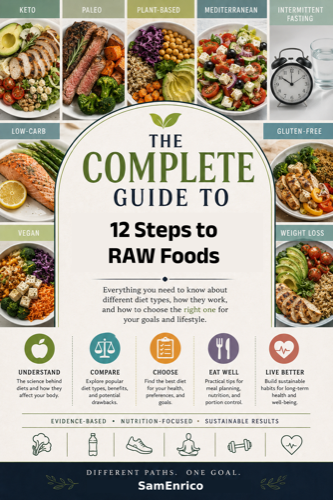 The Complete Guide to 12 Steps to RAW FoodsHouser Julissa$11.99
You may also like
 Hong Kong Handover 1997Dunn Johnnie$11.99
 Zumba For Postnatal Recovery CourseNeal Christian$11.99
 Zumba for BeginnersLadner Nikia$11.99
 YouTube Comment Mining GuideHumes Pandora$12.99
 Worry Box MeditationCarlin Rudy$11.99
 Workplace Stress MeditationNguyen Lynn$11.99
 Workplace Stress and Sleep RepairHawley Ivory$11.99
 Workplace Perfectionism CureDelaney Jeffry$11.99
 Workplace Injustice Anger GuideWallen Isabelle$11.99
 Work Addiction and Burnout LinkGreenwood Ester$11.99
 Women in Yoga and WellnessBeattie Galina$11.99
 Women in Stand Up ComedyChun Evangeline$11.99