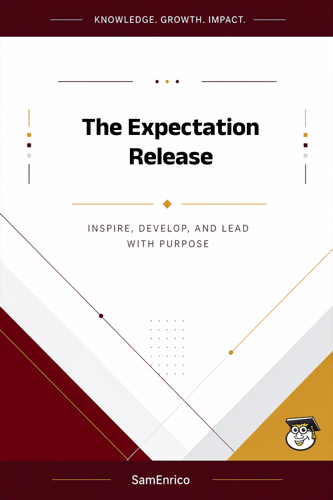
The Expectation Release eBook
Teaches letting go of how things 'should' be.
by Neil Willian
Teaches letting go of how things 'should' be.
Formats
Free sample
Chapter 1: The Secret Dictator--–- The first time I realized I had a dictator living inside my skull, I was crying over a lukewarm cup of coffee. Not because I had received bad news. Not because I was grieving a loss. Not because anything was objectively wrong. I was crying because the coffee should have been hot.
That was the moment I understood: I had spent decades making invisible contracts with reality—and reality had never signed a single one.This book is about tearing up those contracts. Not because you are weak. Because you are exhausted.The Expectation Gap Every human being walks around with a mental model of how the world ought to be. Psychologists call this the "expected state." When reality matches that model, we feel contentment, relief, or at least neutrality. When reality deviates—even slightly—we experience a negative emotional reaction.
The size of that reaction is not determined by the size of the deviation. It is determined by the size of the attachment to the expectation.I call this distance between what you expected and what actually happened the Expectation Gap.Consider these everyday scenarios:You expected the grocery store to have avocados. They are out. Your jaw tightens.You expected your partner to text you back within an hour. Two hours pass.
You feel abandoned.You expected to finish your work by 3pm. It is now 4pm. You feel like a failure.You expected your body to look the way it did at twenty-five. It does not. You feel shame.In each case, the objective event is trivial (avocados, a text, an hour, a reflection).
But the emotional reaction is not trivial at all. That is because the expectation was not trivial. You were not merely hoping for avocados. You were counting on them. You were not merely wanting a text.
You were needing it to prove you are loved.The Expectation Gap is where anxiety lives. It is where resentment breeds. It is where relationships die by a thousand small disappointments and where your inner peace goes to be mugged by a reality that refuses to follow your script.Should Statements: The Language of the Dictator Cognitive Behavioral Therapy, one of the most empirically validated forms of psychotherapy, has a name for the internal dictator's favorite linguistic structure. They are called "should statements." The dictator says:"I should be further ahead in my career by now.""They should know how I feel without me having to explain it.""My body should look different.""The world should be fair.""I should be happy. I have no right to feel sad."Each "should" is a cognitive distortion.
It is not a neutral observation about reality. It is a demand. And like all demands, when it is not met, punishment follows. The punishment might be anxiety, rage, shame, or despair. But it is always punishment.Dr.
Albert Ellis, the founder of Rational Emotive Behavior Therapy, famously called this "musturbation"—the compulsive tendency to turn preferences into absolute necessities. He observed that humans have a remarkable ability to take a simple preference ("I would prefer to succeed at this job interview") and escalate it into a tyrannical demand ("I must succeed at this job interview, and if I do not, I am a worthless human being").The difference between a preference and a demand is the difference between peace and suffering.Preference: "I would like it if my partner remembered our anniversary."Demand: "My partner should remember our anniversary, and I am hurt that they did not."Preference: "I hope I get this promotion."Demand: "I should get this promotion because I worked harder than everyone else, and if I do not, the system is rigged against me."Preference: "I would enjoy it if my body were different."Demand: "My body should be different, and I hate it for failing me."The dictator does not speak in preferences. The dictator speaks in demands. And the dictator has been in charge of your inner world for so long that you have forgotten there is any other way to speak.The Shame Connection Brené Brown, whose decade of research on vulnerability and shame has reshaped how we understand human connection, makes a devastating observation in The Gifts of Imperfection: unattainable expectations do not motivate us. They shame us.Here is what the self-help industry rarely tells you.
The voice that says "you should be better" is not your ally. It feels like an ally because it sounds ambitious. It sounds like drive. It sounds like the voice of someone who refuses to settle. But drive and shame are not the same thing.
Drive says, "I want to grow, and I am curious about what I can become." Shame says, "You are not enough right now, and you never will be unless you fix yourself."The dictator uses "should" as a whip. And whips do not create lasting change. They create scar tissue.Consider the difference between these two internal statements after a mistake:Shame-based (dictator): "I should have known better. What is wrong with me? I always do this.
I am so stupid."Growth-based (release): "That did not go the way I hoped. What can I learn from this? What will I do differently next time?"The first statement is an expectation masquerading as self-improvement. The second statement is a preference followed by curiosity. The first leads to a shame spiral.
The second leads to actionable insight.If you have ever wondered why you know what you should do but cannot seem to do it, this is often the reason. The "should" is attached to a shaming inner voice. And human beings do not respond well to shame. We respond by avoiding, numbing, procrastinating, or rebelling. The dictator creates resistance precisely because it is a dictator.The Unified Definition of Release Before we go any further, I need to define the central term of this book.
Because if there is one thing that has ruined more self-help books than anything else, it is a vague, floating word like "release" that means different things on different pages.Here is the definition that will govern every chapter of The Expectation Release:Release = The conscious choice to stop investing emotional energy in outcomes you cannot control, while either (a) redirecting that energy to controllable actions, or (b) resting in uncertainty when no action is possible.Notice what release is not:Release is not giving up on your goals.Release is not becoming passive or apathetic.Release is not pretending you do not care.Release is not toxic positivity or forced gratitude.Release is not lowering your standards.Release is simply this: a strategic withdrawal of emotional investment from the uncontrollable. Your effort, your values, your boundaries, your actions—those are controllable. Keep investing there. The weather, the past, other people's opinions, your partner's mood, the stock market, your biology's aging process—those are not controllable. Stop investing there.This book will teach you two modes of release, and you will need both:Active Release: When there is a meaningful action you can take, you redirect the emotional energy you were wasting on worry into that action.
Example: You are anxious about a job interview. Active release means you stop ruminating about whether they will like you…
This is the end of the free sample. Get the eBook to keep going. Buy now
About this book
Details
- Author
- Neil Willian
- Publisher
- SamEnrico
- Language
- English
- Genre
- Non-Fiction, Self-Help, Expectations
- Released
- 2026-06-09
- Pages (approx.)
- 151
- Available as
- eBook, Audiobook

Read better in the ZLOADR app
Your eBooks on your phone or tablet. Sign in with your SamEnrico account and start reading.
More by Neil Willian
 Stress and Digital Distraction CouplesNeil Willian$11.99
 Drowning Rescue CPRNeil Willian$11.99
 Menopause Hot Flash BreathNeil Willian$11.99
 Gratitude for Difficult ChildhoodNeil Willian$11.99
 YouTube Creator MemoirNeil Willian$11.99
 Missing My Family at SeaNeil Willian$11.99
 Travel Nap Jet Lag PreventionNeil Willian$11.99
 Blue Zone Plant Based DietNeil Willian$11.99
 Gates of Immortality: The Untold Siege of BabylonNeil Willian$11.99
 The Codebreakers' War: How Women Cracked the Enigma Before the MachinesNeil Willian$11.99
 The Lost Peaks of Kilimanjaro: The Renaissance Climbers Who Defied the ImpossibleNeil Willian$11.99
 How to Start a Mitre Business (Beginners Guide)Neil Willian$11.99