
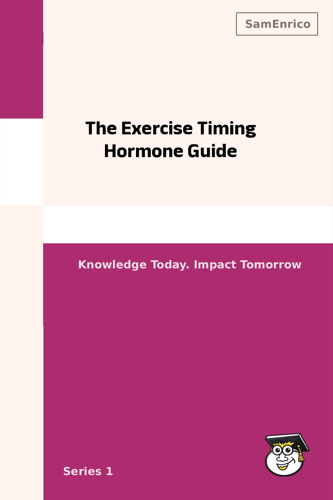
Non-FictionHealth & WellnessExercise Chronobiology
The Exercise Timing Hormone Guide eBook
Morning vs evening exercise effects on cortisol.
by Wick Madge
Morning vs evening exercise effects on cortisol.
Formats
Free sample
Chapter 1: The Silent Saboteur–- Sarah had done everything right. For three years, the 38-year-old marketing director woke at 5:30 AM, laced up her running shoes, and logged five miles before the rest of her family opened their eyes. She ignored the rain, the snow, and the voice in her head begging for another hour of sleep. She read the articles calling morning exercisers "more successful." She posted her sunrise runs on Instagram with the hashtag #Discipline Over Motivation. She was proud of her consistency.There was just one problem.
Sarah was gaining weight.Not rapidly—a pound here, a pound there. But over thirty-six months, the woman who ran five days a week before dawn had added fourteen pounds to her frame, mostly around her midsection. Her sleep, once deep and restorative, had fragmented into restless hours of staring at the ceiling. Her 2:00 PM energy crash was so predictable that her assistant started scheduling her difficult calls for 10:00 AM, knowing Sarah would be useless by mid-afternoon.Her doctor ran the standard tests. Thyroid: normal.
Blood sugar: normal. Iron: normal. "You're just getting older," the doctor said. "Maybe cut back on the wine."But Sarah didn't drink wine. She didn't eat dessert.
She had a personal trainer, a nutritionist, and a willpower that had carried her through three marathons. By every metric of conventional fitness wisdom, she should have been lean, energetic, and thriving. Instead, she felt like she was fighting her own body—and losing.What Sarah didn't know, and what her doctor didn't test for, was the timing of her cortisol. Not the level—the timing.This chapter will dismantle everything you think you know about cortisol, reveal why the "more discipline is better" model of fitness is actively harming millions of people, and introduce the single most important framework you will need to understand the rest of this book: the distinction between acute and chronic cortisol elevation. By the end of this chapter, you will understand why Sarah's 5:30 AM runs were not the solution to her problems but the cause of them—and why your own exercise timing may be working against you without your knowledge.The Hormone That Was Framed Cortisol has a public relations problem.
Walk into any wellness store, browse any health influencer's feed, or skim the title of any popular diet book, and you will encounter the same villain narrative: cortisol is a toxic stress hormone that must be suppressed, reduced, eliminated, or "hacked" into submission. You will find supplements promising to "block cortisol." You will find breathing techniques claiming to "flush cortisol." You will find entire lifestyle programs built around the assumption that lower cortisol is always better cortisol.This narrative is not just incomplete. It is dangerously wrong.Cortisol is a glucocorticoid hormone produced by the adrenal glands, which sit atop your kidneys like small caps. It belongs to a class of hormones called corticosteroids, and it has been shaped by hundreds of millions of years of evolution to perform functions that are absolutely essential to your survival. Without cortisol, you would die within days.
With too little cortisol—a condition called Addison's disease—you would experience profound fatigue, muscle weakness, low blood pressure, and eventually organ failure.Consider what cortisol does for you every single day:It wakes you up. The sharp spike of cortisol known as the Cortisol Awakening Response (CAR) is the biological alarm clock that transitions your brain from sleep to wakefulness. Without this surge, you would drift through mornings in a fog, unable to focus, unable to initiate movement, unable to face the demands of the day.It gives you energy. Cortisol triggers gluconeogenesis—the production of new glucose from non-carbohydrate sources like amino acids and lactate. When you haven't eaten for several hours, cortisol liberates stored energy so your brain (which consumes 20% of your body's glucose) can continue functioning.
Without this mechanism, you would collapse between meals.It controls inflammation. Cortisol is one of the body's most powerful anti-inflammatory signals. It suppresses the immune system's inflammatory response precisely when that response would cause more damage than benefit. This is why synthetic cortisol derivatives like hydrocortisone and prednisone are prescribed for autoimmune conditions, asthma, and severe allergies.It enables you to respond to threats. The classic "fight or flight" response is mediated by both epinephrine (adrenaline) and cortisol.
Epinephrine acts within seconds; cortisol acts within minutes and sustains the response, ensuring you have the metabolic resources to outrun danger or confront it.Cortisol is not the enemy. Cortisol is the silent conductor of your body's daily symphony—the hormone that orchestrates energy, attention, immunity, and resilience. The problem is not cortisol itself. The problem is mistimed cortisol.The Critical Distinction: Acute vs. Chronic This distinction is the single most important concept in this book.
You will see it referenced in every subsequent chapter. If you remember nothing else from this chapter, remember this:Acute cortisol spikes are healthy, necessary, and performance-enhancing.Chronically elevated baseline cortisol is destructive, aging, and fattening.Let us break this down with precision.Acute Cortisol Spikes: These are brief, predictable, and followed by rapid recovery. Your morning CAR is an acute spike. The increase in cortisol you experience during a challenging workout is an acute spike. The rise you feel when you have an important presentation or a close call while driving is an acute spike.
In all these cases, cortisol rises sharply, performs its function, and then declines as the body's negative feedback loops activate. The entire cycle lasts minutes to hours, and the body returns to baseline.Chronically Elevated Baseline Cortisol: This is a sustained elevation that never fully drops. It is the low-grade hum of stress that persists for weeks or months. It is the executive who checks email at 11:00 PM. It is the parent whose nervous system never fully powers down.
It is the athlete who trains hard but never recovers. In this state, cortisol remains moderately elevated around the clock, flattening the natural curve that should have sharp peaks at 8:00 AM and deep valleys at midnight.Here is the paradox that confuses most people: the exact same hormone that is essential and protective when released as an acute spike becomes destructive when the background level is persistently elevated.Think of cortisol like a flame. A flame in a furnace, carefully controlled, produces heat that warms a home. The same flame uncontrolled becomes a fire that destroys the home. The problem is not the flame.
The problem is the context, the timing, and the dose.Throughout this book, when we discuss morning exercise "riding the cortisol wave," we are referring to acute spikes. When we discuss evening stress-dump workouts lowering cortisol, we are referring to reducing chronically elevated baseline levels. These two goals are not contradictory. They are complementary.The body is designed for cortisol to look like a mountain range—sharp peaks and deep valleys. The modern, always-on lifestyle flattens that mountain range into a plateau.
The plateau is where metabolic disease lives.The 8:00 AM Peak: Why Your Body Built a Morning Surge Now we must look at the specific architecture of your daily cortisol rhythm. This architecture is not a suggestion. It is not a preference. It…
This is the end of the free sample. Get the eBook to keep going. Buy now
About this book
Details
- Author
- Wick Madge
- Publisher
- SamEnrico
- Language
- English
- Genre
- Non-Fiction, Health & Wellness, Exercise Chronobiology
- Released
- 2026-06-06
- Pages (approx.)
- 147
- Available as
- eBook, Audiobook

Read better in the ZLOADR app
Your eBooks on your phone or tablet. Sign in with your SamEnrico account and start reading.
More by Wick Madge
 Daily Calorie Log for Weight LossWick Madge$11.99
 The Funniest One In The RoomWick Madge$11.99
 MDD In Women GuideWick Madge$11.99
 Foster Care Meal TimesWick Madge$11.99
 The Siege of Szigetvár: Suleiman's Last StandWick Madge$11.99
 RoadgeekWick Madge$11.99
 Startup Wave Setup GuideWick Madge$12.99
 Minority Firm Healthcare ContractsWick Madge$12.99
 The Breeder's Guide to Wiltshire Horn SheepWick Madge$11.99
You may also like
 Hong Kong Handover 1997Dunn Johnnie$11.99
 Zumba For Postnatal Recovery CourseNeal Christian$11.99
 Zumba for BeginnersLadner Nikia$11.99
 YouTube Comment Mining GuideHumes Pandora$12.99
 Worry Box MeditationCarlin Rudy$11.99
 Workplace Stress MeditationNguyen Lynn$11.99
 Workplace Stress and Sleep RepairHawley Ivory$11.99
 Workplace Perfectionism CureDelaney Jeffry$11.99
 Workplace Injustice Anger GuideWallen Isabelle$11.99
 Work Addiction and Burnout LinkGreenwood Ester$11.99
 Women in Yoga and WellnessBeattie Galina$11.99
 Women in Stand Up ComedyChun Evangeline$11.99