
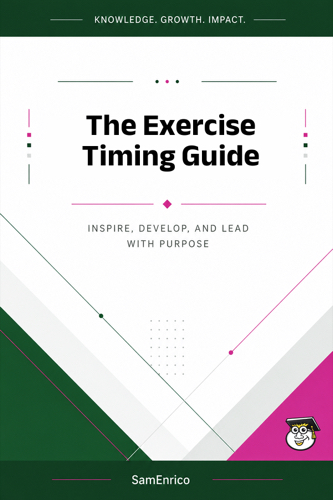
The Exercise Timing Guide eBook
Morning or afternoon workouts better than evening
Morning or afternoon workouts better than evening exercise.
Formats
Free sample
Chapter 1: The 26% Difference...–- The alarm clock reads 5:47 AM. Outside, the world is still dark, quiet, and cold. You lace up your sneakers, pour a glass of water, and head out the door for your morning run. You've been doing this for three years. Three years of discipline.
Three years of showing up when others are still dreaming. And yet, your coworker who started six months ago—the one who rolls into the gym at 4:30 PM looking annoyingly energetic—has already surpassed your strength gains, dropped more body fat, and seems to actually enjoy working out.Here is the question that will change everything you know about fitness: What if the problem isn't your effort, your diet, or your exercise selection? What if the problem is simply your clock?For the past four decades, the fitness industry has obsessed over one question: "What should I do?" Squats or deadlifts? Cardio or HIIT? Keto or plant-based?
Trainers, influencers, and supplement companies have built billion-dollar empires selling you the perfect "what." But they have almost completely ignored the other half of the equation—the "when."This book is built on a single, scientifically undeniable premise: The exact same workout performed at different times of day can produce dramatically different results. Not slightly different. Not marginally different. In some cases, the difference between morning and evening performance can reach 26 percent. That is not a typo.
Twenty-six percent.Let that sink in. If you could improve any other aspect of your fitness by 26 percent with zero additional effort—just by changing the time on the clock—wouldn't you want to know how?The Morning vs. Afternoon Experiment That Started Everything Before we dive into the science, I want you to perform a small mental experiment. Imagine two versions of yourself.Version A wakes up at 6:00 AM. Within thirty minutes, you are in your home gym or at the fitness studio, ready to train.
You load the barbell with 225 pounds for squats. You take a deep breath, descend, and push back up. It feels heavy—heavier than it should. Your legs feel stiff. Your lower back is tight from sleeping.
You complete your sets, but you're not proud of the numbers.Version B goes about a normal workday, then heads to the same gym at 4:30 PM. You load the exact same barbell with the exact same 225 pounds. This time, something feels different. The weight moves more smoothly. Your depth is better.
Your breathing feels more controlled. You finish your sets and think, "Maybe I should add five more pounds next week."Same person. Same barbell. Same workout. Different results.This is not imagination.
This is biology. And the difference between Version A and Version B is the single most overlooked variable in all of fitness: your circadian rhythm.Your Body's Hidden Timekeeper Most people think "circadian rhythm" is just fancy terminology for being tired at night and awake during the day. They imagine it as a simple light switch—day on, night off. In reality, your circadian rhythm is more like a symphony conductor standing in front of a hundred-piece orchestra, ensuring that every instrument plays at precisely the right moment.Here is what your circadian rhythm actually controls:Hormone release – When your body releases cortisol (the "get up and go" hormone), melatonin (the "time to sleep" hormone), growth hormone (the "repair and build" hormone), and testosterone (the "strength and drive" hormone)Core body temperature – Your internal thermostat, which fluctuates by about one full degree Celsius over 24 hours Metabolic rate – How efficiently your cells convert food into energy Nervous system excitability – How quickly your nerves fire and communicate with your muscles Blood pressure and heart rate – Your cardiovascular system's readiness for activity Digestive function – When your stomach produces enzymes and your gut absorbs nutrients Even your gut microbiome – The trillions of bacteria living in your intestines have their own daily rhythms Every single cell in your body contains its own tiny molecular clock. These clocks are synchronized by a master clock located deep in your brain—a cluster of approximately 20,000 neurons called the suprachiasmatic nucleus, or SCN, nestled just above the optic nerves where they cross.
This master clock takes its primary cue from light entering your eyes, which is why sunrise and sunset have such profound effects on how you feel.But here is where it gets fascinating: your muscles have their own clocks, too. Even if you remove a muscle cell from your body and place it in a petri dish, it will continue to beat with a roughly 24-hour rhythm. Your muscles know what time it is. And they perform differently depending on that time.The One-Degree Difference That Changes Everything Let me introduce you to the single most important number in this entire book: 37.5° Celsius (approximately 99.5° Fahrenheit).That is the average peak core body temperature for most healthy adults, reached between 4:00 PM and 6:00 PM each day. Twelve hours earlier, around 4:00 AM to 6:00 AM, your core temperature bottoms out at roughly 36.1°C (97.0°F).One degree.
That is all the difference.You might think a one-degree change is trivial. After all, your body temperature fluctuates more than that when you have a mild fever. But within the narrow, carefully regulated band of human physiology, one degree is enormous. Here is what that single degree does to your exercise performance:Your muscles become more elastic. Warm muscles are like warm taffy—they stretch further before tearing.
Cold muscles are more like cold taffy: stiff, brittle, and prone to snapping. This is not just about comfort; it is about injury prevention. The difference in muscle elasticity between your morning low and afternoon peak can reduce your risk of strains and pulls by a measurable margin.Your nerve conduction speed increases. Nerves are essentially biological wires. Like all wires, they transmit signals faster when warm.
A 0.5°C to 1°C increase in muscle temperature accelerates the speed at which your brain's "contract!" command reaches your muscle fibers. The result? Faster reaction times, better coordination, and more explosive movements.Your metabolic enzymes work more efficiently. The chemical reactions that produce muscular energy—breaking down ATP, converting glycogen to glucose, oxidizing fat—all occur faster at higher temperatures. This means that in the afternoon, your muscles can produce the same amount of force while consuming less energy, or they can produce significantly more force using the same energy.Your joints become more lubricated.
Synovial fluid, the lubricant inside your joints, becomes less viscous (thinner and more slippery) as temperature rises. This is why your knees, shoulders, and hips feel "creaky" in the morning but smooth out by afternoon.The numbers bear this out. Research consistently shows that maximum voluntary contraction strength—the scientific term for how hard you can consciously make a muscle pull—is approximately 6 percent higher in the late afternoon than in the early morning. For some individuals, the difference reaches 10 percent. For extreme cases, particularly among "night owl" chronotypes, the difference can reach 26 percent.To put that in real-world terms: if you can squat 300 pounds in the morning, you can likely squat 318 pounds in the afternoon.
If you can do ten pull-ups at dawn, you can probably do eleven by dinner time. If your one-mile run…
This is the end of the free sample. Get the eBook to keep going. Buy now
About this book
Details
- Author
- Redding George
- Publisher
- SamEnrico
- Language
- English
- Genre
- Non-Fiction, Health & Wellness, Exercise
- Released
- 2026-06-05
- Pages (approx.)
- 145
- Available as
- eBook, Audiobook

Read better in the ZLOADR app
Your eBooks on your phone or tablet. Sign in with your SamEnrico account and start reading.
More by Redding George
 HIIT For Weight Loss GuideRedding George$11.99
 Progressive Muscle SleepRedding George$11.99
 Cello Secrets of a SoloistRedding George$11.99
 Assertiveness for Nurses GuideRedding George$11.99
 Silk and Scandal: The Fall of the First Lady of FashionRedding George$11.99
 The Breeder's Guide to Gotland HorsesRedding George$11.99
 Insurance Retention PlaybookRedding George$12.99
 Community Free to PaidRedding George$12.99
 A Beginners Guide to Haxey Hood (Volume 1)Redding George$11.99
 Framing CarpenterRedding George$11.99
You may also like
 The IBS Exercise GuideWadsworth Jordan$11.99
 The Winter Exercise SAD GuideLoomis Thanh$11.99
 Endometriosis and ExerciseWhitman Dusty$11.99
 IBS Exercise Protocol GuideJustus Sunday$11.99
 Exercise For GADChilders Terica$11.99
 The Cardio Exercise ED GuideRivas Ressie$11.99
 Shift Work Exercise Timing GuideSlocum Jona$11.99
 Menopause Exercise PrescriptionHolder Delmer$11.99
 Exercise as Antidepressant GuideStaley Yuri$11.99
 The Exercise Adrenal GuideCloud Ethelene$11.99
 Mediterranean and ExerciseGarvin Annamae$11.99
 IBS Exercise Guidelines HandbookBolin Alisia$11.99