
Non-FictionBusiness BriefExecutive
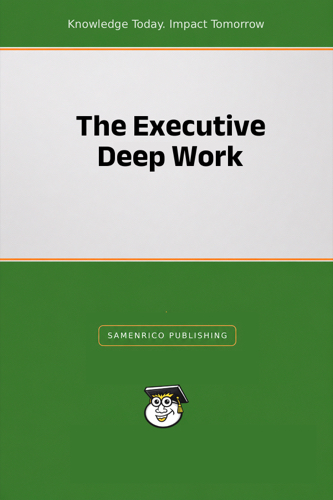
The Executive Deep Work eBook
Schedule uninterrupted blocks for high level decis
Schedule uninterrupted blocks for high level decision making.
Formats
Free sample
Chapter 1: The Responsiveness Lie--–- The email arrives at 6:47 AM. You are still in bed, phone on the nightstand. The subject line reads “URGENT: Q3 Numbers.” Your thumb hovers. You tell yourself it will only take thirty seconds to read. Sixty seconds later, you are typing a response.
By 7:15 AM, you have answered eleven emails, skimmed three Slack threads, and mentally fired the head of product twice. You have not yet brushed your teeth. You have not yet looked at your child. You have not yet thought a single original thought about the future of your company. You are, by every external measure, incredibly productive.
And you are failing.This is the opening scene of the most dangerous addiction in modern leadership: the addiction to responsiveness. It feels like diligence. It looks like commitment. It rewards you with the small, satisfying click of the “sent” notification, the dopamine hit of clearing a red badge, the social validation of being the first to reply. But beneath this veneer of busy competence lies a brutal truth that most executives discover too late: responsiveness is not a strategy.
It is a tax. And you are paying it with the one asset you can never replenish—your cognitive capacity to make high-stakes decisions.If you are reading this book, you are likely a founder, CEO, VP, or director. Your job description contains words like “strategy,” “vision,” “leadership,” and “execution.” But your calendar tells a different story. Your calendar says you spend sixty to eighty percent of your week in meetings, another twenty percent on email, and the remaining crumbs of time—usually between 5:00 PM and 7:00 PM, when your brain resembles wet cement—on “thinking.” You have convinced yourself that this is simply the price of leadership in a hyper-connected world. You are wrong.
The price is much higher than you think, and the currency is not your time. It is your judgment.This chapter is the diagnosis. Before we can build the fortress of executive deep work, we must first understand why you cannot think. We must name the enemy. And the enemy is not your team, your board, your investors, or your impossible calendar.
The enemy is the false god of responsiveness—the deeply ingrained belief that being immediately available to every person, every question, and every “urgent” request is what makes you a good leader.The Pavlovian Executive Let us begin with a simple experiment. Take out your phone. Open your email app. Look at your inbox. How many unread messages do you have?
Now look at the “sent” folder. How many messages did you send yesterday? Last week? Now ask yourself a harder question: Of the messages you sent in the past seven days, which three will matter in twelve months? Which one will matter in five years?The silence you are hearing is the sound of the trap snapping shut.The modern executive inbox is not a communication tool.
It is a sabotage system, designed by engineers who optimized for engagement, not effectiveness. Every notification is a small lever pulled in a Skinner box. You check email. You receive a reply. You feel a sense of closure.
You check again. The variable ratio reinforcement schedule—sometimes you get a gratifying reply immediately, sometimes you wait hours—is the same psychological mechanism that makes slot machines addictive. You are not leading. You are pressing a button for a pellet.We call this The Responsiveness Fallacy: the mistaken belief that the speed of your reply correlates with the quality of your leadership. In reality, the opposite is true.
Speed correlates with shallowness. The fastest replies are almost always the least thoughtful. The executive who replies within three minutes is not demonstrating competence; they are demonstrating a reflexive, System 1 response to a stimulus—exactly the kind of thinking that leads to disastrous strategic errors.Consider the data. A study of over 1,000 executives conducted by the Harvard Business Review found that those who checked email less than five times per day made significantly better strategic decisions—as measured by return on invested capital and employee retention—than those who checked email continuously. The difference was not small.
The “low-check” executives outperformed their “high-check” peers by an average of 23 percent over three years. Twenty-three percent. That is the difference between a good year and a great one. Between a promotion and a pivot. Between building a legacy and becoming a case study.But here is the kicker: the high-check executives believed they were more effective.
They rated themselves 30 percent higher on “responsiveness” and “team satisfaction.” They were, in their own minds, winning. Their teams, however, rated them lower on “clarity,” “strategic direction,” and “trust.” The teams knew what the executives could not see: that a leader who is always available is a leader who never truly thinks.The Cult of Busy There is a performance in modern leadership that has become so ubiquitous we no longer recognize it as theater. It is the performance of busyness. The walking quickly down the hallway with a slight frown. The typing furiously during a meeting to show you are handling something critical.
The “sorry for the delay” email sent at 11:00 PM. The calendar back-to-back with thirty-minute slots, each one bleeding into the next, leaving no time for reflection, no space for silence, no room for the kind of slow, deliberate thinking that separates great decisions from catastrophic ones.This is the Cult of Busy, and its high priest is the open-door policy.The open-door policy sounds wonderful. It sounds collaborative, egalitarian, and modern. “My door is always open,” the executive announces, imagining themselves as a wise mentor accessible to all. In practice, the open-door policy is a cognitive demolition tool.
Every time someone walks through that door—or, in the remote era, every time a Slack message pings, a Zoom call starts early, or a calendar invite appears with the word “quick” in the title—your brain is forced to perform a context switch. And context switching is not free. It is not even cheap. It is ruinous.The neuroscience is clear. When you are engaged in a complex cognitive task—say, evaluating the risks of a potential acquisition or mapping out next year’s organizational structure—your brain builds what researchers call a “task network.” This network involves multiple regions working together: the prefrontal cortex for executive control, the parietal lobe for attention, the basal ganglia for procedural memory.
Building this network takes time. Estimates vary, but most research suggests it takes between ten and twenty-three minutes to achieve a state of deep cognitive immersion, often called “flow.”Now imagine you are twenty minutes into analyzing a critical strategic problem. Your task network is fully engaged. You are seeing connections you missed before. A pattern is emerging.
And then—a Slack message. A subordinate asking for an approval on a $5,000 expense. It takes you seven seconds to read the message. You reply “approved” in four seconds. You return to your analysis.
But you are not returning to the same analysis. Your brain must now rebuild the task network from scratch. That is another ten to twenty-three minutes. In a typical day, with forty to sixty interruptions, you…
This is the end of the free sample. Get the eBook to keep going. Buy now
About this book
Details
- Author
- Nicholas Hyacinth
- Publisher
- SamEnrico
- Language
- English
- Genre
- Non-Fiction, Business Brief, Executive
- Released
- 2026-06-07
- Pages (approx.)
- 150
- Available as
- eBook, Audiobook

Read better in the ZLOADR app
Your eBooks on your phone or tablet. Sign in with your SamEnrico account and start reading.
More by Nicholas Hyacinth
 Senior Conversation ConfidenceNicholas Hyacinth$11.99
 Digital Communication for Remote BoardsNicholas Hyacinth$11.99
 Tennis Player's HypnosisNicholas Hyacinth$11.99
 Flow in EngineeringNicholas Hyacinth$11.99
 Cliffside Ocean ViewNicholas Hyacinth$11.99
 Hot Spring Soak GuideNicholas Hyacinth$11.99
 Affirmations for Morning RoutineNicholas Hyacinth$11.99
 The Last Wyrm of the Black ForestNicholas Hyacinth$11.99
 The Golden Calculators: Timbuktu's Mathematical MarvelsNicholas Hyacinth$11.99
 How to Produce Diaper OrganizersNicholas Hyacinth$11.99
 Vampire Bats: Blood-feederNicholas Hyacinth$11.99
 Business Credit for Technology StartupsNicholas Hyacinth$12.99
You may also like
 Hong Kong Handover 1997Dunn Johnnie$11.99
 Zumba For Postnatal Recovery CourseNeal Christian$11.99
 Zumba for BeginnersLadner Nikia$11.99
 YouTube Comment Mining GuideHumes Pandora$12.99
 Worry Box MeditationCarlin Rudy$11.99
 Workplace Stress MeditationNguyen Lynn$11.99
 Workplace Stress and Sleep RepairHawley Ivory$11.99
 Workplace Perfectionism CureDelaney Jeffry$11.99
 Workplace Injustice Anger GuideWallen Isabelle$11.99
 Work Addiction and Burnout LinkGreenwood Ester$11.99
 Women in Yoga and WellnessBeattie Galina$11.99
 Women in Stand Up ComedyChun Evangeline$11.99