
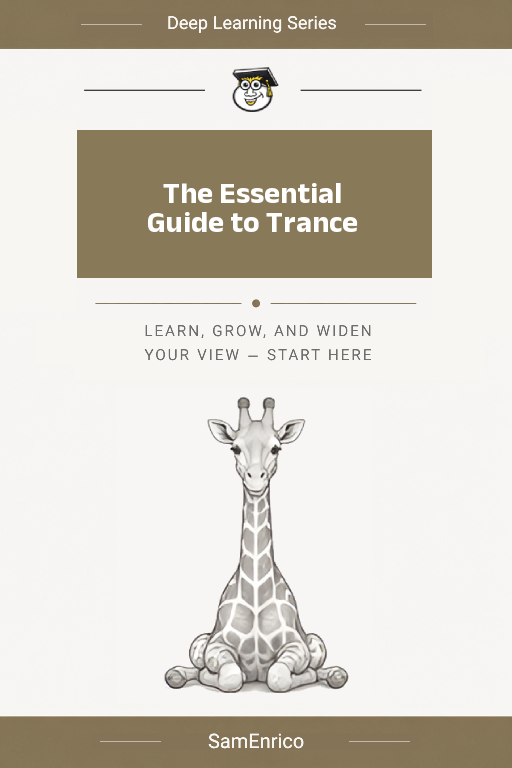
Non-FictionInformativeEducational
The Essential Guide to Trance
This publication, published by SamEnrico, covers T
This publication, published by SamEnrico, covers The Essential Guide to Trance
Formats
About this book
Free sample
Chapter 1: The Forgotten Technology--– In the summer of 1993, a twenty-three-year-old Italian pianist named Roberto Concina walked into a recording studio in Milan with no intention of making dance music. He had been hired to produce a ballad for a local singer, but the session was canceled at the last minute. With studio time already paid for and the engineer waiting impatiently, Concina sat down at a borrowed Roland D-50 synthesizer and began playing a simple piano melody in E minor. He added a kick drum – not because he wanted to make a club track, but because the engineer insisted on a rhythm track to test the monitors. The result was a three-minute demo that Concina almost deleted.
Instead, he pressed save, labeled the file "My Dream," and forgot about it for six months. When he finally played it for a friend who DJ'd at a small club called Baia Imperiale in Riccione, the friend demanded a copy. Within weeks, bootlegs of the untitled track were being traded across Europe. By early 1994, the record – now renamed "Children" and credited to Robert Miles – had become the first Trance anthem to cross over to mainstream radio. But more importantly, for millions of people who heard it, the track did something that pop music had never done: it induced a specific, repeatable, and deeply pleasurable state of altered consciousness that listeners instinctively called "trance."Twenty years later, a neuroscientist at Mc Gill University named Daniel Levitin would scan the brains of subjects listening to "Children" while inside an f MRI machine.
He found that the track's long, repetitive breakdown – a full thirty-two seconds with no percussion, just a piano melody and a swelling pad – triggered the same neural pathways as meditation and low-dose psychedelics. The brain's default mode network, responsible for self-referential thought and the narrative voice that says "I" and "me," actually decreased in activity during the breakdown. When the kick drum returned, the nucleus accumbens – the brain's reward center – lit up like a Christmas tree. Levitin concluded that "Children" was not just music. It was a technology for…
This is the end of the free sample. Get the eBook to keep going. Buy now
Contents
- Chapter 1
- Chapter 2
- Chapter 3
- Chapter 4
- Chapter 5
- Chapter 6
- Chapter 7
- Chapter 8
- Chapter 9
- Chapter 10
- Chapter 11
- Chapter 12
Details
- Author
- Severson Lettie
- Publisher
- SamEnrico
- Language
- English
- Genre
- Non-Fiction, Informative, Educational
- Released
- 2026-05-18
- Pages (approx.)
- 140
- Available as
- eBook, Audiobook

Read better in the ZLOADR app
Your eBooks on your phone or tablet. Sign in with your SamEnrico account and start reading.
More by Severson Lettie
 Pituitary Tumor HGH ExcessSeverson Lettie$11.99
 Clear Goals Flow MethodSeverson Lettie$11.99
 Silent Brainstorming TechniqueSeverson Lettie$11.99
 Rejection Anger RestructuringSeverson Lettie$11.99
 The Mortgage Stress SolutionSeverson Lettie$11.99
 Benzodiazepine Master GuideSeverson Lettie$11.99
 Immigrant Financial Stress GuideSeverson Lettie$11.99
 Delegation Skills for New ManagersSeverson Lettie$11.99
 The Thunderbird's Song: How a Great Spirit Shaped the LandSeverson Lettie$11.99
 The Labyrinth's Last Guardian: Theseus and the Minotaur's SecretSeverson Lettie$11.99
 Quinoa: Seed HarvestingSeverson Lettie$11.99
 Information Fast for BurnoutSeverson Lettie$12.99
You may also like
 Hong Kong Handover 1997Dunn Johnnie$11.99
 Zumba For Postnatal Recovery CourseNeal Christian$11.99
 Zumba for BeginnersLadner Nikia$11.99
 YouTube Comment Mining GuideHumes Pandora$12.99
 Worry Box MeditationCarlin Rudy$11.99
 Workplace Stress MeditationNguyen Lynn$11.99
 Workplace Stress and Sleep RepairHawley Ivory$11.99
 Workplace Perfectionism CureDelaney Jeffry$11.99
 Workplace Injustice Anger GuideWallen Isabelle$11.99
 Work Addiction and Burnout LinkGreenwood Ester$11.99
 Women in Yoga and WellnessBeattie Galina$11.99
 Women in Stand Up ComedyChun Evangeline$11.99