
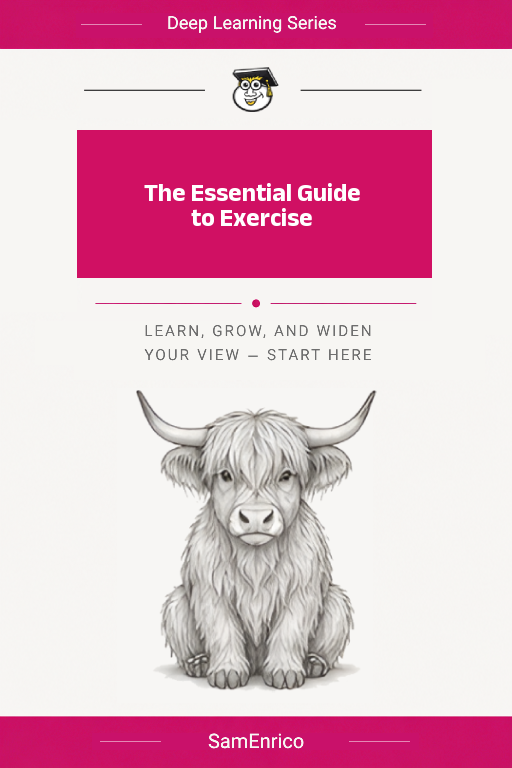
Non-FictionInformativeEducational
The Essential Guide to Exercise eBook
This publication, published by SamEnrico, covers T
This publication, published by SamEnrico, covers The Essential Guide to Exercise
Formats
Free sample
Chapter 1: The Brain’s Hidden Currency...–- Every morning, before your feet touch the floor, a silent auction takes place inside your skull. Your brain, that three-pound universe of electrochemical genius, is deciding how to spend its limited currency of attention, motivation, and emotional stability. It has bids coming from every direction: the cortisol hangover from yesterday’s stressful meeting, the dopamine deficit from poor sleep, the low-grade inflammation from last night’s processed dinner, and the gnawing anxiety about the unfinished project due Friday. Most people wake up already in debt, and they spend the entire day wondering why they feel tired, foggy, and unmotivated. They reach for coffee, energy drinks, sugary snacks, or doom-scrolling on their phones—all of which are payday loans against their neurological reserves.
But there is another way, a method that not only pays off the debt but grows the principal. It is the single most powerful, most accessible, and most underutilized tool for rewiring your brain for resilience, clarity, and lasting well-being. That tool is exercise. And everything you think you know about why you should do it is probably wrong.This is not another book about six-pack abs, biceps peaks, or fitting into your high school jeans. Those outcomes are fine, even pleasant, but they are the wrong reasons to move your body.
They are the equivalent of buying a Ferrari to hold open the garage door. You are sitting on a neurological engine that can reverse depression, halt anxiety in its tracks, sharpen your memory, protect you from dementia, and literally grow new brain cells—and you are worried about a flatter stomach? The world has sold you a lie about exercise. It has convinced you that movement is punishment for what you ate, a chore to be checked off, or a means to an aesthetic end. The fitness industry profits from your vanity.
The food industry profits from your guilt. And you are left feeling like a failure because you cannot sustain a workout routine based on a motivation that evaporates the moment you look in the mirror and still see the same person.This chapter will dismantle that lie. We are going to flip the entire framework on its head. Instead of asking, “How do I get motivated to exercise?” we will ask, “Why does my brain need exercise the way my lungs need air?” Instead of chasing external validation, we will build an internal why that is bulletproof, evidence-based, and rooted in the most exciting neuroscience of the past twenty years. By the time you finish reading these pages, you will understand that skipping a workout is not a moral failing or a sign of laziness.
It is a biological mistake, like forgetting to take a prescription medication for a condition you definitely have. Because here is the truth that the billion-dollar supplement and pharmaceutical industries do not want you to know: exercise is the most effective, least expensive, and most side-effect-free treatment for the majority of mental health and cognitive decline conditions that plague modern society.The Spark That Changes Everything In 2008, psychiatrist John Ratey published a book called Spark, which summarized a revolution that had been quietly building in neuroscience labs around the world. The revolution had a simple, almost heretical premise: exercise is not primarily about muscles, lungs, or hearts. It is primarily about the brain. Ratey and his colleagues had spent years studying the effects of physical activity on mental health, academic performance, and cognitive decline, and their findings were staggering.
In one study, students who participated in a morning exercise program before school showed significant improvements in reading comprehension, math scores, and even behavior. In another, regular exercise was shown to be as effective as selective serotonin reuptake inhibitors (SSRIs) for treating mild to moderate depression—without the side effects of weight gain, sexual dysfunction, or emotional blunting. In yet another, older adults who walked briskly for forty-five minutes three times per week reversed age-related shrinkage of the hippocampus, the brain region responsible for memory and learning.Let that sink in. They reversed brain shrinkage. With walking.The mechanism behind these benefits is a protein called Brain-Derived Neurotrophic Factor, or BDNF.
If you remember only one acronym from this entire book, make it this one. BDNF is often called “Miracle-Gro for the brain” because it does exactly what that garden product does for your plants: it fertilizes, nurtures, and supports the growth of new neurons and new connections between them. When you exercise, especially at moderate to high intensity, your muscles, heart, and lungs send signals to your brain that say, “We are under stress. We need to adapt. Grow more connections.
Build more resilience.” In response, your brain upregulates BDNF production dramatically. Within minutes of starting a workout, BDNF levels begin to rise. Within weeks of consistent exercise, the structural architecture of your brain begins to change for the better.The opposite is also true. A sedentary lifestyle downregulates BDNF production. Your brain, receiving no signal to adapt, begins to atrophy.
The hippocampus shrinks. The prefrontal cortex—the seat of impulse control, planning, and decision-making—thins. Connections between neurons weaken. This is not a metaphor; it is a measurable, biological process. The reason so many people feel mentally foggy, emotionally volatile, and chronically overwhelmed is not because they are broken or weak.
It is because they have not given their brains the one signal that evolution designed them to receive: movement.The Neurotransmitter Symphony Beyond BDNF, exercise orchestrates a complex symphony of neurotransmitters that directly regulate your mood, focus, and energy levels. Understanding this symphony is the key to unlocking exercise as a tool for mental health, not just physical health. Let us meet the four principal players: dopamine, serotonin, norepinephrine, and endocannabinoids.Dopamine is the molecule of motivation, reward, and anticipation. It is released not when you achieve a goal, but when you are moving toward it. Low dopamine levels are associated with anhedonia (the inability to feel pleasure), lack of motivation, and the core symptoms of depression and attention deficit disorders.
Exercise, particularly goal-directed movement like finishing a set number of reps or completing a timed run, provides a clean, natural dopamine boost. Unlike drugs that hijack the dopamine system (cocaine, amphetamines, social media notifications), exercise releases dopamine in a way that strengthens, rather than weakens, your brain’s sensitivity to it. Over time, consistent exercisers find that they feel more motivated in every area of life, not just in the gym.Serotonin is the molecule of mood stability, satiety, and calm. Most prescription antidepressants (SSRIs) work by preventing the reuptake of serotonin, keeping more of it available in the synaptic gap between neurons. Exercise does the same thing—naturally.
It increases both the production of serotonin and the sensitivity of serotonin receptors. This is why a thirty-minute run can lift a low mood more reliably than any pill, and why exercise is now recommended as a first-line treatment for mild to moderate depression by major medical organizations, including the American Psychiatric Association.Norepinephrine is the molecule of alertness, focus, and arousal. It is chemically related to adrenaline, and it is what helps you wake up in the morning, pay attention…
This is the end of the free sample. Get the eBook to keep going. Buy now
About this book
Details
- Author
- Kearns Candance
- Publisher
- SamEnrico
- Language
- English
- Genre
- Non-Fiction, Informative, Educational
- Released
- 2026-05-09
- Pages (approx.)
- 141
- Available as
- eBook, Audiobook

Read better in the ZLOADR app
Your eBooks on your phone or tablet. Sign in with your SamEnrico account and start reading.
More by Kearns Candance
 Failure Bingo GameKearns Candance$11.99
 Salary Negotiation ConfidenceKearns Candance$11.99
 Best Friend Perspective AngerKearns Candance$11.99
 Intermittent Fasting HGH BoostKearns Candance$11.99
 Comparison Financial StressKearns Candance$11.99
 Talking About AdoptionKearns Candance$11.99
 Metabolic Adaptation Over 40Kearns Candance$11.99
 HIIT for AnxietyKearns Candance$11.99
 The Trial of the Century: The 1924 Impeachment of Belgium’s Justice MinisterKearns Candance$11.99
 The Great Post Office Heist: The First Digital Crime WaveKearns Candance$11.99
 Potato: Irish PotatoKearns Candance$11.99
 How to Produce Protective ApronsKearns Candance$11.99
You may also like
 Hong Kong Handover 1997Dunn Johnnie$11.99
 Zumba For Postnatal Recovery CourseNeal Christian$11.99
 Zumba for BeginnersLadner Nikia$11.99
 YouTube Comment Mining GuideHumes Pandora$12.99
 Worry Box MeditationCarlin Rudy$11.99
 Workplace Stress MeditationNguyen Lynn$11.99
 Workplace Stress and Sleep RepairHawley Ivory$11.99
 Workplace Perfectionism CureDelaney Jeffry$11.99
 Workplace Injustice Anger GuideWallen Isabelle$11.99
 Work Addiction and Burnout LinkGreenwood Ester$11.99
 Women in Yoga and WellnessBeattie Galina$11.99
 Women in Stand Up ComedyChun Evangeline$11.99