
Non-FictionInformativeEducational
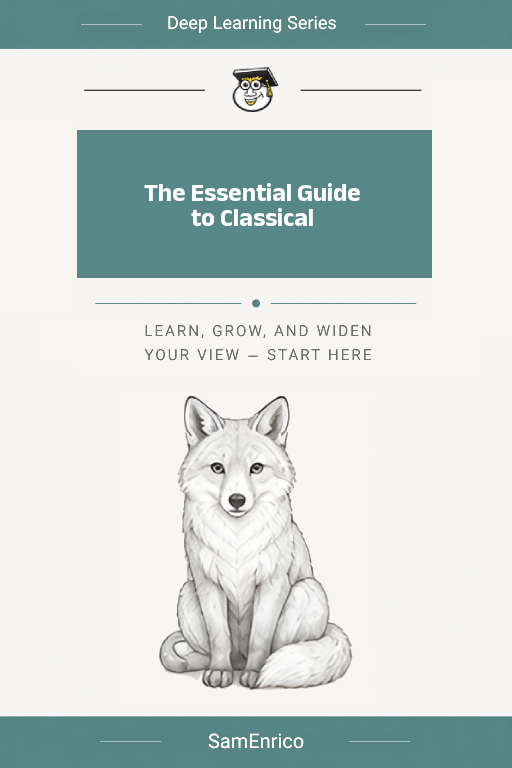
The Essential Guide to Classical eBook
This publication, published by SamEnrico, covers T
by Lau Arianne
This publication, published by SamEnrico, covers The Essential Guide to Classical
Formats
Free sample
Chapter 1: The Permission Slip...–- Every great journey begins with a single step, but the journey into classical music often begins with a single fear: the fear of being wrong. You worry you will clap at the wrong time, wear the wrong clothes, or—worst of all—fail to understand what the music is “supposed” to mean. This chapter exists to give you something precious and rare: permission. Permission to listen badly. Permission to feel confused.
Permission to love the wrong pieces and dislike the “correct” ones. Because here is the secret that concert halls and critics rarely advertise: there is no test at the end. No one will hand you a scorecard. The only requirement for enjoying classical music is showing up with open ears and an honest heart.Let us begin with a confession. The author of this book—the one you are holding right now—spent his first three years of “serious” classical listening absolutely hating opera.
He found the vibrato annoying, the plots ridiculous, and the fat lady singing cliché exhausting. He told himself this meant he was not a real classical fan. He was wrong. He simply had not found the right opera yet. When he finally heard Puccini’s La Bohème on a rainy Tuesday night, something cracked open.
He cried at the death of Mimì, not because he understood the Italian but because the music bypassed his brain entirely and landed somewhere in his chest. That is the power this chapter wants to unlock for you: the power to stop intellectualizing and start feeling.The Great Wall of Intimidation Why does classical music scare people so much? The answer has almost nothing to do with the music itself and everything to do with the culture that grew up around it like ivy on an old building. In the 19th century, classical concerts were rowdy, beer-soaked affairs. Audiences talked, ate, cheered, and booed.
Mozart’s operas played alongside bawdy farces. Beethoven premiered his Eroica Symphony in a theater where people were probably unwrapping sandwiches. The idea of silent, reverent worship in a concert hall is a 20th-century invention, largely driven by recording technology and the rise of the conductor as a cult figure.The German composer and conductor Richard Wagner (whom you will meet properly in Chapter 7) bears much of the blame. He insisted that audiences sit in the dark, shut up, and treat his operas as sacred rituals. The practice spread, and by the 1950s, classical music had acquired a suffocating aura of high seriousness.
Critics wrote in jargon. Program notes read like Ph D dissertations. And ordinary people—people who loved melody, rhythm, and emotion—felt locked out of their own concert halls.Here is the truth: You already listen to classical music. Every time a film score makes you cry, you are listening to the harmonic language of Romantic composers like Tchaikovsky and Mahler. Every time a video game uses a swelling orchestra for a boss battle, you are hearing the structural DNA of Holst and Stravinsky.
Every time a pop song moves from a minor verse to a major chorus, you are experiencing the same tension-and-release mechanism that Haydn perfected in 1780. Classical music is not a foreign language. It is your native tongue with an accent you have not yet learned to place.The Three Lies You Were Told Before we go any further, let us clear the rubble. Three lies have kept generations of potential listeners away from the concert hall. Each one is nonsense.
Each one will be dismantled below.Lie #1: You need to understand music theory to appreciate classical music.False. You do not need to know what a Neapolitan sixth chord is to weep at the funeral march in Beethoven’s Eroica. You do not need to analyze counterpoint to feel the ache in Barber’s Adagio for Strings. Theory is a description of what happened, not a requirement for experiencing it. You do not need to know the chemical formula of water to enjoy swimming.Lie #2: Classical music is only for rich, educated, older people.False.
The cheapest seat in most concert halls costs less than a movie ticket plus popcorn. Student rush tickets can be as low as ten dollars. Streaming services give you access to thousands of full performances for the price of a monthly coffee subscription. As for age: the fastest-growing demographic on classical streaming platforms is listeners under 35. Teenagers are discovering Bach on Tik Tok.
College students are making memes about Mahler. The stereotype is dying; help us bury it.Lie #3: There is a correct way to listen, and you probably are not doing it.False. Aaron Copland—one of America’s greatest composers—wrote extensively about the three planes of listening: the sensory (just enjoying the sound), the expressive (feeling an emotion), and the sheerly musical (noticing structure). He insisted that no plane is superior to the others. Sometimes you just want the sonic wallpaper of a Bach concerto while you cook dinner.
That is valid. Sometimes you want to be destroyed by the grief of Mahler’s Kindertotenlieder. Also valid. Sometimes you want to geek out over how Beethoven modulates from C minor to C major in the finale of his Fifth Symphony. Valid too.
The only invalid way to listen is to not listen at all.The Sam Enrico Gateway Method (Phase One)This book will introduce you to many tools, but the most important one is the Sam Enrico Gateway Method. It is a simple two-phase process designed to use what you already love as a bridge into what you will love next. We will cover Phase One now and Phase Two in the final chapter of this book.Phase One: The Three-Song Input Open your preferred streaming service—Spotify, Apple Music, Tidal, or even You Tube. Select three non-classical songs that you genuinely love. Do not pick what you think you should love.
Pick what you actually play on repeat. For the sake of demonstration, let us imagine three hypothetical listeners:Listener A chooses: Radiohead – “Pyramid Song,” Bon Iver – “Holocene,” and Lana Del Rey – “Video Games.”Listener B chooses: Adele – “Someone Like You,” Coldplay – “Viva la Vida,” and Taylor Swift – “exile.”Listener C chooses: John Williams – “Imperial March” (from Star Wars), Hans Zimmer – “Time” (from Inception), and Ludwig Göransson – “Can You Hear the Music” (from Oppenheimer).Now, here is the magic trick. Most streaming algorithms will generate a “song radio” or “recommended” list based on these inputs. What you are looking for is the instrumental or orchestral suggestion that appears. For Listener A, the algorithm often suggests Arvo Pärt’s Spiegel im Spiegel (minimalist, haunting, piano and violin) or Olafur Arnalds (modern neoclassical).
For Listener B, Puccini’s O mio babbino caro or Rachmaninoff’s Vocalise often surfaces. For Listener C, the algorithm practically screams Holst’s The Planets and Stravinsky’s Rite of Spring.Write down the classical piece the algorithm suggests. That is your gateway. Do not worry if you have never heard of it. That is the point.
The algorithm has recognized something your ears already know: a shared emotional contour, a harmonic DNA, a rhythmic fingerprint. You are not…
This is the end of the free sample. Get the eBook to keep going. Buy now
About this book
Details
- Author
- Lau Arianne
- Publisher
- SamEnrico
- Language
- English
- Genre
- Non-Fiction, Informative, Educational
- Released
- 2026-06-02
- Pages (approx.)
- 158
- Available as
- eBook, Audiobook

Read better in the ZLOADR app
Your eBooks on your phone or tablet. Sign in with your SamEnrico account and start reading.
More by Lau Arianne
 The Father's Prison LettersLau Arianne$11.99
 Leptin Resistance GuideLau Arianne$11.99
 History Timeline MemoryLau Arianne$11.99
 Atychiphobia Treatment WorkbookLau Arianne$11.99
 Light Exposure Therapy for Night ShiftLau Arianne$11.99
 CPR for Swimming PoolsLau Arianne$11.99
 Marathoner Self HypnosisLau Arianne$11.99
 Forgiveness Conversations GuideLau Arianne$11.99
 The Healers of Timbuktu: The Golden Script of Medical MasteryLau Arianne$11.99
 The Arsenic Inheritance: A Victorian Poisoning ScandalLau Arianne$11.99
 Onion: Bulb Onion HarvestingLau Arianne$11.99
 How to Produce Printer FiltersLau Arianne$11.99
You may also like
 Hong Kong Handover 1997Dunn Johnnie$11.99
 Zumba For Postnatal Recovery CourseNeal Christian$11.99
 Zumba for BeginnersLadner Nikia$11.99
 YouTube Comment Mining GuideHumes Pandora$12.99
 Worry Box MeditationCarlin Rudy$11.99
 Workplace Stress MeditationNguyen Lynn$11.99
 Workplace Stress and Sleep RepairHawley Ivory$11.99
 Workplace Perfectionism CureDelaney Jeffry$11.99
 Workplace Injustice Anger GuideWallen Isabelle$11.99
 Work Addiction and Burnout LinkGreenwood Ester$11.99
 Women in Yoga and WellnessBeattie Galina$11.99
 Women in Stand Up ComedyChun Evangeline$11.99