
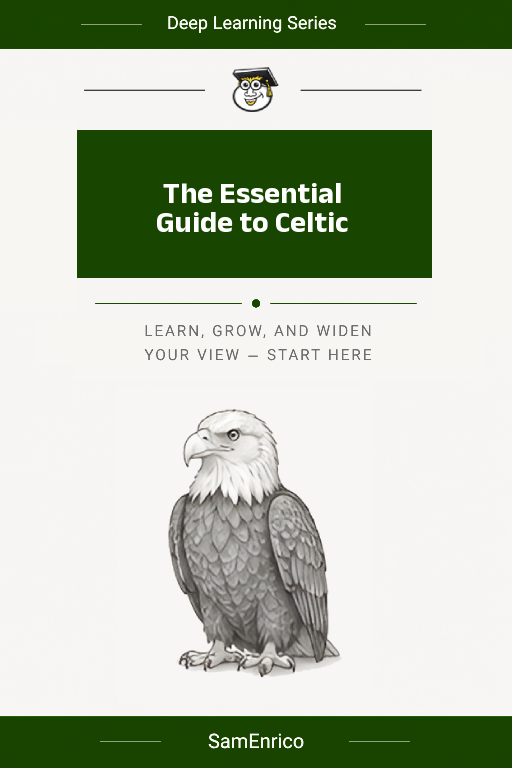
The Essential Guide to Celtic
This publication, published by SamEnrico, covers T
by Darnell Mi
This publication, published by SamEnrico, covers The Essential Guide to Celtic
Formats
About this book
Free sample
Chapter 1: Who Were the Celts? Unraveling the Identity--–- Imagine a people who never wrote their own history. Everything we know about them was recorded by their enemies, their conquerors, or outsiders who thought them barbaric. The Celts left behind no books, no chronicles, no signed documents. They built no great libraries.
And yet, their legacy haunts the western imagination like no other ancient culture. From the misty shores of Ireland to the rugged highlands of Scotland, from the forgotten hillforts of France to the Celtic-named towns of Galicia and Turkey, the question echoes: who were the Celts, really?The short answer is that the Celts were never a single race, empire, or unified nation. They were something far more interesting: a widespread, diverse collection of Iron Age tribal societies who shared deep linguistic roots, strikingly similar artistic styles, and remarkably consistent religious patterns across much of Europe. They appeared in the archaeological record around 800 BCE and, at their greatest extent, stretched from the Atlantic coasts of Iberia in the west to the steppes of Anatolia (modern-day Turkey) in the east. They sacked Rome in 390 BCE, hired themselves out as mercenaries to Greeks and Egyptians, and terrified the Roman Republic for centuries.
Yet within a few hundred years, their continental European heartlands had been absorbed, conquered, or assimilated by Rome. Their independent political power vanished. Their druids were suppressed. Their languages retreated to the western fringes of the continent.But they did not vanish. The question of who the Celts were is not merely archaeological curiosity.
It is a question that has been weaponized by nationalists, romanticized by poets, commercialized by New Age spiritualists, and fought over by scholars for two centuries. This chapter dismantles the stereotypes, clarifies the evidence, and establishes the foundational understanding that the rest of this book will build upon. By the end, you will understand why "Celt" is not a genetic destiny but a cultural affiliation—and why that distinction matters more than you might think.The Problem of the Name: Where Did "Celt" Come From?The very word "Celt" is borrowed from the Greeks. Around 500 BCE…
This is the end of the free sample. Get the eBook to keep going. Buy now
Contents
- Chapter 1
- Chapter 2
- Chapter 3
- Chapter 4
- Chapter 5
- Chapter 6
- Chapter 7
- Chapter 8
- Chapter 9
- Chapter 10
- Chapter 11
- Chapter 12
Details
- Author
- Darnell Mi
- Publisher
- SamEnrico
- Language
- English
- Genre
- Non-Fiction, Informative, Educational
- Released
- 2026-05-18
- Pages (approx.)
- 160
- Available as
- eBook, Audiobook

Read better in the ZLOADR app
Your eBooks on your phone or tablet. Sign in with your SamEnrico account and start reading.
More by Darnell Mi
 Anger Restructuring MythsDarnell Mi$11.99
 Packaging Innovation GuideDarnell Mi$11.99
 Blue Zone Dinner GuideDarnell Mi$11.99
 EDS Joint Pain PracticeDarnell Mi$11.99
 Support Group for Baby LossDarnell Mi$11.99
 PPC for WholesalersDarnell Mi$11.99
 Overemployment Risk GuideDarnell Mi$11.99
 Gaming and RelationshipsDarnell Mi$11.99
 The Day the Internet Almost Broke: The Great Cloudflare Outage of 2020Darnell Mi$11.99
 Gallipoli: The Anzac Dream ShatteredDarnell Mi$11.99
 A Collector's Handbook to the Alfa Romeo Alfasud TiDarnell Mi$11.99
 How to Produce Reptile and Amphibian FoodDarnell Mi$11.99