
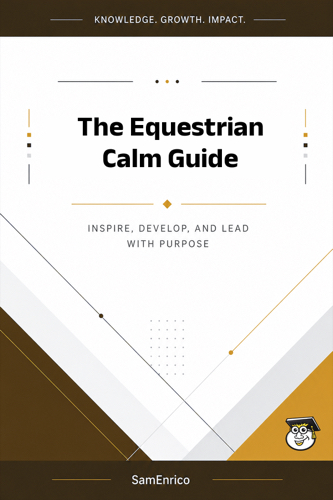
Non-FictionSelf-HelpEquestrian
The Equestrian Calm Guide eBook
Use self hypnosis to transmit calmness to the hors
by Low Delilah
Use self hypnosis to transmit calmness to the horse and improve focus.
Formats
Free sample
Chapter 1: The Mirror's Betrayal--–- Sarah had done everything right. She had arrived at the cross-country course an hour early. She had walked the lines twice, memorized the distances, and watched three other horses jump the exact fence that now loomed in front of her. She had even whispered to herself in the warm-up, "You are calm. You are capable.
You have done this a hundred times."None of it mattered.As she turned the corner and saw the solid oxer—the same fence where she had stopped three weeks ago—her body betrayed her before her mind could catch up. Her heart rate spiked from 78 to 114 beats per minute. Her shoulders rose toward her ears like a cat preparing for a fight. Her legs, which had been soft and wrapping, turned into vises. Her breath stopped somewhere in her throat, trapped between the words "don't" and "stop."Her horse, a sensitive thoroughbred named Finn who had jumped clear in his last three outings, felt all of it.Within two seconds, Finn's ears pinned back.
His stride shortened from a confident gallop to a hesitant shuffle. His head came up, his back hollowed, and at the last stride—the stride where Sarah needed him most—he planted his front feet and skidded to a halt. Sarah flew up his neck, lost her stirrups, and landed in the dirt with a thud that knocked the air from her lungs.Back at the trailer, brushing the mud off her breeches, Sarah said to her trainer, "He's being difficult. He's lost his confidence. He just doesn't want to jump today."Her trainer, a woman who had ridden at the international level, said nothing for a long moment.
Then she asked, "Sarah, what was your heart rate doing right before the fence?"Sarah blinked. "I don't know. I wasn't wearing a monitor.""You didn't need one," the trainer said. "I could see it from twenty meters away. Your shoulders went up.
Your leg went on. You stopped breathing. Finn didn't refuse because he's difficult. He refused because you told him to."Sarah opened her mouth to argue, then closed it. Because deep down, she knew the trainer was right.The horse had not betrayed her.
The mirror had not lied. Finn had simply shown her exactly what she had been feeling.And that was the most uncomfortable truth Sarah had ever faced.The Invisible Conversation You Are Already Having Every ride is a conversation. But here is what most riders misunderstand: the conversation is not happening through your reins, your legs, or your seat aids. Those are the words you think you are saying. The real conversation—the one your horse is actually listening to—is happening beneath your conscious awareness, in the language of heartbeats, micro-muscle twitches, breath rhythm, and pupil dilation.You are already transmitting everything.
Your horse is already receiving everything. The question is not whether you are communicating. The question is whether you are communicating what you intend.This chapter is called "The Mirror's Betrayal" because that is how it feels when you first discover the truth. It feels like betrayal when your horse spooks at nothing, refuses a fence he usually jumps, or bolts for no reason. It feels like betrayal when your trainer tells you that you are the problem.
But the horse is not betraying you. The horse is simply being a mirror. And mirrors do not lie.The goal of this chapter is to help you understand, for the first time, the science of why your anxiety is contagious, why "pretending to be calm" will never work, and what you need to do differently to become the kind of rider your horse wants to trust.By the end of this chapter, you will understand:What mirror neurons are and why they make your horse a biological radar for your emotions The difference between forced stillness (which fails) and intentional supple posture (which works)How to conduct a "Heart Rate Bridging" experiment that will shock you Why your horse's spook might actually be your own fear reflected back at you Let us begin with the neurons that changed everything.The Discovery of Mirror Neurons and What It Means for Riders In the early 1990s, a team of Italian neuroscientists led by Giacomo Rizzolatti was studying macaque monkeys at the University of Parma. They had implanted electrodes in the monkeys' brains to measure neuron activity during specific actions—reaching for a peanut, grasping a piece of fruit, tearing a piece of paper.Then something unexpected happened.One day, a researcher walked into the lab, reached for a piece of fruit, and ate it in front of a monkey. The monkey was not moving.
The monkey was simply watching. But the electrodes recorded that the same neurons fired in the monkey's brain as if the monkey itself had reached for the fruit. The monkey's brain was simulating the action it was observing as if it were performing it.Rizzolatti called these "mirror neurons."The discovery upended decades of neuroscience. Mirror neurons explained how we learn by imitation, how empathy works, and why watching someone yawn makes us yawn. But the most profound implication was this: your brain cannot fully distinguish between an action you perform and an action you observe.
The same neural pathways activate either way.Now consider your horse.Horses are prey animals. Their survival for fifty million years has depended on reading the emotional states of their herd members and detecting threats in their environment within milliseconds. They do not have the luxury of conscious deliberation. When a horse sees another horse tense its muscles, the observing horse's mirror neurons fire, and its own muscles tense before it knows why. This is not a choice.
It is a biological imperative.When you sit in the saddle, your horse is not looking at your face or listening to your words. Your horse is reading your body with a sensitivity that would seem like magic if you did not understand the science. Your horse feels the change in your heart rate through vibrations transmitted from your seat bones to the saddle to his back. Your horse detects the rise in your shoulders through the shift in your center of gravity. Your horse senses the tension in your jaw through the micro-movements of the reins.And your horse's mirror neurons are firing constantly, translating your physiology into his own.This is why a rider who is anxious will inevitably produce an anxious horse.
It is not because the horse is "sensitive" or "difficult." It is because the horse is a mammal with a functioning nervous system. He is doing exactly what evolution programmed him to do: synchronize with the creature on his back.The rider's anxiety is not hidden. It is broadcast.Neuroception: The Unseen Security System In 2004, clinical psychologist Stephen Porges introduced a concept called neuroception. He defined it as the nervous system's ability to scan the environment for safety or threat without any conscious awareness. Neuroception happens approximately thirty times per second.
It operates below the level of thought, below the level of feeling, even below the level of perception. It is your body's most primitive security…
This is the end of the free sample. Get the eBook to keep going. Buy now
About this book
Details
- Author
- Low Delilah
- Publisher
- SamEnrico
- Language
- English
- Genre
- Non-Fiction, Self-Help, Equestrian
- Released
- 2026-06-07
- Pages (approx.)
- 155
- Available as
- eBook, Audiobook

Read better in the ZLOADR app
Your eBooks on your phone or tablet. Sign in with your SamEnrico account and start reading.
More by Low Delilah
 WorldCom Accounting FraudLow Delilah$11.99
 Anger Art Therapy GuideLow Delilah$11.99
 People Pleasing Recovery CourseLow Delilah$11.99
 Low Income Senior Housing GuideLow Delilah$11.99
 The Last Broadcast: The 1977 Hanafi SiegeLow Delilah$11.99
 The Alchemist and the Tides: Medieval Mariners and the Mysteries of Atomic SeasLow Delilah$11.99
 10 Ways to Use Cream Of Wheat (Recipe Book)Low Delilah$11.99
 Understanding Digeorge SyndromeLow Delilah$17.99
 University of São Paulo GuideLow Delilah$12.99
 Portuguese Work Visa GuideLow Delilah$12.99
 Associate AdvisorLow Delilah$11.99
You may also like
 Hong Kong Handover 1997Dunn Johnnie$11.99
 Zumba For Postnatal Recovery CourseNeal Christian$11.99
 Zumba for BeginnersLadner Nikia$11.99
 YouTube Comment Mining GuideHumes Pandora$12.99
 Worry Box MeditationCarlin Rudy$11.99
 Workplace Stress MeditationNguyen Lynn$11.99
 Workplace Stress and Sleep RepairHawley Ivory$11.99
 Workplace Perfectionism CureDelaney Jeffry$11.99
 Workplace Injustice Anger GuideWallen Isabelle$11.99
 Work Addiction and Burnout LinkGreenwood Ester$11.99
 Women in Yoga and WellnessBeattie Galina$11.99
 Women in Stand Up ComedyChun Evangeline$11.99