
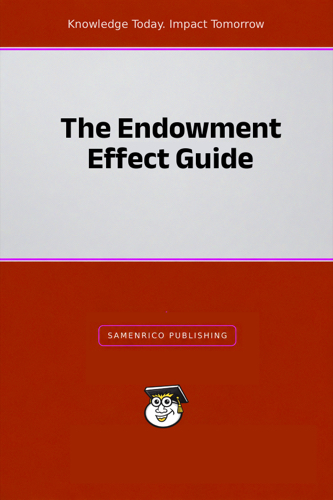
The Endowment Effect Guide eBook
Use free trials and ownership to make customers va
Use free trials and ownership to make customers value your product more.
Formats
Free sample
Chapter 1: The Mug That Broke Economics--–- The conference room smelled of stale coffee and desperation. Thirty-two slides. Fourteen features. Three case studies. One hundred twenty-seven thousand dollars in software development.
And after all of it, the founder looked at me with the expression of a man who had just watched his life's work dissolve into a spreadsheet of red ink.“We had ten thousand people sign up for the free trial,” he said, sliding the report across the table. “Eight hundred converted. Eight hundred. Our product is objectively better than the competitor’s. Our onboarding is smoother.
Our price is lower. So why did ninety-two percent of them walk away?”I didn’t answer immediately. Not because the question was hard, but because the answer was almost insulting in its simplicity. He had spent three years building a better mousetrap. He had optimized every pixel, every email, every pricing tier.
And he had missed the only thing that actually matters.“They didn’t walk away,” I said. “They never arrived. Your product was never theirs.”He blinked. “What do you mean, ‘never theirs’? They signed up.
They clicked the button. They used the features.”“Using isn’t owning,” I said. “And until they own it, they won’t pay for it.”This book is about that gap. The chasm between trying and owning. The psychological switch that flips when a product stops being a tool and starts being mine.
And it all begins with a coffee mug.The Experiment That Changed Everything In 1990, three researchers—Daniel Kahneman, Jack Knetsch, and Richard Thaler—walked into a university classroom and committed what economists considered a form of heresy. They gave half the students a coffee mug. Not a fancy mug. A standard university mug with a campus logo, the kind that retails for six dollars and sits in faculty offices collecting tea stains.Then they did something strange. They told the students with mugs: “Sell it.
Name your price.” They told the students without mugs: “Buy it. Name your price.”According to classical economics, the average selling price and the average buying price should have been roughly the same. A mug is a mug. Its value doesn’t change depending on who holds it. Supply and demand would find equilibrium around five or six dollars, and that would be that.But that’s not what happened.The students who owned the mugs demanded an average of ten dollars to give them up.
The students who didn’t own the mugs offered an average of five dollars to acquire them. The exact same mug. The exact same classroom. The exact same moment in time. But the owners valued it at double the price of the buyers.Kahneman, Knetsch, and Thaler had discovered something that should have been impossible.
They called it the Endowment Effect.And it broke economics.Why the Mug Matters More Than Your Product Let me tell you why that coffee mug is the most important object in the history of behavioral economics.The mug doesn’t have features. It doesn’t have a free trial. It doesn’t have a dashboard, a notification system, or a monthly subscription. It holds coffee. That’s it.
And yet, the moment someone was given that mug—given it, not bought it, not earned it—they became emotionally attached to it. They demanded twice as much to sell it as they would have paid to buy it.Now apply that to your business.Your product has features. Your product has a free trial. Your product probably has a beautiful onboarding flow with animated illustrations and a friendly chatbot. And despite all of that, your users are treating your product like the buyers treated the mug—like something that’s worth half of what you’re asking.Why?
Because they don’t own it yet. They’re trying it. They’re evaluating it. They’re keeping it at arm’s length, holding their wallets closed, waiting to be convinced. And waiting.
And waiting. And then they disappear.The students who didn’t own the mug weren’t being cheap. They were being rational. They had no relationship with the mug. It was just an object.
Your trial users aren’t being cheap either. They’re being rational. Your product is just a tool. Until it becomes theirs, it will never be worth what you’re asking.This is the central failure of modern product marketing. We sell features when we should be selling the feeling of ownership.
We optimize conversion funnels when we should be designing psychological investment. We measure trial starts when we should be measuring the moment a user says, “This is mine.”The Hierarchy of Ownership: Four Levels, One Goal Before we go any further, I need to give you a framework. Throughout this book, we’re going to talk about different ways to create ownership. Linguistic ownership. Visual ownership.
Investment ownership. Social ownership. But without a map, these will just feel like tactics. The Hierarchy of Ownership is your map.Level 1: Linguistic Ownership (Weakest)This is the easiest to implement and the least powerful. Linguistic ownership means using possessive language—“Your Account,” “Your Dashboard,” “Your Plan”—to create the illusion of ownership.
It’s the verbal equivalent of a sticky name tag. It works, but only when combined with something deeper.Example: Every Saa S product that says “Welcome back, Sarah” instead of “Welcome back, User.” It’s a start. It’s not enough.Level 2: Visual Ownership (Medium)This is where the user sees themselves inside the product. An avatar. A profile picture.
A data visualization that says “Your Name’s Report.” A preview of a customized product. The Mirror Test (which we’ll cover in Chapter 5) asks a simple question: Can the user see their own reflection in the interface? If not, ownership hasn’t begun.Example: Spotify’s “Made for You” playlists. They don’t just recommend songs; they create the illusion that Spotify knows you, that the playlist is yours, that canceling would mean losing a custom mixtape.Level 3: Investment Ownership (Strong)This is the engine of the Endowment Effect. When a user invests effort—typing, uploading, customizing, setting up, creating—they begin to own the result.
The IKEA Effect (named for the furniture company) shows that people value furniture they assembled themselves more than pre-assembled furniture, even when the pre-assembled version is objectively better. Effort creates attachment.Example: Canva users who have saved ten designs. Those designs aren’t just images; they’re proof of effort. Losing them means losing time, creativity, and identity.Level 4: Social Ownership (Strongest)This is ownership extended to identity and tribe. When a user’s product usage becomes part of how they see themselves—or how their community sees them—canceling becomes an existential threat.
A 200-day streak on Duolingo isn’t a feature; it’s an identity. Losing it means losing a piece of who you are.Example: Strava runners with Local Legend badges. They don’t just track runs; they belong to a community. Leaving Strava means leaving status, friends, and recognition.Here’s the crucial insight: Most products never get past Level 1. They change the copy to “Your Dashboard” and wonder why conversion…
This is the end of the free sample. Get the eBook to keep going. Buy now
About this book
Details
- Author
- Hartley Yuriko
- Publisher
- SamEnrico
- Language
- English
- Genre
- Non-Fiction, Business Brief, Marketing
- Released
- 2026-06-10
- Pages (approx.)
- 127
- Available as
- eBook, Audiobook

Read better in the ZLOADR app
Your eBooks on your phone or tablet. Sign in with your SamEnrico account and start reading.
More by Hartley Yuriko
 Elizabeth I Court Survival GuideHartley Yuriko$11.99
 Schema Therapy Emotions GuideHartley Yuriko$11.99
 Stress Management for Real Estate AgentsHartley Yuriko$11.99
 Terms Enforcement Practical GuideHartley Yuriko$12.99
 How to Produce Art and Craft KitsHartley Yuriko$11.99
 Alabaster (Variety of Gypsum) MiningHartley Yuriko$11.99
 How to Become a Papier Mache MolderHartley Yuriko$11.99
You may also like
 The Attraction EffectJuarez Emerald$11.99
 London Marketing StrategiesJacobson Rosario$11.99
 Fiverr Buyer Persona GuideMcclellan Kermit$11.99
 The Self Reference EffectAckerman Kirby$11.99
 Mentorship for MarketersRawls Jamee$11.99
 The Social Proof BlueprintFenton Launa$11.99
 The Humor EffectBraden Nadia$11.99
 Leading Hybrid Marketing TeamsHollins Korey$11.99
 Email Drip Campaign ManagementHeck Neva$11.99
 The Representativeness BiasDarby Magen$11.99
 Business Credit for Marketing AgenciesGrisham Maranda$11.99
 Nudge Theory in BusinessGunn Patricia$11.99