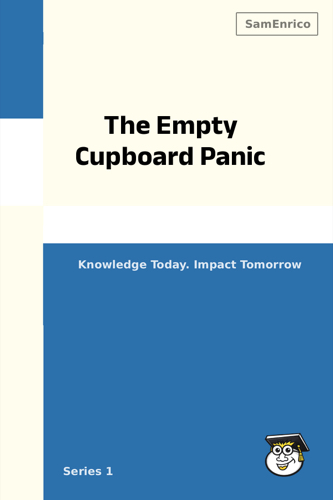
The Empty Cupboard Panic eBook
Details the feeling of opening an empty pantry and
Details the feeling of opening an empty pantry and the creative meals made from nothing.
Formats
Free sample
Chapter 1: The Panic Audit...--–- You open the cupboard. The hinge squeaks. Inside, there is a half-empty bag of rice, a single can of black beans with the label peeling off, a jar of mustard with exactly one teaspoon left, and a box of pasta that has been opened and re-taped shut so many times it looks like a hostage note. Behind you, the refrigerator hums. Inside it, you already know, there is a limp carrot, two eggs whose expiration date you are afraid to read, and a takeout container of something you can no longer identify.
Your stomach growls. Your shoulders tighten. Your brain, instead of solving the problem, begins a familiar loop: There’s nothing to eat. There’s nothing to eat. There’s nothing to eat.This is the empty cupboard panic.
It is not about hunger alone. Hunger is a physical sensation, and while it is painful, it is also straightforward. The empty cupboard panic is something else entirely. It is the collision of hunger with shame, with exhaustion, with the dread of another trip to the grocery store you cannot afford, with the weight of having to feed yourself or other people one more time when you have no energy and no plan and no idea where to start. It is the feeling of standing in front of abundance—because make no mistake, that half-empty bag of rice is abundance compared to what millions of people face every day—and seeing only scarcity.
The food is there. Your eyes just do not know how to recognize it.This chapter is called the Panic Audit for a reason. Before you cook anything, before you even take a pot off the hook, you have to stop the spiral. You have to step back from the cupboard, close the door, take three breaths, and then open it again with a new set of eyes. The Panic Audit is not a recipe.
It is not a technique. It is a way of seeing. It is the single most important skill in this entire book because without it, none of the other chapters will help you. You can have the best broken pasta recipe in the world, but if you open your cupboard and see only failure, you will never make it.So let us begin. Let us audit the panic.The First Rule: You Are Not Out of Food, You Are Out of Ideas The mantra of this book, repeated until it becomes boring and then useful, is this: You are not out of food.
You are out of ideas. Write it on your hand. Tape it to your cupboard door. Say it out loud when you feel the panic rising. The difference between these two statements is the difference between despair and possibility.
If you are out of food, the only solution is money. If you are out of ideas, the solution is already in your kitchen.Look at that half-empty bag of rice again. Really look at it. It is not a sad remnant of a more abundant time. It is a blank canvas.
Rice, when you know what to do with it, can become breakfast, lunch, dinner, dessert, and even a hangover cure. Rice can be toasted into a nutty broth. Rice can be simmered into a creamy porridge. Rice can be fried with that limp carrot and those two questionable eggs into a meal that tastes like a gift. The problem is not that you lack food.
The problem is that you look at rice and see a side dish. You look at rice and see what is missing—the chicken, the vegetables, the sauce, the occasion. This book will teach you to look at rice and see a main character.The same is true for every other item in your kitchen. A can of black beans is not a sad leftover from a chili you never made. It is protein, fiber, and a thickening agent all in one.
A jar of mustard with one teaspoon left is not trash waiting to happen. It is acid, emulsifier, and flavor bomb. A limp carrot is not a vegetable you should have used three days ago. It is sweetness, texture, and the base of a broth. The only thing standing between you and a meal is the story you are telling yourself about what you need.So stop telling that story.
Start telling a new one. You have everything you need. You just have to see it.The Five Functional Categories (Throw Away Your Cuisine Map)Most of us organize our pantries by cuisine. We have an Italian shelf (pasta, tomatoes, olive oil), a Mexican shelf (beans, tortillas, salsa), an Asian shelf (soy sauce, rice vinegar, noodles). This system works beautifully when you have a fully stocked kitchen and a specific craving.
It works terribly when your cupboard is bare because it makes you feel like you are missing entire national cuisines. You open the door, see that you have no tomatoes, and think, Well, I cannot make Italian food. You see that you have no tortillas, and think, Well, I cannot make Mexican food.This is backwards. You do not need to make a cuisine. You need to make a meal.
So let us reorganize your pantry not by where the food comes from, but by what the food does. The Panic Audit introduces five functional categories that work regardless of whether you have tomatoes or tortillas. These categories are not about identity. They are about action.Category One: Cans. This includes any shelf-stable food that comes in a metal container.
Legumes (chickpeas, black beans, kidney beans, lentils), fish (tuna, sardines, anchovies, salmon), tomatoes (whole, crushed, diced, paste), and anything else that arrived in your house in a can and has been sitting there ever since. Cans are your emergency fund. They do not go bad. They do not judge you. They wait patiently for the moment you remember they exist.
A single can of anything can be the difference between a meal and a bowl of plain rice.Category Two: Grains. This includes rice (white, brown, jasmine, basmati), pasta (spaghetti, shells, elbows, broken remnants), oats (rolled, steel-cut, instant), quinoa, couscous, barley, and bread (fresh, stale, frozen, or reduced to crumbs). Grains are your base. They are the stage upon which everything else performs. Without a grain, you have soup or salad or a plate of vegetables.
With a grain, you have a meal. Even the smallest amount of grain—a quarter cup of rice, a handful of pasta, two slices of stale bread—can be stretched, bulked, and transformed.Category Three: Crumbs. This is the most overlooked category in the average kitchen. Crumbs are the ends of cracker bags, the dust at the bottom of cereal boxes, the heel of a bread loaf no one wanted, the crumbled remains of a tortilla chip bag, the stale bits of pretzels or popcorn or anything that once was crunchy. Crumbs are not a garnish.
Crumbs are a weapon. Toasted with oil, they become a topping that resurrects bland soups. Mixed with an egg, they become a binder for vegetable patties. Sprinkled over anything, they become texture…
This is the end of the free sample. Get the eBook to keep going. Buy now
About this book
Details
- Author
- Taggart Shandra
- Publisher
- SamEnrico
- Language
- English
- Genre
- Non-Fiction, Biography, Hunger
- Released
- 2026-06-10
- Pages (approx.)
- 137
- Available as
- eBook, Audiobook

Read better in the ZLOADR app
Your eBooks on your phone or tablet. Sign in with your SamEnrico account and start reading.
More by Taggart Shandra
 Mindfulness for Busy ParentsTaggart Shandra$11.99
 Meeting Maker App GuideTaggart Shandra$11.99
 Children's Dream Decoder GuideTaggart Shandra$11.99
 Assertiveness For Faith CommunitiesTaggart Shandra$11.99
 The Monk Who Smiled Through TortureTaggart Shandra$11.99
 SlidesAI Power UserTaggart Shandra$11.99
 Counter Reformation Sacred Music GuideTaggart Shandra$11.99
 Secular Anticipatory GriefTaggart Shandra$11.99
 The Healers of the Black Sea: Byzantine Dromons and the Plague of 747 ADTaggart Shandra$11.99
 Echoes of the Deep: The Unsinkable Mystery of the SS BaychimoTaggart Shandra$11.99
 The Forgotten Telegraph: Stuart's Impossible Crossing and the Birth of Global CommunicationTaggart Shandra$11.99
 Understanding AcrodysplasiaTaggart Shandra$17.99