
Non-FictionSelf-HelpEmotional Intelligence
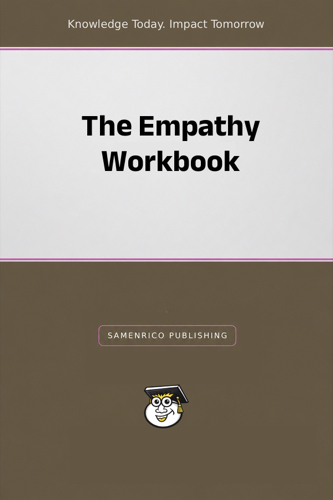
The Empathy Workbook eBook
Practice seeing situations from others' perspectiv
Practice seeing situations from others' perspectives with guided exercises.
Formats
Free sample
Chapter 1: The Empathy Myth--You have likely been told, at some point in your life, that you are either an empathetic person or you are not. Perhaps a teacher called you “sensitive.” A parent said you “don’t think about others enough.” A partner accused you of “lacking empathy.” Or perhaps you have silently judged yourself this way, assuming that your struggles to understand certain people reflect a fixed flaw in your character.That assumption is wrong. And it is one of the most damaging misconceptions in all of human psychology.Empathy is not a personality trait you are born with or without, like eye color or height. It is not a moral virtue that good people possess and bad people lack. Empathy is a skill.
And like any skill—learning a language, playing an instrument, cooking a meal from scratch—it can be learned, practiced, improved, and maintained. It can also atrophy from disuse or become distorted by stress and fatigue.This chapter will dismantle the empathy myth once and for all. You will learn what empathy actually is (and is not), why your brain is wired to learn it regardless of your upbringing or personality, and how to measure your current starting point so that you can track your progress through this workbook. By the end of this chapter, you will have a clear baseline, a personalized empathy profile, and the first concrete practices that begin rewiring your brain for deeper perspective-taking.What Empathy Is Not: Clearing the Ground Before we can build empathy skills, we must clear away the misconceptions that have been piled on top of the word. In popular culture, “empathy” is used to mean at least five different things, and confusing them leads to frustration, guilt, and giving up.Empathy is not sympathy.
Sympathy is feeling for someone. When you see a person crying and you think, “Oh, that’s sad, I feel bad for them,” that is sympathy. It is a reaction from a distance. It often contains an unspoken “at least”—“At least it’s not me,” “At least they have family to support them.” Sympathy looks down from a slight height. Empathy, as we will define it in this workbook, does not.Empathy is not compassion.
Compassion is feeling for someone with a desire to help. It is sympathy plus action. Compassion is wonderful and necessary, but it is not the same as understanding someone’s perspective. You can feel compassion for a person whose situation you do not actually understand. In fact, compassion without understanding often leads to misguided help—giving someone what you would want in their situation, not what they actually need.Empathy is not emotional contagion.
Emotional contagion is when you catch someone else’s feelings as if they were a virus. Your friend is anxious, and suddenly you are anxious. Your coworker is angry, and your jaw clenches. This is not empathy; it is a lack of boundaries. Emotional contagion is exhausting and often unhelpful.
It leads to burnout, not understanding. Many people who call themselves “empaths” are actually experiencing high emotional contagion—and they suffer for it.Empathy is not agreement. You can understand why someone believes something without agreeing with them. You can see how a person arrived at a hurtful conclusion without excusing the harm. This is the hardest distinction for most people, because we are taught that understanding is the first step toward accepting.
But understanding is simply mapping someone else’s internal terrain. You can hold the map without moving there.Empathy is not mind-reading. No one expects you to know exactly what another person is feeling without them telling you. Empathy is not magic. It is a process of forming hypotheses, testing them with questions, and revising based on new information.
The exercises in this workbook will teach you to become more accurate at this process, but they will never make you infallible. And that is fine.What Empathy Actually Is: A Working Definition for This Workbook After reviewing the research from neuroscience, psychology, and communication studies—and synthesizing the insights from the ten bestselling books that inform this workbook—we arrive at a single, consistent definition:Empathy is the cognitive skill of accurately understanding another person’s perspective, combined with compassionate concern for their wellbeing, while maintaining enough emotional separation to remain helpful.Let us break this definition into its three components.First, it is cognitive. Empathy happens in your brain, not just your heart. It involves attention, memory, reasoning, and imagination. This is good news because cognitive skills can be trained.
You can improve your empathic accuracy just as you can improve your math skills or your vocabulary.Second, it involves compassionate concern. Pure cold calculation of another person’s mental state is not empathy; it is strategic perspective-taking, and it can be used to manipulate. Empathy includes a genuine desire for the other person’s wellbeing. But note: this desire does not require you to feel their pain. It requires you to care about it.Third, it maintains separation.
You are not empathy if you drown in another person’s emotions. You are empathy if you can stand beside their experience, see it clearly, and offer a hand without falling in. This is why emotional contagion is not empathy. This is why boundaries are not the opposite of empathy but its necessary condition.Throughout this workbook, whenever you see the word “empathy,” this is what it means. If you find yourself slipping into old definitions—feeling overwhelmed by others’ emotions, or mistaking sympathy for understanding—return to this page.The Neuroscience of a Trainable Skill Why are we so confident that empathy can be learned?
Because your brain is built for it.Mirror neurons are brain cells that fire both when you perform an action and when you observe someone else performing that same action. When you see someone smile, the neurons involved in your own smiling fire—not enough to make you smile necessarily, but enough to give you a micro-experience of their expression. When you see someone wince in pain, parts of your own pain matrix activate. Your brain is literally wired to simulate the experiences of others.But mirror neurons are not magic. They require attention.
They are stronger when you are looking directly at someone, when you are not stressed, and when you have practiced attending to others’ expressions. In other words, mirror neurons respond to training.The default mode network is a set of brain regions that activates when you are not focused on an external task—when you are daydreaming, remembering, or imagining the future. Critically, the default mode network also activates during perspective-taking. When you deliberately imagine what someone else is thinking or feeling, your brain lights up in the same regions used to imagine your own past and future. You are, in a very real sense, running a simulation of another person on the hardware of your own self.This simulation can be more or less accurate.
Accuracy improves with practice, feedback, and motivation. It declines with fatigue, prejudice, and distraction.The implications are clear: your brain is not a fixed organ with a fixed empathy setting. It is a learning…
This is the end of the free sample. Get the eBook to keep going. Buy now
About this book
Details
- Author
- Naranjo Patrica
- Publisher
- SamEnrico
- Language
- English
- Genre
- Non-Fiction, Self-Help, Emotional Intelligence
- Released
- 2026-06-11
- Pages (approx.)
- 139
- Available as
- eBook, Audiobook

Read better in the ZLOADR app
Your eBooks on your phone or tablet. Sign in with your SamEnrico account and start reading.
More by Naranjo Patrica
 Transactional Funding GuideNaranjo Patrica$11.99
 Trigeminal Neuralgia PracticeNaranjo Patrica$11.99
 Quality Control CreativityNaranjo Patrica$11.99
 Emergency Freelance SavingsNaranjo Patrica$11.99
 The ED Understanding GuideNaranjo Patrica$11.99
 Anger Restructuring for Brain InjuryNaranjo Patrica$11.99
 Gambling Therapy OptionsNaranjo Patrica$11.99
 The Petrobras Scandal: Brazil's Billion-Dollar Corruption WebNaranjo Patrica$11.99
 Ra and the Stormborn: A Norse-Egyptian Cosmic ClashNaranjo Patrica$11.99
 A Collector's Handbook to the Alfa Romeo Giulia 1300Naranjo Patrica$11.99
 Co-Founder Accelerator Program GuideNaranjo Patrica$12.99
 Days Sales Outstanding GuideNaranjo Patrica$12.99
You may also like
 Hong Kong Handover 1997Dunn Johnnie$11.99
 Zumba For Postnatal Recovery CourseNeal Christian$11.99
 Zumba for BeginnersLadner Nikia$11.99
 YouTube Comment Mining GuideHumes Pandora$12.99
 Worry Box MeditationCarlin Rudy$11.99
 Workplace Stress MeditationNguyen Lynn$11.99
 Workplace Stress and Sleep RepairHawley Ivory$11.99
 Workplace Perfectionism CureDelaney Jeffry$11.99
 Workplace Injustice Anger GuideWallen Isabelle$11.99
 Work Addiction and Burnout LinkGreenwood Ester$11.99
 Women in Yoga and WellnessBeattie Galina$11.99
 Women in Stand Up ComedyChun Evangeline$11.99