
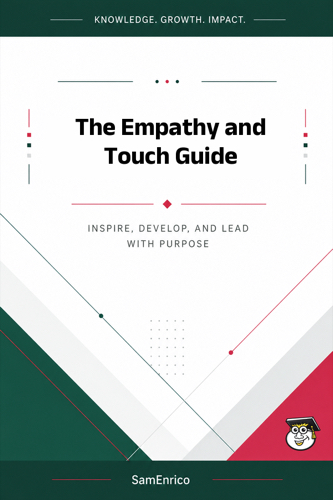
The Empathy and Touch Guide eBook
Use appropriate physical comfort when words fail.
by Jean Andrew
Use appropriate physical comfort when words fail.
Formats
Free sample
Chapter 1: The Silence Reflex--–- The first time I watched someone drown in words, I was the one holding the hose.It was a Tuesday afternoon in a grief counseling center where I was training as a volunteer. A woman in her sixties—let’s call her Margaret—had just lost her husband of forty-two years to a sudden heart attack. She sat on a vinyl chair, her hands folded in her lap, her eyes fixed on a spot on the carpet that only she could see. The lead counselor, a well-meaning man with twenty years of experience, sat across from her. He leaned forward.
He used his kindest voice. And then he began to talk.“Margaret, I want you to know that what you’re feeling is completely normal,” he said. “Grief comes in waves. Some days will be harder than others. But you’re strong.
You’ve raised three children. You’ve survived other losses. You will get through this.”Margaret said nothing. Her breathing grew shallow. Her fingers began to twist the edge of her sleeve.“And remember,” he continued, “your husband wouldn’t want you to suffer like this.
He would want you to live fully. He would want you to find joy again.”Margaret’s shoulders rose toward her ears. Her jaw tightened. She looked, suddenly, less like a grieving widow and more like an animal caught in a trap. The counselor, sensing that his words were not landing, doubled down.
“Have you thought about joining our grief support group? Sometimes being with others who understand—”“Stop,” Margaret whispered. Not loudly. Not angrily. Just a small, broken sound.
“Please stop talking.”The room went silent. The counselor looked confused. He had been trying to help. He had used all the right phrases, all the approved therapeutic language. He had been kind.
And yet Margaret was not comforted. She was, if anything, worse than when she walked in.That was the moment I realized something that would become the central thesis of this book: When the nervous system is overwhelmed, language is not a bridge. It is a barrier.The Myth of the Healing Phrase We have been taught, incorrectly, that words are the primary tool of comfort. From childhood, we are told to “use our words” when someone is upset. We are praised for saying the right thing at a funeral, for offering the perfect phrase to a friend in crisis.
Entire industries—self-help, therapy, coaching, ministry—are built on the assumption that the right sequence of syllables, delivered with the right tone, can ease suffering.This assumption is wrong.Not partially wrong. Not sometimes wrong. Fundamentally, structurally, biologically wrong for a significant percentage of human suffering.Let me be clear: words are not useless. Language is one of humanity’s greatest tools. We use it to build relationships, to share ideas, to create art, to fall in love.
In non-crisis moments, words are essential. But in the specific context of acute emotional distress—grief, panic, trauma, shock—words do not work the way we think they do. They do not soothe. They do not explain. They do not heal.
They intrude.The reason for this is not psychological. It is neurological. To understand why words fail when distress peaks, we have to look inside the brain.Broca’s Area: The Speech Center That Shuts Down Deep within the left hemisphere of the human brain, just above the temple, lies a small, folded region of tissue called Broca’s area. Discovered by French physician Paul Broca in 1861, this region is responsible for the production of spoken language. When Broca’s area is functioning normally, you can form sentences, find words, and speak fluently.
When it is damaged—by a stroke, a tumor, or a traumatic injury—you lose the ability to produce speech. You may understand words. You may know what you want to say. But the words will not come out.Here is what most people do not know: Broca’s area can be temporarily disabled by stress.Under extreme emotional distress, the brain’s survival circuitry—the amygdala, the hypothalamus, the brainstem—overrides higher cortical functions. Blood flow is redirected away from Broca’s area and toward the parts of the brain that keep you alive.
This is called transient aphasia: temporary, stress-induced speech loss. It is why people in the middle of a panic attack stammer, fall silent, or repeat the same phrase (“I don’t know, I don’t know, I don’t know”) over and over. It is why grieving people sometimes say “I can’t find the words”—because they literally cannot. The words exist somewhere in their memory, but the neural pathway that would carry those words to their mouth has been temporarily closed for maintenance, and all available bandwidth has been rerouted to survival.Think of Broca’s area as a drawbridge. In normal conditions, the drawbridge is down, and words travel freely from thought to speech.
But when the brain detects a threat—even a psychological threat like the pain of loss or the terror of a panic attack—the drawbridge goes up. The moat fills with cortisol. And no amount of talking from the other side will lower that bridge.This is why Margaret could not respond to the counselor’s kind words. It was not that she was being difficult or resistant. It was not that she was in denial.
It was that her Broca’s area had raised the drawbridge. She could hear the counselor’s voice, but the neural machinery required to formulate a response—or even to fully process his sentences—was offline.Polyvagal Theory: The Three Nervous System States To understand when words fail and touch becomes essential, we need a more complete map of the nervous system. That map comes from polyvagal theory, developed by Dr. Stephen Porges in the 1990s. Polyvagal theory has revolutionized trauma therapy, emergency medicine, and our understanding of human connection.
At its core, it describes three distinct neural circuits, each associated with a different state of safety or threat.State One: Ventral Vagal (Safe and Social)This is the state of calm connection. The ventral vagal complex—a branch of the vagus nerve—is active. Your heart rate is steady. Your breathing is slow. Your face is mobile and expressive.
You can make eye contact, listen to another person, and respond with coherent speech. In this state, words work. Touch is welcome. You are open to the world.State Two: Sympathetic (Fight or Flight)This is the state of mobilization. The sympathetic nervous system has taken over.
Your heart races. Your breathing quickens. Blood flows to your large muscle groups. You are ready to fight or flee. In this state, you may speak rapidly, loudly, or angrily.
Your words may be sharp or fragmented. You are not open to comfort; you are scanning for threats. Touch, in this state, is often interpreted as an attack—unless it is delivered with extreme care and explicit permission.State Three: Dorsal Vagal (Shutdown)This is the state of collapse. The dorsal branch of the vagus nerve has activated, triggering a freeze response. Your heart rate drops.
Your breathing becomes shallow. Your face may go blank. You may feel numb, dissociated, or frozen. In this state, you…
This is the end of the free sample. Get the eBook to keep going. Buy now
About this book
Details
- Author
- Jean Andrew
- Publisher
- SamEnrico
- Language
- English
- Genre
- Non-Fiction, Self-Help, Touch
- Released
- 2026-06-06
- Pages (approx.)
- 149
- Available as
- eBook, Audiobook

Read better in the ZLOADR app
Your eBooks on your phone or tablet. Sign in with your SamEnrico account and start reading.
More by Jean Andrew
 Veterans Men DepressionJean Andrew$11.99
 Kinesthetic Self Trance GuideJean Andrew$11.99
 Fear Of Loud Noises GuideJean Andrew$11.99
 Menopause Hot Flash CoolJean Andrew$11.99
 REIT Management FeesJean Andrew$11.99
 Herbal Master GuideJean Andrew$11.99
 Grandparent Caregiver StressJean Andrew$11.99
 The Ballad of the Fearless Writers: Uncovering Dictatorship Through Sports in Latin AmericaJean Andrew$11.99
 The Vanishing of the Caravan: A 19th-Century Middle Eastern MysteryJean Andrew$11.99
 How to Produce Fencing MasksJean Andrew$11.99
 Internet Law: Privacy, P2p & Platform LiabilityJean Andrew$11.99
 Virtual Office Cost Comparison WorkbookJean Andrew$12.99
You may also like
 Hong Kong Handover 1997Dunn Johnnie$11.99
 Zumba For Postnatal Recovery CourseNeal Christian$11.99
 Zumba for BeginnersLadner Nikia$11.99
 YouTube Comment Mining GuideHumes Pandora$12.99
 Worry Box MeditationCarlin Rudy$11.99
 Workplace Stress MeditationNguyen Lynn$11.99
 Workplace Stress and Sleep RepairHawley Ivory$11.99
 Workplace Perfectionism CureDelaney Jeffry$11.99
 Workplace Injustice Anger GuideWallen Isabelle$11.99
 Work Addiction and Burnout LinkGreenwood Ester$11.99
 Women in Yoga and WellnessBeattie Galina$11.99
 Women in Stand Up ComedyChun Evangeline$11.99