
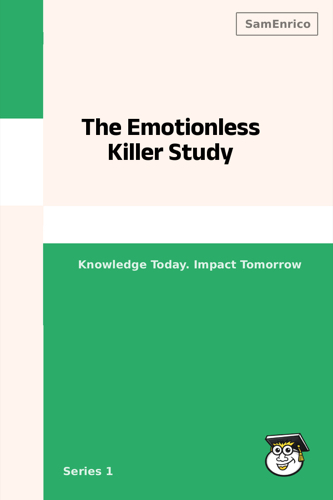
Non-FictionTrue CrimeHomicide Studies
The Emotionless Killer Study eBook
Affective deficits in psychopathic murderers.
Affective deficits in psychopathic murderers.
Formats
Free sample
Chapter 1: The Void Defined...--–- The man sitting across from me had killed three people. He described each murder with the detached precision of a mechanic explaining a faulty transmission. The first victim, he said, "shouldn't have been home." The second "made too much noise." The third "looked at me wrong." When I asked if he felt anything when he thinks about them now—guilt, sadness, regret—he tilted his head like a dog hearing a strange sound. "Why would I?" he said. "They're dead.
It's over." His voice was flat. His eyes were empty. And yet, five minutes earlier, he had made me laugh with a perfectly timed joke about prison food. He had asked about my family with what seemed like genuine interest. He had complimented my shoes.
This was not a monster from a horror film. This was a man in a beige prison jumpsuit who understood social rules perfectly but could not feel them. This chapter is about the landscape of that emptiness—what psychopathy actually is, how we measure it, and why the distinction between the "cold" psychopath and the "hot" sociopath matters more than most people realize.The Problem with Labels Before we can understand the emotionless killer, we must first clear away the underbrush of confusion that surrounds the term "psychopath." In popular culture, the word gets thrown around casually—the cheating ex-boyfriend is a psychopath, the ruthless boss is a psychopath, the politician who lied is a psychopath. This casual usage has blurred the clinical meaning beyond recognition. At the same time, forensic psychology has generated its own terminological thicket: psychopathy, sociopathy, antisocial personality disorder (ASPD), dissocial personality disorder, and the "Dark Triad" all compete for attention.
The result is that even intelligent readers often cannot say, with confidence, what distinguishes a psychopath from a sociopath, or whether either term has real scientific meaning.This chapter provides that foundation. By the end, you will understand the specific diagnostic criteria that separate the cold psychopath from the hot sociopath, the role of the Hare Psychopathy Checklist-Revised (PCL-R) as the gold standard of measurement, and the critical insight that psychopathy is not a binary condition (you either have it or you don't) but a spectrum along which all of us fall somewhere. Most importantly, you will understand that the core of psychopathy is not violence—violence is a possible behavior, not a defining trait. The core is the affective void: the absence of emotional depth, particularly fear, guilt, and empathy. Everything else—the manipulation, the charm, the criminality—flows from that emptiness.The Historical Evolution of Psychopathy The concept of a person who commits evil acts without emotional disturbance is not new.
Eighteenth-century clinicians described "moral insanity"—a condition in which intellectual faculties remained intact but moral sense was absent. The patients could reason perfectly well about mathematics, geography, or literature, but they could not feel the wrongness of theft, betrayal, or violence. In 1941, American psychiatrist Hervey Cleckley published The Mask of Sanity, a book that remains required reading for anyone studying psychopathy. Cleckley interviewed and treated dozens of patients who seemed perfectly normal on the surface—charming, intelligent, socially adept—but who engaged in repeated self-destructive and antisocial acts without any apparent emotional distress or learning from consequences. He called their normal exterior a "mask" concealing an inner void.
Cleckley's sixteen criteria for psychopathy included superficial charm, absence of nervousness, unreliability, insincerity without shame, antisocial behavior without remorse, poor judgment, failure to learn from punishment, emotional poverty, and specific loss of insight. Notably, Cleckley's patients were not all violent. Many were con artists, bigamists, or simply people who drifted through life leaving a trail of broken promises and exploited relationships. The violence, when it occurred, was instrumental—a means to an end, not an expression of rage.Cleckley's work laid the foundation, but it lacked a reliable measurement tool. Different clinicians could look at the same patient and disagree about whether they met criteria for psychopathy.
This changed in the 1970s and 1980s when Canadian psychologist Robert Hare began developing the Psychopathy Checklist, which would eventually become the Psychopathy Checklist-Revised (PCL-R). Hare's innovation was to operationalize Cleckley's clinical observations into a structured interview and file review that produced a numerical score. The PCL-R consists of twenty items, each scored 0 (does not apply), 1 (applies somewhat), or 2 (fully applies). The items cover four broad domains, or "facets," which we will examine in detail.The Four Facets of the PCL-RThe PCL-R's twenty items cluster into four facets, each capturing a different dimension of the psychopathic personality. Understanding these facets is essential because they explain why psychopathy is not simply "being a bad person" and why some psychopaths become violent while others become CEOs.Facet 1: Interpersonal.
This facet captures the psychopath's social presentation. Items include glibness and superficial charm (the ability to talk smoothly and convincingly without genuine emotional content), grandiose sense of self-worth (an inflated view of one's own abilities and importance, often delusional in its magnitude), and pathological lying (deception as a default mode, not a last resort). The interpersonal facet explains why psychopaths are often described as "charming" or "charismatic"—they have learned to perform the behaviors that others associate with warmth and sincerity, even though they feel nothing underneath. Think of the con man who can convince a widow to hand over her life savings not through threats but through apparent kindness and concern. That is Facet 1 in action.Facet 2: Affective.
This is the core of the void. Items include lack of remorse or guilt (the absence of any emotional pain after harming others), shallow or absent emotional affect (emotions, when expressed, seem performative and brief), callousness and lack of empathy (an inability to feel what others feel), and failure to accept responsibility for one's actions (blaming others or external circumstances for every problem). The affective facet is what makes the psychopath different from the ordinary criminal. Many criminals feel guilt—they know they did wrong, they experience shame, they may even confess out of a need for absolution. The psychopath feels none of this.
When caught, they do not express remorse because they do not experience it. They may learn to perform remorse (crying in court, apologizing to victims) but this is cognitive mimicry, not emotional truth.Facet 3: Lifestyle. This facet captures the psychopath's characteristic way of moving through the world. Items include need for stimulation and proneness to boredom (chronic under-arousal that requires ever-more-intense experiences to feel anything), parasitic orientation (living off others without reciprocal contribution), lack of realistic long-term goals (inability to plan for a future that requires delayed gratification), impulsivity (acting on immediate urges without considering consequences), and irresponsibility (failing to meet obligations to work, family, or community). The lifestyle facet explains why psychopaths are often thrill-seekers and why they leave a trail of unfinished projects, broken relationships, and unpaid debts.
They are not lazy in the conventional sense—they can work intensely toward a goal. But the goal is always immediate, and when the thrill fades or the obstacle appears, they move on.Facet 4: Antisocial. This is the facet most closely associated with criminal behavior. Items include poor behavioral controls (explosive reactions to minor provocations, though note that…
This is the end of the free sample. Get the eBook to keep going. Buy now
About this book
Details
- Author
- Atchison Keven
- Publisher
- SamEnrico
- Language
- English
- Genre
- Non-Fiction, True Crime, Homicide Studies
- Released
- 2026-06-05
- Pages (approx.)
- 139
- Available as
- eBook, Audiobook

Read better in the ZLOADR app
Your eBooks on your phone or tablet. Sign in with your SamEnrico account and start reading.
More by Atchison Keven
 Active Listening In EducationAtchison Keven$11.99
 Jealousy in PolyamoryAtchison Keven$11.99
 Affirmations for MultitaskingAtchison Keven$11.99
 TM for Shopaholism GuideAtchison Keven$11.99
 Turtle Ships and Samurai: Korea's Desperate Stand (1592-1598)Atchison Keven$11.99
 Solutions Sales RepresentativeAtchison Keven$11.99
 How to Become a Leather GraderAtchison Keven$11.99
 Understanding Tollner–horst–manzke SyndromeAtchison Keven$17.99
 Blockchain Invoice FactoringAtchison Keven$12.99
 DaVinci Resolve Replaces PremiereAtchison Keven$12.99
You may also like
 Hong Kong Handover 1997Dunn Johnnie$11.99
 Zumba For Postnatal Recovery CourseNeal Christian$11.99
 Zumba for BeginnersLadner Nikia$11.99
 YouTube Comment Mining GuideHumes Pandora$12.99
 Worry Box MeditationCarlin Rudy$11.99
 Workplace Stress MeditationNguyen Lynn$11.99
 Workplace Stress and Sleep RepairHawley Ivory$11.99
 Workplace Perfectionism CureDelaney Jeffry$11.99
 Workplace Injustice Anger GuideWallen Isabelle$11.99
 Work Addiction and Burnout LinkGreenwood Ester$11.99
 Women in Yoga and WellnessBeattie Galina$11.99
 Women in Stand Up ComedyChun Evangeline$11.99